
Game Talk
Charm Pricing: Why $29.99 Sells More Tabletop Games
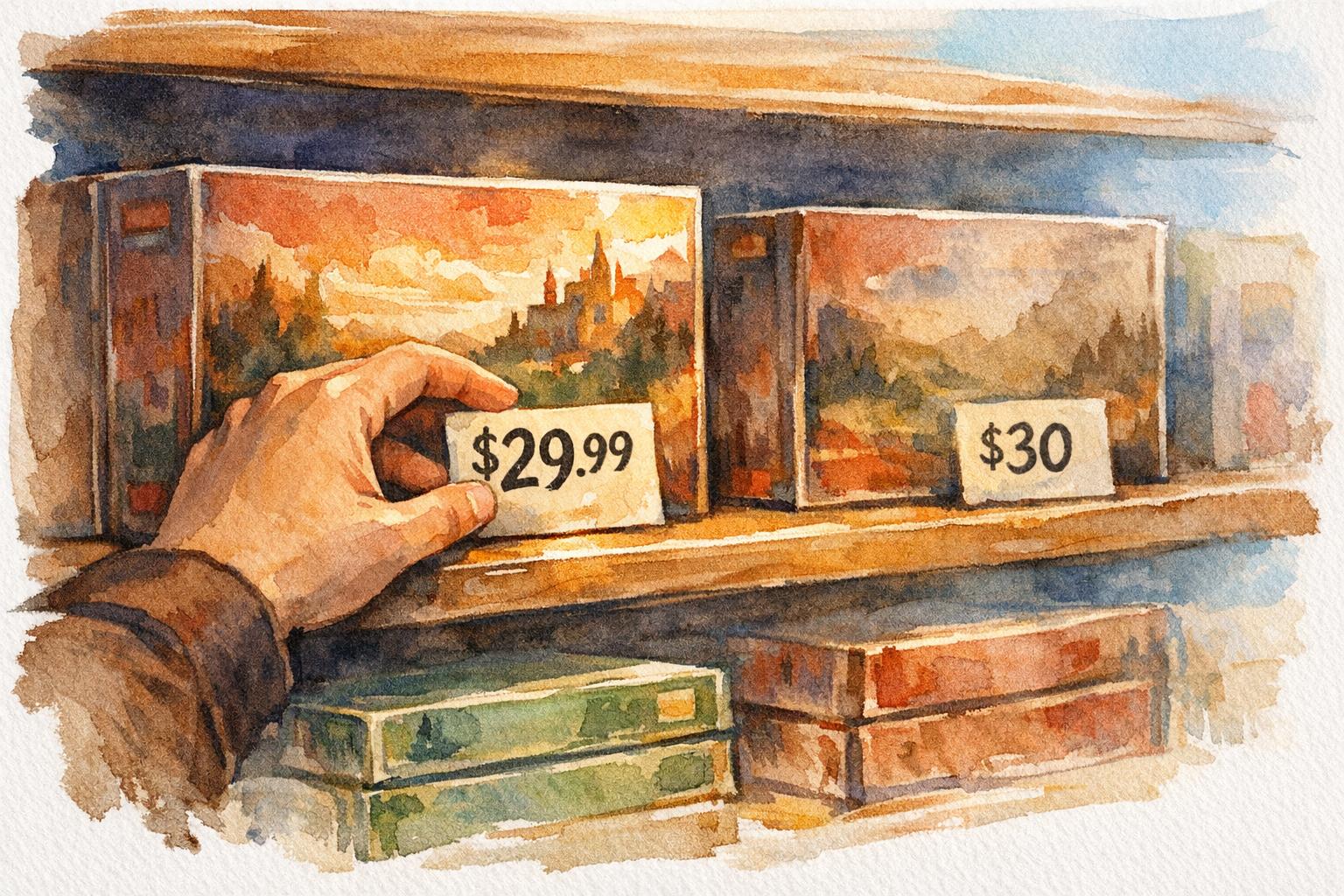
Why does $29.99 sell better than $30? It’s all about perception. Charm pricing, which involves setting prices just below whole numbers (like $29.99 instead of $30.00), takes advantage of how our brains process numbers. This tactic relies on the “left-digit effect”, where shoppers focus on the first number they see. So, $29.99 feels like “twenty-something”, while $30.00 feels like “thirty”, even though the actual difference is just one cent.
Here’s why it works:
- Psychological Impact: The leftmost digit has a stronger influence on perceived value.
- Sales Boost: Research shows prices ending in 9 can increase sales by up to 24%.
- Consumer Behavior: Shoppers associate .99 prices with deals, while whole numbers feel more premium.
- Online Advantage: In price-sorted lists, $29.99 appears before $30.00, grabbing attention first.
Charm pricing is especially effective for driving quick decisions in competitive markets like tabletop games. However, it’s less effective for luxury or high-end products, where round numbers can convey exclusivity. Testing your pricing strategy - like comparing $29.99 vs. $30.00 - can help you find the sweet spot for your audience.
Charm Pricing Statistics: How $29.99 Outperforms $30.00
What Is Charm Pricing?
Definition and Basic Concept
Charm pricing, often called psychological or odd pricing, is the practice of setting prices just below a whole number. For instance, instead of pricing a tabletop game at $30.00, a retailer might list it as $29.99. While this strategy became popular in the 1920s, some believe it originated in the late 19th century as a way to curb employee theft. By pricing items with odd amounts, cashiers were forced to open the register to provide change, ensuring sales were recorded. Today, this approach is everywhere - nearly 60.7% of retail prices end in the number 9, compared to just 7.5% ending in 0. In the tabletop gaming world, you’ll often see examples like $59.99 for high-end strategy games, $29.99 for mid-range titles, and $19.99 for casual card games.
The effectiveness of charm pricing stems from how our brains interpret numbers. It plays on the left-digit effect, a mental shortcut where the first digit of a price heavily influences how we perceive its value. For example, when you see $29.99, your brain zeroes in on the “2”, making the price feel closer to $20.00 than $30.00.
Let’s dive deeper into how this pricing strategy works on our brains.
How Charm Pricing Affects the Brain
In the context of tabletop games, this pricing tactic is particularly effective because it encourages quick decisions.
“The fastest-moving part of our brain actually starts to encode the information before we actually finish the left-to-right process of reading a price.” – Jamie Madigan, Ph.D., Industrial-Organizational Psychologist
This happens because our brains simplify prices into general magnitudes before fully processing the entire number. We tend to focus on the dollar amount and almost ignore the cents, especially when we’re tired, distracted, or comparing several options. This cognitive shortcut makes charm pricing a powerful tool in driving purchases.
sbb-itb-7b84150
Research Studies on Charm Pricing
MIT-Chicago Price Experiment
Back in 2003, Eric T. Anderson from the University of Chicago and Duncan I. Simester from MIT set out to test the effects of charm pricing with a fascinating field experiment. They produced three versions of a catalog, each featuring the same women’s shirt but with different price tags: $34, $39, and $44. The results? The $39 shirt sold 21 units - 31% more than the $34 option (16 units) and also outperformed the $44 version (17 units).
Interestingly, this trend wasn’t limited to lower price points. When the shirt was priced at $79, it sold 24 units, compared to just 15 units at $74 and 12 units at $84. That’s a 60% increase in sales for the $79 option over the $74 one. Published in Quantitative Marketing and Economics, the study highlighted how charm pricing can work its magic even at higher price levels.
“What remains largely unexplained by our work is ‘Why 9?’ The data and explanations are silent on how customers form beliefs that $9 endings convey favorable information that increases demand for an item.” – Eric T. Anderson and Duncan I. Simester
These findings laid the groundwork for broader research confirming the power of charm pricing.
William Poundstone’s Meta-Analysis
Building on these experimental results, William Poundstone conducted a meta-analysis of eight studies and discovered that charm pricing boosts sales by an average of 24% compared to rounded prices. That’s a substantial increase for such a small tweak.
Poundstone’s research also shed light on why this pricing strategy works so well. Buyers tend to focus on the leftmost digits of a price and pay far less attention to the rightmost ones. This means the .99 ending often goes unnoticed, while the perception of value is shaped by the number on the left. In short, a one-cent difference can completely shift how consumers view a product’s price. These findings explain why charm pricing has become a go-to strategy in industries like tabletop gaming to drive sales effectively.
How Charm Pricing Works for Tabletop Games
How Common Is Charm Pricing in Tabletop Games?
In the world of tabletop gaming retail, about 60% of product prices end in 9, and nearly the same percentage use a .99 ending. Popular price points like $19.99, $29.99, and $59.99 are everywhere in this market.
This pricing trend isn’t random - it’s rooted in consumer psychology. Over time, shoppers have been conditioned to view .99 endings as a signal of value, while whole numbers often suggest a more premium product. Industrial-organizational psychologist Jamie Madigan, Ph.D., explains this phenomenon perfectly:
“The psychological difference between a $2.99 designer banana and a $3.00 designer banana is bigger than the difference between $3.60 and $3.59 because the left-most digit matters most.”
In essence, the leftmost digit of a price has an outsized influence on how we perceive cost. A price like $29.99 feels much lower than $30.00 because our brains latch onto that “2” rather than the full amount. This effect is especially powerful in the tabletop games market, where charm pricing is a cornerstone of pricing strategies. It’s a proven way to meet consumer expectations and subtly guide perceptions of affordability, as seen in the pricing for MINIFINITI’s Red Tape.
MINIFINITI’s Pricing for Red Tape
MINIFINITI uses this psychological principle to its advantage with Red Tape, priced at $39.99. Thanks to the left-digit effect, customers mentally categorize the game as “thirty-something”, making it feel noticeably cheaper than a $40.00 price tag.
This $39.99 price point positions Red Tape smartly within the market. It sits above the more budget-friendly tiers of $19.99 and $29.99 but remains far below the premium $59.99 range. The .99 ending reinforces the perception of value while keeping the game accessible. By adopting charm pricing, MINIFINITI aligns with industry norms and ensures the price feels both familiar and appealing to buyers, while also reflecting the game’s unique appeal.
When Charm Pricing Doesn’t Work
Cases Where Charm Pricing Hurts Sales
Charm pricing isn’t always a win. For luxury or high-end tabletop games, prices ending in .99 can give off a discount vibe instead of signaling exclusivity. Imagine a deluxe edition packed with premium features like custom miniatures, top-tier artwork, and wooden tokens. Pricing it at $99.99 might make it feel less special, while $100.00 conveys a sense of prestige and sophistication.
A study from August 2021 by Junha Kim, Joseph Goodman, and Selin Malkoc at Ohio State University sheds light on this. At a campus coffee stand, when a small coffee was priced at $0.95, only 29% of customers upgraded to the larger size priced at $1.20. But when the small coffee was $1.00 and the large was $1.25, 56% chose the upgrade. The key difference? Customers avoided crossing the psychological barrier of $1.00.
“Going from $19.99 to $25 may seem like it will cost more than going from $20 to $26, even though it is actually less. Crossing that round number threshold makes a big difference for consumers.” - Junha Kim, Doctoral Student in Marketing, Ohio State University
This concept applies to tabletop games too. If your base game is $19.99 and the deluxe edition is $25.00, customers might hesitate because the upgrade crosses a round-number threshold. Changing the base price to $20.00 and the deluxe edition to $26.00 could make the upgrade feel more reasonable.
These scenarios highlight why testing your pricing strategy is so important.
How to Test Your Pricing
To sidestep these pricing pitfalls, testing is crucial. A/B testing can help you pinpoint the most effective price. For instance, offer your game at $30.00 to one group and $29.99 to another, then compare the results. Also, consider how your product is positioned. If you offer different tiers - like a base game, an expansion, and a deluxe bundle - a round number for the base price might make upgrades feel less daunting. For boutique games with intricate or premium components, round prices can reinforce the perception of quality.
Run small-scale tests before committing to full production. Let the sales data guide your decisions and ensure your pricing aligns with your game’s value and target audience.
Why Do So Many Price Tags End In .99?
Conclusion
The research and case studies presented make one thing clear: charm pricing takes advantage of the left-digit effect, making $29.99 feel closer to $20 than $30. Studies reveal that prices ending in 9 can increase sales by around 24% compared to rounded prices.
For standard editions, using charm pricing can help drive higher sales volumes. On the other hand, round numbers work well for deluxe editions, signaling exclusivity and premium value. Jamey Stegmaier, Founder of Stonemaier Games, highlights this strategy:
“If you price it at $50, you might get 1000 backers… OR you can price it at $49 and get 1240 backers… you not only [make] over $10,000 more than the higher price point, but you also probably just unlocked a stretch goal.”
These insights emphasize the importance of tailoring pricing strategies to match product positioning and consumer behavior. A/B testing is crucial here - compare price points like $30.00 versus $29.99, and test how tiered pricing impacts upgrades. Small changes in pricing can have a big impact on consumer decisions.
Ultimately, aligning your pricing strategy with your brand and target audience is essential. Charm pricing works best for rational, deal-focused purchases, while round numbers resonate more with emotionally driven decisions, such as gift-buying. The right pricing not only drives sales but also shapes how customers perceive the value and quality of your product.
FAQs
Why does pricing tabletop games at $29.99 feel more appealing to buyers?
Charm pricing, the practice of ending prices in .99, plays on a subtle psychological trick known as the left-digit effect. Essentially, shoppers tend to focus on the first number of a price, making $29.99 feel noticeably cheaper than $30 - even though the actual difference is just a penny. This perception of savings can nudge customers toward making a purchase.
For tabletop games, this tactic works especially well. It taps into the buyer’s quest for engaging entertainment while creating the impression of a better deal, boosting the appeal of the purchase.
Why doesn’t charm pricing work well for luxury tabletop games?
Charm pricing - like $29.99 - is often associated with affordability and mainstream appeal. However, this approach can clash with the exclusive and premium image that luxury tabletop games aim to convey. High-end products generally benefit from round pricing, such as $100 or $250, as it emphasizes their prestige and reinforces their perceived value.
For consumers seeking luxury items, the focus is typically on quality and uniqueness. Using charm pricing in this context might inadvertently make the product feel less refined or special, which could undermine its appeal to this audience.
How can businesses test the effectiveness of charm pricing?
To see how charm pricing affects sales, businesses can try controlled experiments. For example, they might price an item at $29.99 instead of $30 and then compare sales data. Studies suggest that prices ending in .99 or .95 often make products seem like a better deal, boosting demand.
By observing customer behavior and sales patterns before and after using charm pricing, businesses can gather useful insights. For instance, tracking how frequently customers pick items with charm-priced tags compared to those with rounded prices can reveal how well this strategy works.