
Game Talk
Research: Cognitive Benefits of Tabletop Gaming
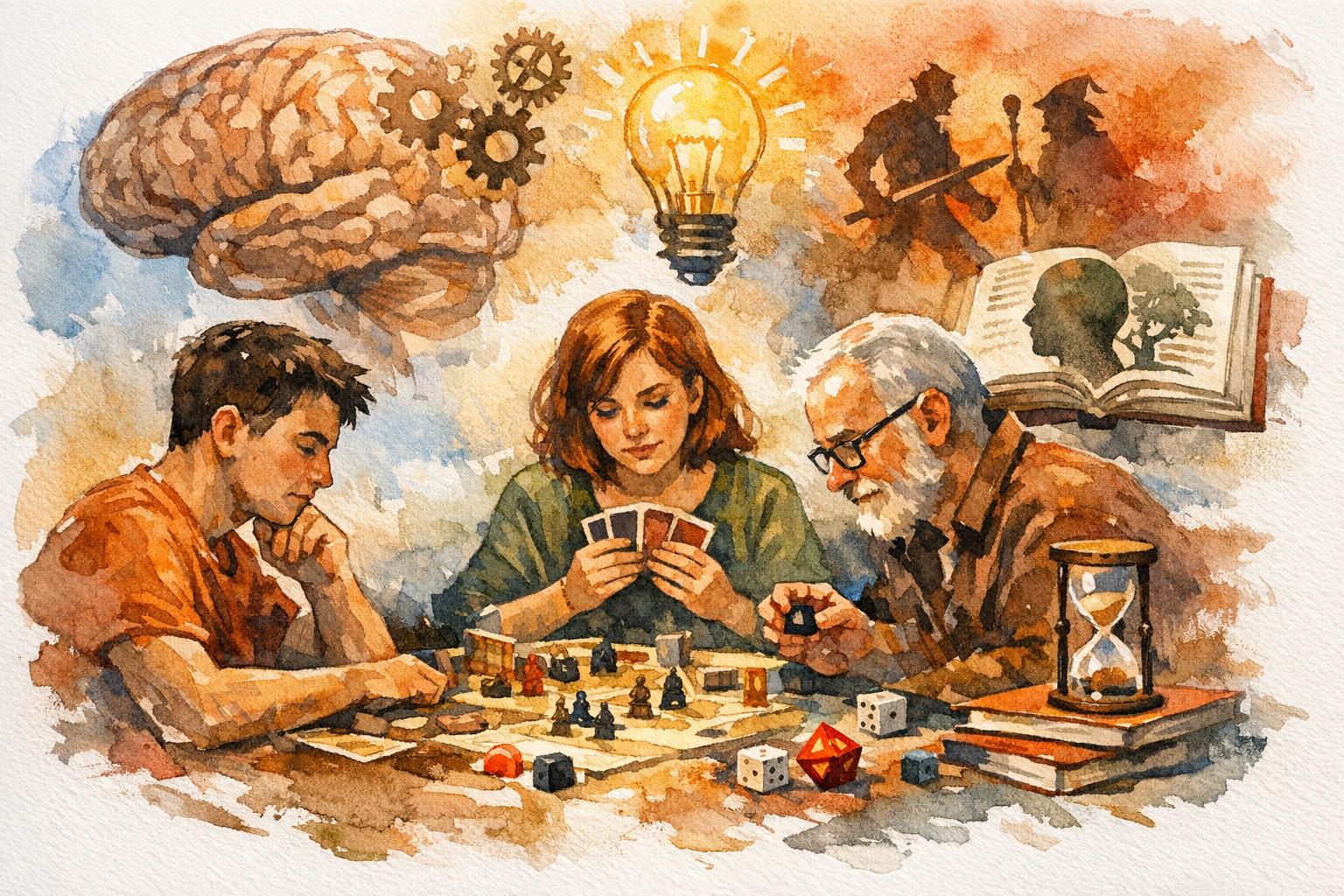
Tabletop gaming is more than just fun - it actively engages your brain and improves mental skills across all age groups. Here’s what research says:
- Memory Boost: Games like Chess and Go enhance working memory, visuospatial skills, and even reduce dementia risk in older adults by 15%.
- Improved Focus: Players develop better attention control, cognitive flexibility, and impulse management.
- Sharper Reasoning: Problem-solving and planning skills improve through challenges in games like Dungeons & Dragons.
- Educational Impact: Kids playing math-based games show measurable gains in memory, problem-solving, and even academic performance.
- Therapeutic Potential: Role-playing games help neurodivergent players with social skills and focus.
Studies confirm that tabletop games activate multiple cognitive processes, offering both mental stimulation and social interaction. Whether you’re strategizing in a legacy campaign or solving puzzles with friends, these games push your brain to perform at its best.
Why Dungeons & Dragons is good for your brain | Science Quickly Video Podcast
How Tabletop Games Improve Memory
Tabletop games are more than just a source of entertainment - they actively engage your brain. Players need to keep track of game states, anticipate opponents’ moves, and adapt strategies on the fly. This dynamic process taps directly into working memory and exercises the visuospatial system, which is responsible for handling and manipulating visual information.
Memory Improvements in Older Adults
A long-term study led by Dr. Jean François Dartigues offers some fascinating insights into how tabletop games benefit older adults. Over 20 years, researchers followed 3,675 participants aged 65 and older in Bordeaux, France. The findings? Regular board game players experienced slower declines in their Mini-Mental State Examination scores, with a hazard ratio of 0.85 for dementia risk.
Dr. Dartigues explained:
“A possible beneficial effect of board game playing on the risk of dementia could be mediated by less cognitive decline and less depression in elderly board game players.” – Jean François Dartigues, Dr. and Lead Researcher, INSERM U 897
Classic strategy games like Go and Chess also play a role in sharpening cognitive abilities. A 2023 systematic review by Federico Emanuele Pozzi and his team found that Go increased activity in brain regions like the left middle temporal gyrus and bilateral putamen. Meanwhile, Chess improved participants’ quality of life, with statistically significant results on the WHO-QoL-OLD scale (p < 0.00001). Playing Go also elevated levels of Brain-Derived Neurotrophic Factor (BDNF), a molecule essential for memory function in both healthy and aging brains.
While older adults clearly benefit from these games, the memory-boosting effects extend to younger age groups as well.
Memory Benefits for Children and Teenagers
The impact of tabletop games on younger minds is equally compelling. A 2015 study involving 234 3rd- and 4th-graders across seven Spanish schools revealed notable improvements in visuospatial memory and problem-solving skills. Students participated in 15 bi-weekly 30-minute sessions featuring targeted games. Third graders who played mathematical games like Pig 10 and 7ate9 showed medium-to-large gains in visuospatial short-term memory. Meanwhile, fourth graders who engaged with memory-based games like Spooky Stairs and Chicken, Cha Cha Cha! demonstrated enhanced problem-solving abilities.
These cognitive gains are tied to the way working memory updates and processes information in real time. Interestingly, researchers also observed “transfer effects.” For example, practicing number operations through mathematical games unexpectedly improved visuospatial memory. School-based programs using quick, 15–20 minute “filler” games saw attendance rates as high as 98.8% to 100%, highlighting how accessible these benefits are for children.
Tabletop games, whether played by the young or old, clearly do more than entertain - they strengthen the brain in ways that can have lasting benefits.
How Tabletop Games Improve Focus and Attention
Tabletop games are more than just a source of entertainment - they actively enhance focus and attention. The mechanics involved, like keeping track of multiple elements, adapting to unexpected changes, and managing impulses, directly strengthen key mental skills such as inhibitory control and cognitive flexibility. These abilities are essential for maintaining attention across various age groups.
Even traditional strategy games bring similar benefits. For instance, older adults who frequently play games like Go, Ska, and Mahjong show measurable improvements in attention and processing speed, as confirmed by the Trail Making Test results. And it’s not just older players who benefit - these advantages extend to younger generations too, as shown below.
Attention Improvements in Teenagers
Teenagers also reap significant benefits from board games that require quick thinking and decision-making. One study highlighted notable improvements in cognitive flexibility (F = 24.829, p < 0.001) and inhibition (F = 8.915, p = 0.004) among children after participating in an 18-session intervention. These games sharpen the brain’s ability to switch tasks, a crucial skill for staying focused in complex situations. Plus, the engaging and playful nature of board games keeps younger players motivated, helping them sustain attention for longer periods compared to traditional classroom activities.
Focus Benefits for Neurodivergent Players
Structured tabletop games also provide a supportive environment for neurodivergent individuals to improve their attention. Research on children with ADHD shows that strategy games like Go (Baduk) can activate underperforming prefrontal functions, which are often linked to attention challenges. Interventions involving board games have demonstrated significant improvements, with effect sizes ranging from -0.87 to -0.61 for ADHD symptoms.
Tabletop role-playing games, such as Dungeons & Dragons, offer unique benefits for autistic players. These games feature clear rules and predictable structures, which reduce the mental strain of masking behaviors. This allows players to focus more effectively on understanding social cues and working toward collaborative goals.
How Tabletop Games Improve Reasoning and Problem-Solving
Beyond enhancing memory and focus, tabletop games play a key role in sharpening reasoning and problem-solving skills. These games push players to refine abilities like working memory, inhibition, and task switching - essential tools for advanced thinking processes like planning and reasoning.
Research highlights that both healthy older adults and those with cognitive impairments experience notable improvements in overall cognition through gameplay, with standardized mean differences (SMDs) of 1.36 and 0.53, respectively. Traditional games, such as Go, have also been shown to boost brain-derived neurotrophic factor (BDNF) levels and enhance activity in brain regions linked to executive functions, directly supporting reasoning skills. These insights pave the way for using such games in targeted strategies to strengthen cognitive abilities.
Executive Function Improvements
Board games specifically designed to challenge executive functions offer measurable cognitive benefits. For instance, a quadruple-blind randomized clinical trial conducted between October 2020 and June 2021 involved 68 children (ages 7–12) at risk of social exclusion. Over nine weeks, the children participated in 18 one-hour game sessions, resulting in significant improvements in cognitive flexibility and inhibition skills.
The potential of board games extends to clinical settings as well. A 2009 study demonstrated that chess training significantly enhanced planning skills and overall cognitive function in patients with schizophrenia. These findings underscore the broader application of such games in improving mental processes.
Problem-Solving in Role-Playing Games
Tabletop role-playing games (TTRPGs), like Dungeons & Dragons, are particularly effective at fostering strategic thinking while also reducing stress. In a 2024 study, researchers Alyssia Merrick, Wendy Wen Li, and Dan J. Miller conducted an 8-week program where 25 community participants played D&D for one hour per week. The results showed notable reductions in depression, stress, and anxiety, alongside increased self-esteem and self-efficacy scores.
“Tabletop role-playing games enable collaborative problem-solving, helping players overcome challenges and progress in the story.”
- Livia Yuliawati, School of Psychology, Universitas Ciputra Surabaya
These games create a safe environment for players to practice assertiveness and experiment with different problem-solving approaches. They also enhance situational awareness and empathy. Moreover, studies reveal that TTRPG players demonstrate significantly greater creativity potential through divergent thinking compared to non-players.
sbb-itb-7b84150
Comparison of Research Studies
Cognitive Benefits of Tabletop Gaming: Research Study Comparison
Research into the cognitive benefits of tabletop gaming spans a wide range of groups, from young children to senior adults. These studies vary significantly in scope, from short-term interventions lasting just six weeks to comprehensive reviews that analyze decades of data. Below, we’ll take a closer look at how the outcomes compare across different studies.
Quantitative data sheds light on the extent of cognitive improvements. The type of game and the demographics of participants play a major role in determining these effects. For example, a 2023 study involving 496 French adults (average age: 28.08) revealed that video games were linked to enhanced mental flexibility and planning. Interestingly, board games did not show the same predictive power for these specific cognitive functions within the same statistical model.
Effect sizes also vary depending on the population studied. Among older adults with no cognitive impairments, global cognition showed a standardized mean difference (SMD) of 1.36, while those with cognitive impairments saw a smaller but still notable improvement (SMD = 0.53). In another study, children at risk of social exclusion participated in a 9-week program that led to significant gains in cognitive flexibility (p < 0.001) and inhibition (p = 0.004). These findings highlight the importance of customizing game-based interventions to suit the needs of specific groups.
Comparison Table of Studies
Study Focus
Key Cognitive Gains
Age Range
Duration
Traditional Board Games & Dementia Prevention
Global cognition, Executive function, Attention
Elderly (60+ years)
Systematic Review
Modern Board Games & Executive Function
Flexibility, Inhibition, Sustained Attention
Children (7–12 years)
9 weeks (18 sessions)
Tabletop Games & Older Adult Cognition
Global cognition improvements (SMD = 1.36 for intact cognition; SMD = 0.53 for impairment)
Older Adults
Meta-analysis (11 studies)
Board Game Interventions
Memory, Attention, Executive function, ADHD symptoms
Children & Older Adults
Systematic Review (27 studies)
Video vs. Board Games
Mental flexibility, Planning, Working memory (Video games only)
Adults (Mean age 28.08)
Cross-sectional study
Health Education & Behavior
Health knowledge (d = 0.82), Behavior change (d = 0.33)
Ages 8 to 70+ years
5 minutes to 30 hours
Academic & School Skills
Calculus (d = 2.19), Mental flexibility (d = 0.76)
Primary school children
6 weeks (12 sessions)
The data clearly shows that tabletop games can lead to measurable cognitive benefits across all age groups. However, the specific improvements depend on factors like the type of game, the length of the intervention, and the characteristics of the participants.
Real-World Applications for Skill Development
Research-backed cognitive benefits are finding their way into classrooms and social programs, where they are being used to improve academic performance and behavior.
Bringing Tabletop Games into Schools
A study conducted in rural Spain tested the impact of board games on 99 children through a program of 12 sessions over six weeks. The results were impressive: the group that played games showed a dramatic boost in calculus skills, with an effect size of d = 2.19, compared to d = 0.97 in the control group. They also displayed notable improvements in cognitive flexibility (d = 0.76).
Another study from the University of Lleida looked at 234 third- and fourth-grade students across seven schools in Catalonia. Over an eight-week period, teachers incorporated 30-minute game sessions twice a week at the end of math lessons. Third graders in the program showed medium-to-large gains in visuospatial short-term memory and number operations compared to their peers in a control group.
“The use of board games during school hours could be as good or better methodology for cognitive training and learning academic skills than regular classes.”
– ScienceDirect, Trends in Neuroscience and Education
In addition to academic benefits, tabletop games are also helping children improve their behavior, especially those dealing with social challenges.
Behavioral Growth Through Games
For children facing social and behavioral difficulties, tabletop games have shown promise as an effective tool. A study conducted in Spain between February and April 2015 involved 68 children, aged 7 to 12, who were at risk of social exclusion. Over the course of 18 sessions spanning nine weeks, they played modern board games like Ghost Blitz and Bee Alert. The results? Significant gains in cognitive flexibility (p < 0.001) and inhibition (p = 0.004).
These weekly gaming sessions seemed to activate prefrontal cortical functions, improving impulse control while encouraging peer communication and group interaction. By blending fun with function, tabletop games offer a dynamic way to complement traditional therapies.
Conclusion
Studies reveal that tabletop games can play a key role in boosting cognitive abilities such as memory, concentration, and reasoning skills.
The findings highlight the broad range of benefits these games offer. For older adults, they contribute to noticeable improvements in overall cognitive performance (with an SMD of 1.36 for those with intact cognition and 0.53 for those with impairments). Meanwhile, children experience significant gains in skills like inhibition and mental flexibility.
What sets tabletop games apart is their unique ability to merge strategic thinking with social interaction. This combination not only strengthens cognitive abilities but also promotes motivation. Unlike solitary brain training exercises, these games provide a more engaging and sustainable way to challenge the mind through shared experiences.
“Tabletop games had the characteristics of cognitive training and interpersonal interactions.” – PubMed
FAQs
How can playing tabletop games help lower the risk of dementia in older adults?
Playing tabletop games has been found to play a meaningful role in reducing the risk of dementia among older adults. By engaging cognitive functions like memory, reasoning, and focus, these games keep the brain active, helping to maintain mental sharpness and slow down cognitive decline. This stimulation is crucial in preventing conditions such as Alzheimer’s and vascular dementia.
Beyond the cognitive benefits, tabletop games also promote social interaction, which is vital for emotional and mental well-being as we get older. Games that involve strategy or problem-solving not only provide mental exercise but also offer a sense of connection and purpose. Regular participation can enhance overall quality of life and even help alleviate depression, a known risk factor for dementia. Adding these games to your daily routine is a fun and rewarding way to support long-term brain health.
What cognitive skills can children develop by playing tabletop games?
Playing tabletop games can be a fun way for children to strengthen a range of cognitive skills, such as memory, attention, problem-solving, and reasoning. These games often challenge players to think strategically, remember rules, and adjust to new scenarios, all of which help build mental flexibility and sharpen executive functions.
Games that involve spatial tasks - like arranging pieces or navigating game boards - can also boost spatial awareness and visual processing. These abilities not only contribute to academic performance but also play a key role in developing critical thinking and navigating everyday challenges.
Can tabletop games help neurodivergent individuals improve cognitive and social skills?
Tabletop games have shown promise as tools for supporting neurodivergent individuals. Research indicates that tabletop role-playing games (TTRPGs) can improve cognitive functions such as memory, focus, and reasoning. Beyond that, they provide a safe space to develop social skills and emotional resilience, making them particularly beneficial for people with autism spectrum disorders or social anxiety.
On a broader scale, studies suggest that tabletop games may help slow cognitive decline in older adults. This positions them as an engaging, non-medical way to promote mental sharpness and social interaction across different age groups and communities.