
Cultural Memory Through Board Games
Board games are more than just fun - they are a way societies preserve and share their history, values, and traditions. For over 5,500 years, these games have acted as "living archives", connecting players to the past through mechanics, storytelling, and shared experiences. Today, they serve as tools for education, language preservation, and even resistance against historical erasure.
Key Takeaways:
- Preservation of History: Games like the Yo'eme Language and Cultural Game help revitalize endangered languages and traditions.
- Learning Through Play: Board games teach history, economics, and social changes by immersing players in scenarios, like industrialization or colonialism.
- Modern Efforts: Projects like the Digital Ludeme Project and museum collections ensure the survival of ancient and modern games.
- Social Connection: Playing games fosters shared memories and collaboration, keeping traditions alive in a "post-digital" world.
How Board Games Contribute to Cultural Memory: Theoretical Foundations
Cultural Memory and Material Objects
Board games are more than just entertainment - they're physical links to cultural memory. Scholars like Jan Assmann and Astrid Erll describe this as "cultural memory objectivations", where physical objects hold and express the values, beliefs, and stories of a society. When you roll dice or move a game piece, you're engaging with an artifact that reflects how people viewed their world at a specific point in history.
These games carry a dual legacy. Their physical elements - like boards, cards, and dice - preserve tangible aspects of heritage, while the rules and practices of gameplay protect intangible traditions. This combination of the material and the intangible makes board games unique cultural artifacts, bridging the past and present.
Board Games as Historical Narratives
Beyond their physical components, board games also serve as tools for exploring history. They allow players to construct historical understanding through play, acting as systems of "historying". Adam Chapman, a scholar in this field, explains that a game's historicity emerges from three factors: how players interpret the game, their experience while playing, and how the game aligns with their cultural knowledge.
This process can create what Alison Landsberg calls "prosthetic memories" - personal connections to historical events or periods that players haven't lived through. Through immersive gameplay, players can form emotional ties to historical narratives, gaining a deeper, more personal understanding of the past. These aren't fabricated memories but mediated experiences that make history feel immediate and relevant.
"The focus of memory studies rests, precisely, not on the 'past as it really was', but on the 'past as a human construct'." - Stefano Caselli, Krista Bonello Rutter Giappone, and Tomasz Z. Majkowski
By blending narrative and mechanics, board games create a space where players not only learn about history but also actively participate in its reconstruction.
Game Mechanics as Simulations of History and Culture
The mechanics of board games go beyond gameplay - they act as structural metaphors for historical and cultural change. Take railroad strategy games, for instance. These simulate the economic and social shifts of the Industrial Revolution, allowing players to engage with the same ideas that shaped historical thought during that era.
This concept, known as "procedural rhetoric," suggests that games communicate ideas through the actions they require from players. The Digital Ludeme Project highlights how these mechanics, or "ludemes", pass cultural knowledge across generations. Much like memes, ludemes transmit shared understandings of play, competition, and cooperation, forming a living archive of societal values. By engaging with these mechanics, players tap into and contribute to the ongoing evolution of cultural memory.
8000 Years of Board Game History in 43 Minutes - SHUX Presents
Board Games That Preserve and Shape Cultural Memory: Case Studies
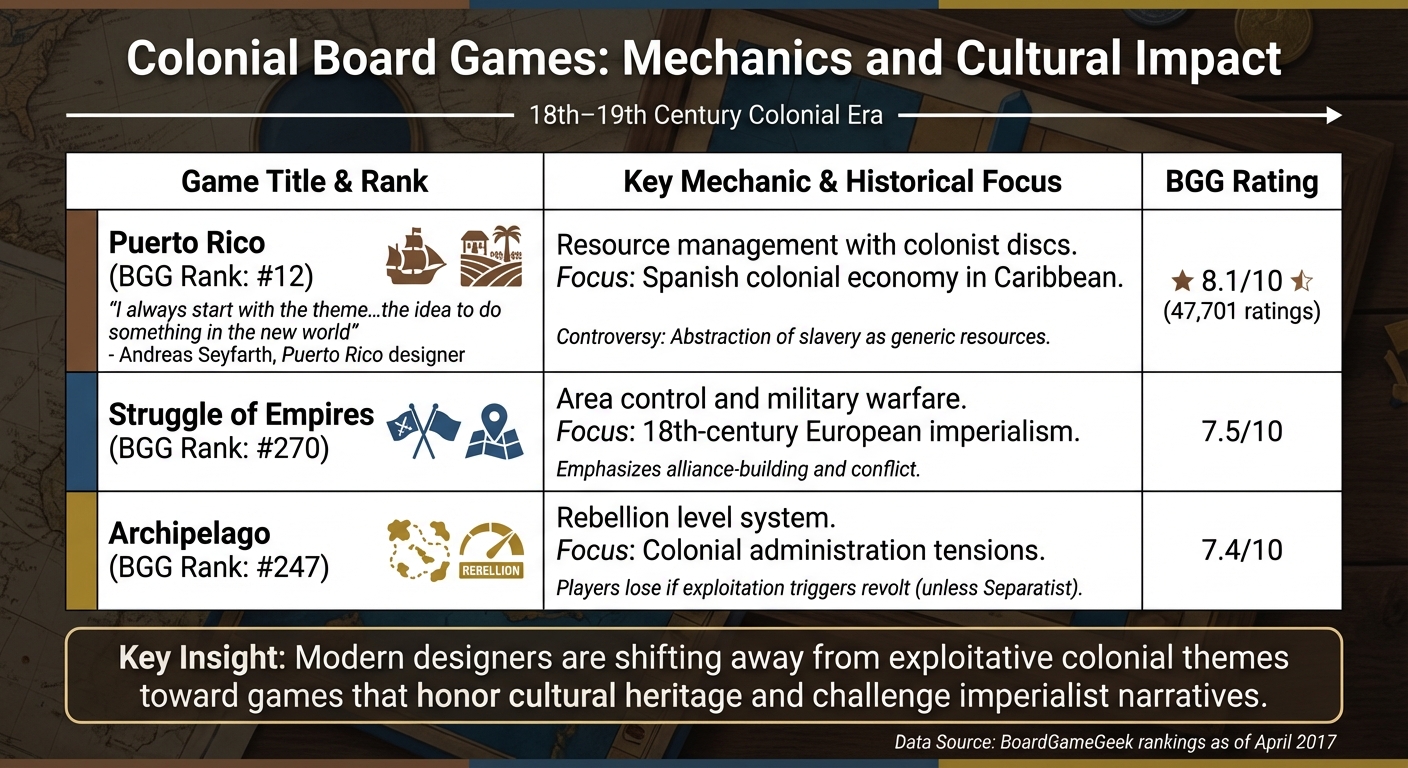
Colonial Board Games Comparison: Mechanics and Cultural Impact
Industrialization and Economic Change in Strategy Games
Railroad strategy games provide a window into the economic transformation of 19th-century America by embedding these changes into their mechanics. Take 1830: Railways and Robber Barons, for example - it focuses on stock manipulation and infrastructure development, capturing the financial drama of railroad expansion in the Eastern United States. Similarly, Age of Steam reflects the competitive spirit and infrastructural growth of the railroad era. The game’s mechanics echo historian Wolfgang Schivelbusch’s observation about the "collapse of spatial and temporal boundaries", immersing players in the sweeping changes brought by industrialization. Through these games, players can experience the mindset of industrial capitalism firsthand. But board games don’t stop at economic shifts - they also delve into the legacies of colonialism.
Colonialism and Power Dynamics in Eurogames
Board games have long explored historical power structures, with colonial-themed games often placing players in the roles of European powers. These games use mechanics that reflect imperialist ideologies, sometimes sparking controversy. Puerto Rico, designed by Andreas Seyfarth, is a prime example. As of April 2017, it ranked 12th on BoardGameGeek, boasting 47,701 ratings and an 8.1/10 score.
"I always start with the theme. For Puerto Rico... one of them was the idea to do something in the new world and build up an economy."
- Andreas Seyfarth
However, critics have pointed out that the game’s abstraction of enslaved individuals as generic "colonist" discs glosses over the harsh realities of slavery, reducing it to a resource management mechanic.
Other games take different approaches to colonial themes. Struggle of Empires (ranked 270th with a 7.5/10 score) highlights the military conflicts and alliance-building strategies of 18th-century European imperialism. Meanwhile, Archipelago (ranked 247th with a 7.4/10 score) introduces a "Rebellion level" mechanic. If colonial exploitation becomes too severe, native populations revolt, causing all players to lose - unless one secretly fulfills a "Separatist" victory condition. This forces players to weigh territorial expansion against local needs, reflecting the tensions of colonial administration.
| Game | BGG Rank | Key Mechanic | Focus |
|---|---|---|---|
| Puerto Rico | 12 | Resource management | Spanish colonial economy |
| Struggle of Empires | 270 | Area control/warfare | European imperialism |
| Archipelago | 247 | Rebellion system | Colonial administration |
Heritage and Identity in Serious Games
While many board games reflect exploitative systems, others aim to reclaim narratives and celebrate cultural identity. Modern designers are increasingly using games as tools to challenge colonial narratives and preserve heritage. The book Playing Oppression by Mary Flanagan and Mikael Jakobsson explores how games can either reinforce or resist imperialist ideologies.
"an indispensable book that can aid game designers and the board game industry in shifting course away from the nightmare of colonialist themes in games."
One powerful example is Gyan Chaupar, an ancient Indian game centered on spiritual enlightenment. When the British adapted it into Snakes and Ladders, much of its original cultural significance was erased, demonstrating how colonialism reshaped traditional games and the memories they carried.
Today, more designers are creating games that honor and respect cultural narratives. These "serious games" often emphasize collaboration and stewardship over exploitation, fostering a deeper awareness of heritage and identity. By doing so, they offer fresh ways to preserve and reinterpret cultural memory through play.
sbb-itb-7b84150
How Board Games Support Memory Formation and Learning
Learning Through Immersive Play
Board games offer a unique way to learn by immersing players in intricate scenarios that often mimic or surpass real-world complexities. These experiences tap into the brain's ability to adapt and grow, benefiting people of all ages. Strategy games, in particular, challenge players to navigate simulations that mirror actual strategic and financial dilemmas.
What makes this learning effective is how effortlessly it happens. Players absorb complex ideas - like scientific principles or historical events - without the experience feeling like a traditional classroom lesson. Stuart West, a Professor of Evolution at the University of Oxford, highlighted this in his observation of the game Evolution: Climate:
"features sophisticated biology… captures key aspects of the evolutionary process and would work as a teaching aid for ages ten and up".
The immersive nature of these games, combined with the "flow" state they create, helps players naturally internalize rules and narratives. When played in groups, this shared experience amplifies understanding and creates a collective learning environment.
Group Dynamics and Shared Memory
One of the standout aspects of board games is how they bring people together, fostering shared memories that last long after the game ends. A review of 45 studies involving 3,550 participants found that collaboration and communication were the most prominent learning outcomes, accounting for 16.14% and 14.52% of observed benefits, respectively. Through negotiating strategies, debating decisions, and reflecting on gameplay, players collectively shape and reinforce the story of their shared experience.
As Fjællingsdal & Klöckner explain:
"Being able to visualize and experience environmental issues within the safe confines of the game is a unique way to immerse learners into the subject of environmental literacy".
The growing popularity of board games - part of a $7 billion industry as of 2023 - reflects a broader trend of people seeking face-to-face interaction in a "post-digital" world. These social experiences transform individual gameplay into a collective understanding of complex subjects.
Cognitive Impact of Game Mechanics
The mechanics of board games play a big role in improving memory and problem-solving abilities. A 2023 study of 496 participants found a strong connection between time spent playing and improvements in fluid intelligence, planning, and working memory. Traditional games like Chess are linked to better short-term memory and fluid intelligence, while modern board games boost verbal working memory and social skills.
Here’s a breakdown of how specific game mechanics impact cognitive skills:
| Game Mechanic | Associated Cognitive Outcome | Frequency |
|---|---|---|
| Dice-rolling | Memory | 12.87% |
| Communication limits | Problem-solving, Empathy | 2.97% |
| Role-playing | Creativity | 3.96% |
| Cooperative/Team-based | Collaboration, Communication | 15.84% |
Among these, memory stands out as the most frequently observed benefit in research on analog game-based learning. For instance, dice-rolling supports memory retention, while mechanics like communication limits encourage problem-solving and empathy. The design of these games ensures that players are not just entertained but actively engaged in cognitive growth.
Preserving Board Games as Heritage
Archiving and Collecting Board Games
Museums and academic institutions play a key role in preserving board games as cultural artifacts. They use controlled environments and archival-grade storage to protect these treasures. For example, The Strong National Museum of Play in Rochester, New York, houses a collection of over 510,000 items related to the history of play. Their conservation efforts include maintaining optimal climate conditions and using archival storage methods to ensure long-term preservation.
However, physical preservation only tells part of the story. Projects like the Digital Ludeme Project take preservation further by using AI and computational tools to digitally reconstruct ancient games. Walter Crist and his research team emphasize that traditional board games are increasingly recognized as endangered intangible cultural heritage. This highlights the need for innovative approaches to safeguard these games and their stories.
Documenting Play Practices and Community Traditions
Preserving a board game isn’t just about keeping the physical object intact; it’s also about capturing the social and cultural context of play. Who played the game? When and where did they play? What rules shaped their experience? Without these details, a preserved game risks losing its cultural significance, becoming just another artifact on a shelf.
Researchers focus on documenting play practices - rules, equipment design, and the traditions surrounding the games. This work ensures that the full story of a game is preserved, not just its physical form. A great example of this holistic approach is the National Videogame Archive, launched in October 2008. This initiative, a collaboration between the National Media Museum in Bradford and Nottingham Trent University, goes beyond preserving games themselves. It also collects supporting materials like box art and manuals, which enrich the cultural narrative of each game. As noted by Tom Woolley, James Newman, and Iain Simons, these materials provide valuable context that helps tell the story of the games and their role in society.
Living Heritage in Contemporary Game Design
Preservation isn’t just about looking back; it’s also about keeping traditions alive in the present. Modern game designers honor the past while introducing new ideas that reflect today’s values. For instance, a study conducted at the Philippine Normal University Visayas explored how traditional Filipino games, known as "Laro ng Lahi", could be preserved and promoted. With a mean score of 3.30, the study highlighted how strategies like integrating these games into school curriculums and cultural competency programs can ensure their survival.
Companies like MINIFINITI also contribute by creating games that foster social connections. They host weekly game nights, providing spaces where people can gather, play, and connect face-to-face. These modern "third spaces" - whether in cafes, community events, or dedicated game nights - keep the tradition of board games alive and thriving. As board game critic Dan Thurot points out, contemporary games often weave cultural history into their mechanics, allowing players to engage with the past through play. By blending historical themes with modern design, these efforts ensure that board games remain a living, evolving part of our cultural heritage rather than relics confined to museum displays.
Conclusion
Board games are more than just entertainment - they are repositories of cultural memory. Through their mechanics, rules, and the social interactions they foster, these games encapsulate the values, histories, and narratives of entire societies. Take, for example, the Royal Game of Ur or the Yo'eme Language and Cultural Game - both serve as tools for preserving ancient practices and revitalizing traditions that might otherwise fade away.
Studies confirm that board games effectively carry cultural memory. The fundamental elements of play, often referred to as ludemes, operate like "game memes", transmitting cultural knowledge from one generation to the next with minimal distortion. When players engage with games simulating industrialization or colonial expansion, they aren't just learning about historical events - they're stepping into the shoes of past societies, experiencing their challenges and perspectives. This underscores the importance of addressing the threats faced by traditional board games.
Today, traditional board games are at risk of disappearing. Walter Crist highlights this pressing issue:
"Traditional board games are becoming a form of endangered intangible cultural heritage, and in many places what were once widely played games have largely been abandoned".
The urgency is compounded by the fragility of digital media, which can degrade within a few decades, and the decline of oral traditions as generations pass.
To safeguard these cultural treasures, preservation efforts must blend modern technology with traditional documentation. Digital projects like the Digital Ludeme Project, which uses AI to reconstruct ancient games, are a step in the right direction. However, these efforts must also include recording the ways games are played and the cultural practices surrounding them. Collaboration among scholars, indigenous communities, and cultural organizations is essential.
As preservation meets innovation, the role of board games as "living archives" becomes even more vital. They serve as bridges between the past and the present, ensuring cultural memory endures. Initiatives like MINIFINITI's community game nights show how blending preservation with fresh approaches can keep board game traditions alive. By embracing both aspects, we can ensure that board games continue to tell the story of human culture - a story that has been unfolding for over 5,500 years.
FAQs
How do board games help preserve endangered languages and cultural traditions?
Board games have become an unexpected yet effective way to help preserve endangered languages, weaving unique vocabularies and grammar into their gameplay. Some games encourage players to use a specific language during actions or challenges, creating a fun and relaxed environment where different generations can practice together. This setup transforms the game into a shared learning experience - elders can teach pronunciation and share stories, while younger players begin to see the language as an active, everyday tool rather than something distant or outdated.
In some cases, classic games are reimagined to support underrepresented languages. Take Scrabble, for example - customized versions tailored to these languages can help standardize spelling, introduce new vocabulary, and even elevate the language's status. Through repeated play, participants naturally absorb new words and deepen their connection to their heritage.
But it’s not just about language. Board games also serve as vessels for preserving broader cultural traditions. By incorporating rituals, myths, and historical narratives into their mechanics and artwork, these games act as "cultural memory objects." They provide an interactive and meaningful way for players to engage with their heritage, ensuring that these traditions continue to be passed down through generations.
How do board game mechanics help players understand historical and cultural changes?
Board game mechanics serve as powerful tools to turn intricate historical and societal dynamics into interactive and engaging experiences. Take games like Age of Steam or Empire Builder, for example. These games use rail-building mechanics to illustrate the transformative role railroads played in shaping economies, landscapes, and societies. By weaving these elements into the gameplay, designers offer players a hands-on way to explore and better understand historical changes.
The mechanics chosen by designers also play a key role in determining which stories get told. Research shows that traditional mechanics often center around themes like conflict or resource expansion, which tend to emphasize Western-centric histories. However, newer approaches - such as cooperative governance or economic simulations - are opening the door to narratives that spotlight more diverse and often overlooked cultural perspectives. In this way, board games do more than just replicate historical events; they actively influence how players interpret and remember them.
How are ancient and modern board games being preserved today?
Efforts to keep board games alive, whether they’re ancient classics or modern creations, blend education, technology, and community involvement. Take the Philippines, for instance - educators are weaving traditional games into school lessons and cultural celebrations, ensuring these pastimes remain a vibrant part of daily life. On another front, digital archiving initiatives are stepping in to document historic board games, preserving their rules and components for generations to come.
The global board game market, now worth $18.53 billion, reflects a surge in interest that’s helping this preservation effort. Board game cafés and bars have become popular gathering spots, where people play everything from timeless classics like chess and Monopoly to newer hits. Meanwhile, companies like MINIFINITI are shaking things up by designing fresh games and hosting events that bring people together, nurturing a sense of connection and keeping these games relevant in today’s world.
By combining education, technology, and social spaces, board games remain powerful links between the past and the present, carrying cultural stories forward.