
How to Design Rulebooks for All Players
A great rulebook sets the tone for your game and ensures players can jump in without frustration. Clear, organized instructions reduce learning time by 37% and improve the overall gaming experience. Here's what you need to know to create a rulebook that works for everyone:
- Understand your audience: Players learn differently - some read every word, others learn as they go, and many rely on videos or explanations. Your rulebook should cater to all these styles.
- Organize effectively: Start with an overview, then cover components, setup, gameplay, and scoring. Include diagrams and quick-reference sections for easy navigation.
- Write clearly: Use short, active sentences and consistent terms. Avoid jargon or overly complex explanations.
- Design with accessibility in mind: Use readable fonts, high-contrast colors, and visuals like labeled diagrams to help all players, including those with visual or cognitive challenges.
- Test thoroughly: Blind playtesting with diverse groups will reveal gaps and ensure everything is easy to follow.
A well-crafted rulebook means less time flipping pages and more time playing. By focusing on clarity, structure, and accessibility, you can create a guide that welcomes every player to the table.
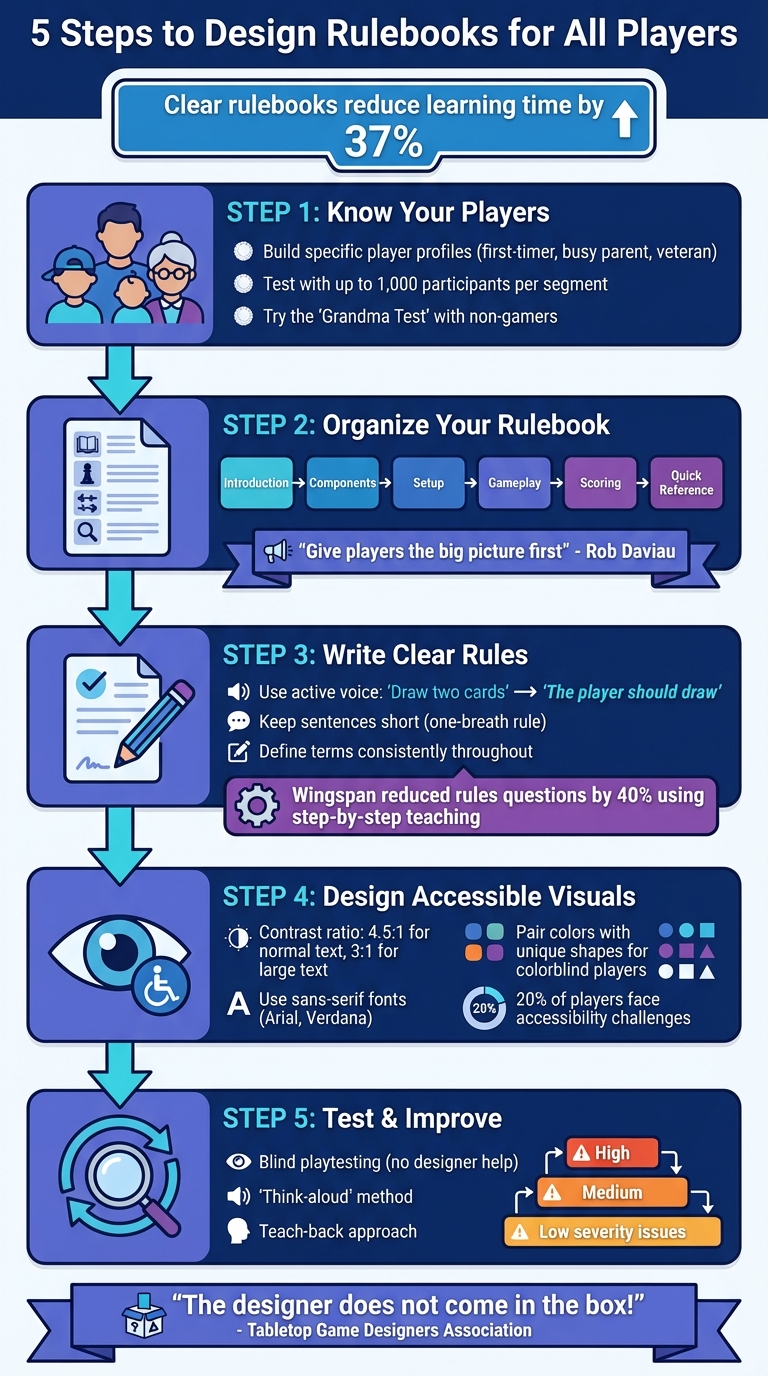
5-Step Process for Creating Accessible Game Rulebooks
RULEBOOKS!(Seven Deadly TCG Sins Followup[ #6)
Know Your Players
To create a rulebook that resonates, you need to understand the different types of players who will interact with it. Think about the meticulous learner who reads every word, the impatient player eager to dive in, and everyone in between. Your rulebook should work for all these approaches.
Consider the needs of new players who rely on step-by-step instructions, active players looking for quick references, and returning players who just need a quick refresher. Accessibility is key, too - use readable font sizes, high contrast, and dual-coded icons to assist players with visual impairments or colorblindness. By addressing these needs, you ensure a smoother experience for everyone. These considerations are the foundation for developing targeted player profiles.
Build Player Profiles
Defining specific player profiles helps you make thoughtful design choices. Instead of aiming for a vague "general audience", focus on distinct player types. Think about the first-time gamer, the busy parent, or the detail-oriented veteran.
Ask yourself: Can the first-time gamer set up the game without any outside help? Can the busy parent find answers to mid-game questions in under 30 seconds? Does the experienced player have enough detail to resolve tricky situations? Designer Matt Leacock sums it up well:
"We observe new players learning the game using only the rulebook. Every question they ask represents a potential improvement to the rules".
Collect Input from Different Players
Once you've outlined your player profiles, gather direct feedback to refine your rulebook. Observe playtests where participants learn and play the game using only the rulebook - no additional guidance from you. Each question they ask points to a gap in your instructions. Let participants know upfront that any confusion they experience highlights areas for improvement - this encourages honest feedback.
Try the "Grandma Test": ask non-gamers or family members unfamiliar with board games to give your rulebook a try. If they can grasp the mechanics, your instructions are likely clear to everyone. Another useful method is the "teach-back" approach - have the game’s winner explain the rules to a new player. Their explanation often reveals the most intuitive way to organize your instructions.
For broader insights, use targeted surveys with screener questions to gather feedback from specific groups based on age, gaming experience, or accessibility needs. Professional testing platforms can help you recruit up to 1,000 participants per audience segment. Additionally, consult with Diversity, Equity, and Inclusion (DEI) or accessibility experts to ensure your language and design are inclusive. Pay special attention to common accessibility challenges in gaming, such as control remapping, text size, colorblind-friendly design, and subtitles.
Organize Your Rulebook
A well-organized rulebook ensures players can quickly find answers without disrupting the flow of gameplay. By creating a logical structure, you accommodate different player preferences - whether they like to methodically read through every detail or dive right into the action. This approach helps make the rulebook accessible to a variety of learning styles.
Basic Rulebook Structure
Start with a clear, sequential layout that mirrors how players actually learn and play. Begin with an introduction and theme, followed by a component list, setup instructions, a gameplay overview, detailed rules, and finally, endgame and scoring. Game designer Rob Daviau highlights the importance of this method:
"Give players the big picture first. They'll understand specific rules better when they know what they're trying to achieve".
Make sure to define the win condition in the first paragraph. This gives players a sense of purpose as they work through the mechanics. Save the back page for a quick reference section - like an icon guide, game flow summary, or index - so players can easily find answers without flipping through the entire rulebook. When designing your pages, ensure related sections (like the component list and setup instructions) appear side-by-side for convenience.
Include a labeled diagram of game components, such as cards or boards, showing key elements like cost, strength, or effects. This helps players quickly identify important details. Add a table of contents with page numbers and use straightforward subheadings like "Phase 1" or "Turn Order" instead of overly creative titles that might confuse readers. Use bold for titles, italics for examples, and CAPITALIZATION for key terms to make the text easier to scan.
Tying a clear structure to a step-by-step presentation ensures players can navigate your rulebook with ease.
Break Information into Small Sections
Introduce rules gradually, starting with simple concepts and building up to more complex ones. Breaking information into smaller, digestible sections helps avoid overwhelming players, especially those who may struggle with memory or processing challenges.
Follow the "one-breath rule" by keeping sentences short and concise. Use numbered steps for processes like setup and turn sequences, and divide broader topics - such as "Movement" - into smaller sub-sections like "Types of Movement."
For advanced rules, place them in callout boxes or sidebars to keep the main flow of instructions straightforward. For example, in Surrealist Dinner Party, the designers included a callout box advising new players to skip the "Send a Guest Home" sub-action during their first few turns. This allowed beginners to ease into the game while keeping the rule accessible for experienced players. Always write directly to the player using active voice - for instance, say "Draw two cards" instead of "The player should draw two cards."
Keep Terms Consistent
Define key terms clearly and stick to the same language throughout the rulebook. Using inconsistent terminology - like swapping between "turn" and "round" - can confuse players and increase their cognitive load, especially for those with learning differences. Proofreader Joe emphasizes this point:
"Standardization is really focused on the tone... ensuring that specific terms are well defined ~ I'm looking at you 'turns' and 'rounds'".
Create a style guide for editors to ensure terms are used consistently across all game materials. Define important keywords - like "Action", "Phase", or "Resource" - early in the rulebook, and use formatting like bold or CAPITALIZATION to make them stand out. However, avoid overusing capitalization, as it can make text harder to read. Pair consistent terminology with helpful icons to make skimming easier and to assist players with colorblindness or other challenges.
Maintain a consistent tone by using second person ("you") for instructions and singular "they" when referring to players in general. Keep the text focused and eliminate anything unnecessary. As TTRPG graphic designer Amber Seger advises:
"If it isn't critical and adding to the learning experience, it really does detract from the overall".
Write Clear and Accessible Rules
A well-written rulebook ensures that everyone - from seasoned gamers to first-timers, non-native English speakers, and players with cognitive differences - can jump into your game without frustration. Clear language minimizes mental effort, allowing players to focus on the fun instead of deciphering confusing instructions. Once your rulebook has a solid structure, the next step is crafting language that’s easy to follow and inclusive for all.
Plain Language Basics
Write directly to the player. Use an active, second-person voice to make the rules feel more engaging and straightforward. For example, say, "Draw two cards" instead of, "The player should draw two cards." Game designer Jamey Stegmaier captures this approach perfectly:
"I write rulebooks as if I'm talking to you. 'Pay $1 to gain 2 resources,' not 'The player pays $1 to gain 2 resources'".
Keep sentences short and focused on one action at a time. Replace overly wordy instructions like "proceeds to draw a card from the deck designated as the resource pile" with "draw a card from the resource deck." Use numerals (e.g., "2") instead of spelling out numbers like "two" to make quantities easier to spot when players scan the page. If you notice frequent use of the word "exception", it might be a sign the mechanic is overly complicated and needs simplifying.
In 2019, Elizabeth Hargrave designed the rulebook for Wingspan to teach one action at a time, showing how each step builds on the last. This method reduced rules-related questions by 40% compared to industry norms. Rulebooks that use clear, simple writing can also cut learning time by an average of 37%.
Use Language That Includes Everyone
Choose words that make all players feel welcome. Use gender-neutral pronouns like "they" or address players as "you" instead of using "he/she". Avoid terms with exclusionary or problematic origins, such as "blacklist", "tribe", or "rule of thumb." Swap them out for neutral alternatives like "no-fly list", "group", or "guideline".
Here’s a quick reference for inclusive language:
| Avoid This Term | Use This Instead | Reason |
|---|---|---|
| Blacklist / Whitelist | No-fly / Approved | Avoids racial undertones in technical terms |
| Crazy / Lame | Unbelievable / Boring | Avoids ableist language |
| Man-made | Manufactured / Synthetic | Gender-neutral alternative |
| You guys | Everyone / Players / Folks | Inclusive of all gender identities |
Write at a reading level that’s accessible to most people - aim for lower secondary education. Avoid describing typical gameplay as "normal", as this can unintentionally imply that other styles are "abnormal." Instead, use terms like "typical" or "standard". With over 1 billion people globally living with some form of disability, inclusive language ensures your rulebook is accessible to everyone.
Combine Text with Visual Aids
Pair your written rules with visuals like diagrams, examples, and icons to make learning easier for all types of players. Use graphics to simplify complex ideas that are hard to explain with words alone. For example, include "anatomy" diagrams to label key parts of cards or game boards, such as cost, strength, or effects. Place visuals right after the related text and label them with numbered captions and clear titles (e.g., "See Figure 1") so players immediately understand their purpose.
Incorporate icons into the text to make rules easier to skim and reinforce specific terms. Leave 1-2 lines of white space between text and images to prevent visual clutter.
Design rulebooks as two-page spreads so that setup diagrams or component lists appear on facing pages. This layout prevents players from flipping back and forth while learning. Also, ensure the text has a color contrast ratio of at least 3:1 against its background, making it readable for players with visual impairments. A thoughtful combination of text and visuals ensures your rules are both clear and engaging for everyone.
sbb-itb-7b84150
Design Accessible Visuals and Layouts
The visual design of your rulebook plays a huge role in shaping the learning experience. Even the clearest writing can fall flat if the layout or text makes reading a struggle. By combining clear language with thoughtful design, you can create a rulebook that's easy for everyone to follow. This means designing with accessibility in mind, so players with visual impairments, reading challenges, or different learning preferences can fully enjoy your game.
Visual Accessibility Basics
Start by choosing high-contrast color combinations that make text easy to read. A good rule of thumb is a contrast ratio of at least 4.5:1 for normal text and 3:1 for larger text (size 14 or above). For example, black or dark blue text on a white or yellow background works well for readability. But don’t rely on color alone - pair colors with unique shapes so colorblind players can easily distinguish elements.
For fonts, stick to simple sans-serif options like Arial or Verdana, as these remain clear even at smaller sizes. Avoid decorative or overly stylized fonts for main text, no matter how well they fit your theme. To further enhance readability, consider printing your rulebook on matte or non-glossy paper to reduce glare under bright lights.
Once you’ve nailed down accessible colors and fonts, focus on structuring the page to guide players naturally through the content.
Create Easy-to-Read Page Layouts
Design your layout to follow a logical flow that mirrors how players interact with the game: Introduction/Theme → Components → Setup → Gameplay Overview → Detailed Rules → Endgame/Scoring → Quick Reference. Align text to the left, keep line lengths between 60–80 characters, and use 1.5× line spacing for better readability.
Maintain a consistent visual hierarchy by using clear headers (H1, H2, H3) so players can quickly skim and find the rules they need. Sidebars or callout boxes are great for highlighting examples, tips, or advanced rules. This approach keeps the main text streamlined for beginners while offering extra detail for more experienced players.
As game designer Bruno Faidutti puts it:
"Your rulebook needs to serve both the methodical learner who reads every word and the impatient player who wants to start immediately".
A well-structured layout not only improves readability but also makes the rulebook more approachable for different types of players.
Add Helpful Illustrations and Diagrams
Pairing text with visuals can make instructions much clearer. Include setup diagrams with numbered steps to show exactly where components go on the board. Whenever possible, use photos of the actual game or detailed graphics instead of abstract drawings to avoid confusion.
Icons are another powerful tool. Embed them within the text to help players quickly identify key points or associate symbols with specific actions. Just make sure the icons scale properly with the text and are large enough to be easily seen.
Game designer Resonym highlights the importance of visuals:
"If you don't show pictures of the components and name them, players will often get confused about which component is which".
Test and Improve Your Rulebook
Even the clearest rulebook can hide unexpected gaps, which only become apparent through real-world testing. To refine your rulebook, blind playtesting is your best tool. This method involves having players learn and play your game using only the rulebook - no help from you allowed. As Jamey Stegmaier, founder of Stonemaier Games, puts it:
"Blind playtesting is a critical 25% improvement tool when playtesters miss a rule that appeared clear. I consider it an opportunity to make it even clearer or put it in a more obvious place".
With this strategy in mind, the next step is to test your rulebook with a variety of player groups.
Test with Different Player Groups
Diverse testers are key to spotting a wide range of issues. Include a mix of novices, seasoned gamers, and players with accessibility needs. While experienced players may breeze through your rulebook by relying on their familiarity with gaming conventions, novices will expose areas where instructions fall short. If beginners can navigate your rulebook successfully, it’s a strong indicator that it’s working as intended.
Accessibility testing is equally important. Around 20% of players face challenges such as small fonts, reliance on color for information, or overly complex instructions. Testing with this group can help you identify and address these barriers. Additionally, an external editor can review your rulebook for issues like unclear cultural references, gendered language, or phrases that might confuse an international audience.
During testing, consider using the "think-aloud" method. Encourage players to verbalize their thoughts as they read and interact with the rulebook. Ask questions like, "What do I do now?" or "How do I make that decision?" to see if they can find answers in the text. Watch for signs of confusion, such as flipping through pages excessively or squinting at the text. And remember, resist the urge to step in and explain anything. As the Tabletop Game Designers Association wisely notes:
"The designer does not come in the box!".
If you intervene, players will rely on you instead of the rulebook.
Address Feedback and Make Changes
Once testing is complete, organize the feedback and prioritize fixes. Break the feedback into categories based on its severity:
- High-severity issues: Problems that block progress or make players quit the game.
- Medium-severity issues: Errors that lead to repeated mistakes or significant frustration.
- Low-severity issues: Minor annoyances or cosmetic confusion.
Focus on high-severity problems first. For example, if multiple testers struggle to locate setup instructions or misunderstand an icon, these are clear areas for revision. Look for patterns in the feedback to identify recurring trouble spots.
Pay attention to emotional reactions as well. For instance, phrasing like "lose 50% movement" can feel harsher than "move at 50% of normal speed", even though the mechanics are identical. After testing, ask the winning player how they would teach the game to someone else. Their explanation will reveal which rules they fully understood and which they simplified. This can help you refine how you present your mechanics and clarify any confusing sections.
Conclusion
Crafting a rulebook that resonates with everyone isn’t about striving for perfection - it’s about making things clear, consistent, and respectful of your players’ time. A well-structured guide, written in straightforward language and paired with helpful visuals, ensures that your game appeals to a variety of players: from the meticulous rule-followers to the impatient ones, and even those who learn best through visuals. The end goal? More time spent playing and less time spent flipping through pages.
The ultimate test of a rulebook’s success is whether players can learn your game without needing you there to explain it. A thoughtfully designed rulebook should cater to different learning styles seamlessly. That’s where blind playtesting becomes invaluable - it pinpoints where instructions may falter. Taking that feedback seriously can elevate a rulebook from merely functional to genuinely effective.
Ambiguity in rules is one of the quickest ways to frustrate players trying to learn a new game. Every tweak you make - whether it’s using inclusive language, adding a labeled diagram, or simplifying a tricky explanation - removes obstacles between your game and its audience. Remember, your rulebook isn’t just a guide; it’s the players’ first real interaction with your game, setting the tone for their entire experience.
Putting effort into creating an accessible and user-friendly rulebook doesn’t just enhance gameplay - it also reduces the number of support questions you’ll get. When players can set up, learn, and dive into your game without outside help, you’ve achieved something special: a welcoming experience that invites everyone to the table. By applying these principles, Infinity Games can ensure every player feels at home with their games.
FAQs
How can I make my rulebook accessible to players with visual impairments?
To make your rulebook easier to use for players with visual impairments, start by choosing a clear, sans-serif font that’s easy to read, with a size large enough to be legible. Stick to high-contrast color combinations, like black text on a white background, to make the content stand out. Don’t rely solely on color to communicate important information - combine it with shapes, icons, or labels to ensure clarity. Align text to the left to maintain consistent spacing, and use bold fonts and ample line spacing to improve readability.
For alternative formats, consider creating a screen-reader-friendly PDF that includes descriptive alt-text for any diagrams or icons. You might also provide audio narration or a video that explains the rules verbally. Adding tactile elements, such as braille instructions or uniquely shaped tokens, can make the game more inclusive. To guide players, include a simple introductory section in the rulebook that highlights these accessibility options, making sure everyone can fully enjoy the game.
What’s the best way to organize a rulebook for different types of players?
To craft a rulebook that suits various learning styles, start with a structure that’s clear and logical. Open with a short overview of the game’s theme, objectives, and main mechanics. From there, arrange the content in a natural sequence: components → setup → gameplay → endgame → reference rules. Use bold headings and concise summaries to make navigation straightforward, and consider including a quick-start guide or flowchart for players eager to jump in right away.
Keep the writing simple and engaging. Use short, direct sentences, and pair the rules with examples to illustrate how they work. Visual learners will appreciate diagrams, labeled illustrations, and color-coded icons, while accessibility can be improved with large fonts and high-contrast colors. For hands-on learners, a components guide with images will help them quickly identify game pieces.
Make sure the rulebook is easy to reference. Number the sections, stick to consistent terminology, and include a glossary or index for quick lookups. Adding tips or FAQs for common questions can be helpful, and linking to video tutorials provides an interactive option for those who prefer to learn that way. By combining these features, you’ll create a rulebook that’s easy to use and welcoming for all players.
How does blind playtesting help make my game rulebook clearer?
Blind playtesting is a critical step in refining your game’s rulebook. It involves having players who are completely unfamiliar with your game attempt to play using only the written instructions - no extra guidance or explanations. This approach helps uncover unclear wording, missing information, or places where the text relies too heavily on visuals to communicate key points. Testers will naturally highlight any areas of confusion or gaps in the rules.
It’s also an excellent way to pinpoint structural issues within the rulebook. Since testers follow the instructions exactly as written, any sections that are out of order or transitions that feel clunky will become obvious. Their feedback can guide you in reorganizing the rulebook into a logical flow. For example, you might start with an overview, then move through components, setup, gameplay, and finally, the end-game. This process ensures your rulebook is easier to navigate and understand, making the game more enjoyable for all players.