
Designing Games with Hidden Roles
Hidden role games are built on secrecy, deduction, and deception. Players are assigned secret identities, creating two groups: an informed minority and an uninformed majority. This setup fuels gameplay with bluffing, social interaction, and strategic misdirection. Games like Mafia and Werewolf exemplify this genre, which has evolved significantly since its inception in 1987.
Key elements of hidden role games include:
- Information Asymmetry: A small group knows each other’s roles, while the majority must deduce who’s who.
- Social Dynamics: Success relies on persuasion, observation, and analyzing others’ behavior.
- Replayability: Randomized roles and evolving player strategies ensure no two games are ever the same.
To design balanced hidden role games:
- Maintain a ratio of one-third informed minority to two-thirds uninformed majority.
- Use special roles (e.g., Detectives, Doctors) to level the playing field.
- Gradually reveal information to keep players engaged and guessing.
The appeal of these games lies in the tension they create, where every decision feels impactful. By combining simple rules with dynamic social interactions, hidden role games deliver engaging, unpredictable sessions that players return to again and again.
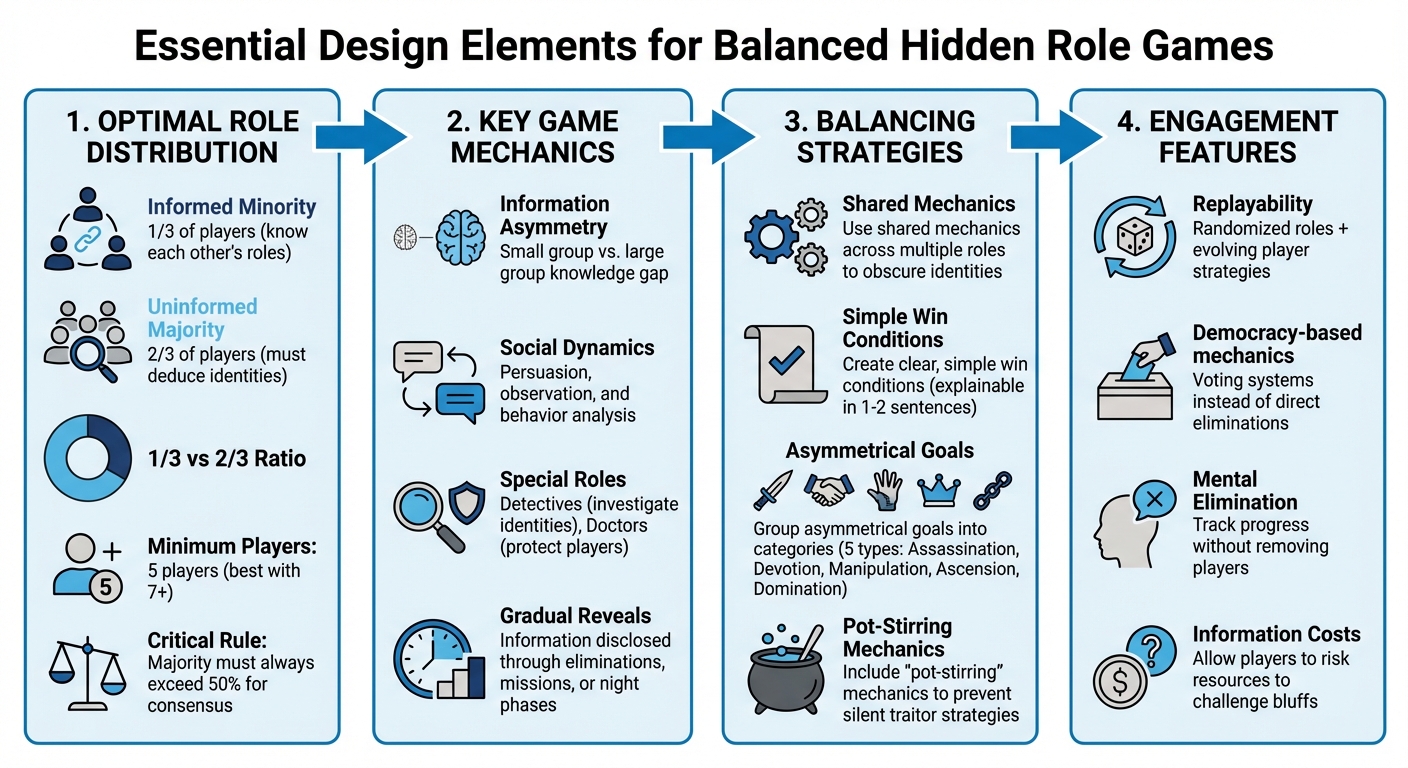
Essential Design Elements for Balanced Hidden Role Games
How Do Hidden Roles Mechanics Work In Games?
Core Elements of Hidden Role Mechanics
Hidden role games thrive because they weave together multiple mechanics that create tension and keep players engaged. By understanding these key elements, designers can craft experiences where every decision and conversation feels meaningful. These mechanics build on the earlier exploration of hidden roles, providing a foundation for balancing and enhancing player involvement.
Different Information Levels and Bluffing
At the heart of hidden role games is information asymmetry - a scenario where a small, informed group faces off against a larger, uninformed one. This imbalance drives players to constantly weigh what they know against what others might know, creating endless opportunities for deception and misdirection.
Every action becomes a clue, prompting questions like, "What’s their motive?" Game designer James Ernest of Crab Fragment Labs captures this dynamic perfectly:
"Bluffing games are not about lying for its own sake... I need to understand, within the context of the game, why you did what you did."
For example, a Mafia member might deliberately vote against their team to disguise their true identity. These calculated moves keep opponents guessing and amplify the intrigue. This kind of strategic bluffing is the lifeblood of hidden role games, ensuring that uncertainty - and engagement - remains high.
Social Interaction and Observation
In hidden role games, success often hinges less on mastering rules and more on navigating social dynamics. The real challenge lies in outwitting your opponents through persuasion, deduction, and deception, rather than relying on experience with the game's mechanics.
Open dialogue is crucial for uninformed players trying to identify threats and build alliances. These conversations lead to intense, high-stakes moments - like when friends argue over who to trust. To maintain this energy, many games include mechanics that force players to share information or take risks. For instance:
- In The Resistance, failed missions expose potential traitors.
- In Mafia, roles like the Detective gather clues, adding layers of suspicion.
These "pot-stirring" mechanics prevent players with hidden roles from simply staying quiet to avoid detection, keeping the gameplay dynamic and interactive.
Replayability Through Unpredictability
One of the most compelling aspects of hidden role games is their unpredictability. Even with the same rules, no two sessions play out the same way. Role assignments, player personalities, and shifting social dynamics ensure fresh experiences every time.
The gradual revelation of information also keeps players hooked. Whether it’s through eliminations, mission results, or special phases like a "Night Phase", new details emerge to shape the narrative. As the game unfolds, players refine their deductions, making the process increasingly satisfying.
Adding to this is the meta-game element: players bring knowledge from previous sessions, which influences their strategies and interactions. This evolving complexity ensures that hidden role games remain engaging and endlessly replayable, providing a strong foundation for thoughtful role balancing and long-term enjoyment in game design.
Designing and Balancing Hidden Roles
Creating balanced hidden roles in games requires careful attention to player numbers, role powers, and how and when information is revealed. Nail these elements, and you’ll create a game where every player has a fair shot at victory, no matter their role. These adjustments are the backbone of balanced gameplay and keep the tension alive from start to finish.
Role Distribution and Assignments
A good rule of thumb? Assign about one-third of players to the informed minority and the remaining two-thirds to the uninformed majority.
Most hidden role games work best with at least five players, but they truly come alive with seven or more. It’s crucial that the majority always makes up more than 50% of the group. Why? Because they need enough players to collaborate and logically deduce who the adversaries are. If the minority hits or exceeds 50%, the majority loses its ability to reach a consensus, and the game dynamics can fall apart.
Game designers often tweak rules based on how many people are playing. For example, Secret Hitler introduces more intricate mechanics for groups larger than six to keep things engaging. Meanwhile, Werewolf usually starts with two werewolves, regardless of the group size, while Mafia scales the minority proportionally.
Balancing Role Abilities and Powers
To level the playing field, the uninformed majority needs tools to counter the inherent advantage of the informed minority. Special roles like Detectives, who can investigate identities, or Doctors, who can protect players, add layers of strategy and give the majority a fighting chance.
One clever way to maintain balance is by using shared mechanics - actions that multiple roles can perform - to obscure identities. For instance, if three different roles collect "Blood" tokens, it becomes harder to pinpoint someone’s role based on that action alone. This keeps players guessing while adding depth to the gameplay.
The team behind Captain's Gambit offers a refreshing perspective on balance:
"We think of balance as a measure of fun rather than a necessary element, meaning we think it's important to look into if something feels wrong but not something to seek out on its own terms." – Mitchell & Team, Designers of Captain's Gambit
Once role abilities are set, it’s time to test. A targeted playtest, like running a “no-traitor” scenario where the hidden role player acts honestly, can reveal if the majority team struggles too much. If they can’t win even without interference, it’s a sign the mechanics might need reworking.
Win Conditions and Reveal Mechanics
Clear win conditions help players quickly evaluate actions and make decisions. For instance, if someone’s moves align with "Condition X", they might seem suspicious, while actions toward "Condition Y" can build trust. Captain's Gambit simplifies this by grouping asymmetrical goals into five categories - Assassination, Devotion, Manipulation, Ascension, and Domination - making it easier for players to assess threats.
Revealing information gradually can heighten the intrigue. Take The Resistance, where failed missions hint at potential traitors without eliminating anyone, keeping all players engaged and leaving a trail of clues. Secret Hitler adds another layer by barring previously elected governments from consecutive terms, forcing players to interact with others and potentially expose hidden agendas.
Finally, think about what happens once a traitor is exposed. The game should either wrap up quickly or introduce new mechanics to avoid a dull “one-versus-many” slog where the exposed player has no meaningful choices left. This keeps the excitement alive until the very end.
sbb-itb-7b84150
Keeping Players Engaged with Hidden Roles
Building Interaction and Immersion
Hidden role games thrive on interaction, but silence can grind them to a halt. When traitors figure out they can win by staying quiet and avoiding attention, the game risks losing its spark. To keep the energy alive, designers need to include mechanics that encourage action and build suspicion among players.
One effective approach is using democracy-based mechanics. Instead of outright eliminations, games like The Resistance rely on voting systems where players choose trusted sub-groups to carry out missions. If a mission fails, suspicions grow, keeping everyone mentally invested and on edge.
A narrator or moderator can also enhance the experience by adding thematic flair. For instance, instead of plainly stating, "Player 3 is dead", they might say, "A lifeless body appears in the town square", to strengthen the game's atmosphere. During night phases, when players close their eyes, adding distractions like stomping or clapping can mask accidental spoilers from movement sounds.
Games that introduce varied win conditions further enrich social dynamics. For example, one player might aim to assassinate a target, another to gather resources, and a third to protect someone. These diverse goals encourage negotiation and create layers of interaction beyond the basic "us versus them" setup. Mitchell from Cloudfall Studios, the creators of Captain's Gambit, underscores this idea:
"Uncertainty is essential for making players feel suspicious of each other. If you don't have enough uncertainty, the game can easily feel too predictable or repetitive".
These strategies lay the foundation for games that balance simplicity with depth, ensuring players stay engaged.
Balancing Complexity and Accessibility
Games with simple rules and meaningful choices tend to resonate more than overly complicated ones. This ties back to the need for balance in role distribution and abilities. Victory conditions should be easy to explain - ideally in just a sentence or two. If players struggle to understand how to win, even without a traitor involved, the mechanics likely need refinement.
Organizing roles into broad categories can simplify gameplay while keeping the experience dynamic. For instance, Captain's Gambit features 21 different captains but groups their win conditions into five categories: Assassination, Devotion, Manipulation, Ascension, and Domination. This grouping helps players focus on broader threats, like identifying "an Ascender", without needing to memorize every role's specific details. Modern game designs often favor "mental elimination" - tracking progress or excluding suspects from key actions - over physically removing players, which keeps everyone involved.
Adding opportunities for players to gain information at a cost can deepen engagement. For example, allowing someone to risk health points or resources to challenge a bluff introduces high-stakes decision-making. As the Cloudfall Studios team explains:
"We think of balance as a measure of fun rather than a necessary element... everyone should feel that they had some agency in their own victory or defeat".
The ultimate goal is to ensure every player feels they have a hand in shaping their fate, rather than striving for perfect mathematical balance between roles.
Conclusion
Hidden role games shift the focus of gameplay from simply following rules to analyzing and interpreting the actions of others. The real excitement comes from moments of persuasion, deduction, and deception, where players must outwit one another to succeed.
The most captivating hidden role games often include mechanics that stir the pot - forcing players to take action rather than stay quiet. Pairing these with gradual reveals of information keeps everyone engaged, as players work to narrow down suspects while never being completely sure of their conclusions.
When designing these games, balance shouldn't just mean equal win rates. Instead, the focus should be on fun and engagement. Every player should feel like their choices mattered, whether they won or lost. This means roles need to be designed not just for fairness but also to ensure they contribute to an exciting and interactive experience.
For effective design, keep hidden role games simple with clear win conditions and straightforward role structures. Testing how information flows and whether players have meaningful choices is essential. The goal is to create scenarios where suspicion feels justified and strategic decisions matter.
The genre still has plenty of room to grow. For instance, the "Confused" mechanic - where teams are evenly matched but unaware of their allies - opens the door for new and exciting gameplay possibilities. Blending hidden roles with cooperative elements and asymmetrical win conditions can lead to fresh experiences that challenge players in unique ways. The key is ensuring that every session feels different while providing opportunities for players to sharpen their deduction skills over time. These approaches help maintain the delicate balance of deduction, interaction, and unpredictability that makes hidden role games so compelling.
FAQs
How do you create balanced gameplay in hidden role games?
To create a well-balanced hidden role game, it’s essential to focus on a few guiding principles. Start by establishing clear and straightforward win conditions. Players should easily grasp their objectives without getting bogged down by overly complicated rules. For smaller hidden factions, give them powerful and meaningful abilities that help level the playing field against larger teams. This ensures that every group, no matter its size, has a fair shot at success.
Steer clear of rigid mechanics like strict turn orders, which can unintentionally benefit one side over another. Instead, encourage open, free-flowing gameplay that prioritizes strategy, negotiation, and persuasion. Testing the game with a variety of group sizes and player skill levels is also key. Aim for a balanced win-rate, ideally between 45% and 55% for all factions, to maintain fairness and replayability.
Incorporate limited and unevenly distributed information, such as secret cards or hidden tokens, to keep players on edge and the tension high. Lastly, ensure that the game’s mechanics align with its theme. When abilities and actions feel natural within the game’s world, it enhances immersion and makes the experience more rewarding.
By following these principles, you’ll design a hidden role game that’s engaging, fair, and filled with strategic depth.
Why is social interaction so important in hidden role games?
Social interaction lies at the core of hidden role games, fueling their tension, strategy, and enjoyment. The secrecy surrounding each player’s role and objectives sparks constant conversation, persuasion, and deduction. Players are challenged to read body language, earn trust, and defend themselves against accusations, creating a lively and immersive atmosphere.
Game designers craft mechanics that naturally spark discussion - like secret roles, timed debates, or night-phase actions. These features keep the focus on player interactions, ensuring every moment feels engaging. When players are deeply involved socially, the game becomes more unforgettable, replayable, and something they’re eager to share with others. It’s this emphasis on human connection that defines the genre’s lasting appeal.
Why is replayability essential in hidden role games?
Replayability is what keeps hidden role games thrilling. It guarantees that every session feels new and full of surprises. With shifting alliances, evolving strategies, and unexpected outcomes, players remain hooked and eager for more.
This ever-changing gameplay doesn’t just amp up the tension and enjoyment - it also keeps players coming back, turning the game into a go-to favorite for game nights.