
Game Talk
Designing Games for Measurable Learning
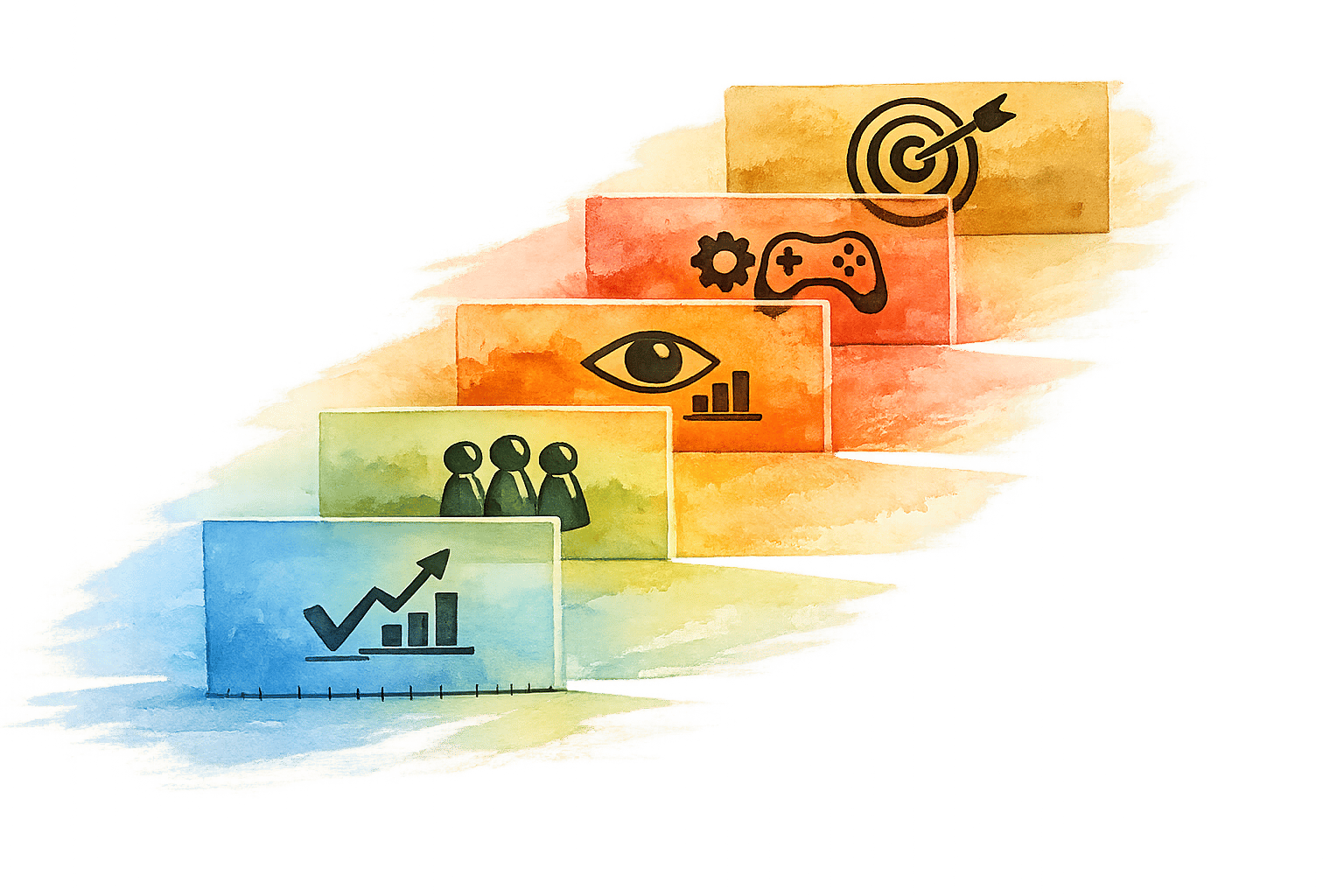
Want to make games that teach effectively? It starts with measurable outcomes. Games can be more than fun - they can teach skills and knowledge, but only if designed with clear goals and integrated assessments. Here’s the process in a nutshell:
- Set Clear Goals: Define what players should learn, using specific, measurable objectives.
- Align Mechanics with Learning: Every game action should reinforce the educational purpose.
- Use Stealth Assessments: Track progress seamlessly during gameplay without traditional quizzes.
- Encourage Collaboration: Design for teamwork by assigning roles and creating interdependent tasks.
- Test Learning Results: Use pre- and post-game evaluations and iterative playtesting to refine the game.
Educational games succeed when gameplay naturally teaches. Think of mechanics as metaphors for the skills being taught, and always tie player actions to learning goals. Ready to level up your game design? Let’s break it down.
5-Step Process for Designing Educational Games with Measurable Learning Outcomes
Stealth Assessment in Games to Measure and Support Learning
Step 1: Set Clear Learning Goals
Before diving into game design - whether it’s crafting mechanics or developing characters - start by defining clear, measurable learning goals. These goals act as the foundation for your decisions, shaping everything from gameplay loops to assessment tools. Without them, you might end up with a game that’s entertaining but lacks educational value.
Your objectives should clearly state what players will be able to do or understand after playing the game. As Filament Games explains:
“The Learning Objectives… should state what the player should be able to do or understand at the end of the game, provided they’ve mastered the game during play”.
For example, instead of saying, “players will understand resource management”, aim for something more specific like, “players will allocate resources to maximize production efficiency within budget constraints.” This version is concrete, measurable, and actionable.
Using Frameworks to Create Goals
Frameworks like SMART goals (Specific, Measurable, Attainable, Related, and Time-bound) are excellent tools for creating realistic and trackable objectives. Another approach is the ABCD method, which breaks goals into four parts: Audience (who is learning), Behavior (what action they’ll perform), Condition (under what circumstances), and Degree (what standard defines success).
You can also structure objectives across different levels - activity, unit, and course - to address both specific skills and broader competencies.
Bloom’s Taxonomy is another helpful tool. It distinguishes between lower-order thinking skills (like identifying or listing) and higher-order skills (like predicting or critiquing). Games aimed at higher-order goals often require more intricate mechanics and deeper engagement from players.
By using these frameworks, you ensure that your learning goals are tightly integrated into the gameplay experience.
Aligning Goals with Game Mechanics
Once you’ve established clear objectives, the next step is to translate them into game mechanics. A useful method for this is the Identity-Verbs-Systems framework, which involves defining who the player becomes, what actions they perform, and how those actions interact within the game systems.
For example, Filament Games used this approach to design a game aligned with a Next Generation Science Standards objective about ecosystem resource availability. They turned the “System” aspect into a sandbox simulation and the “Verbs” (analyze and interpret data) into specific tools that allowed players to collect evidence and construct arguments. Every player action was directly tied to the learning goal.
To avoid unnecessary complexity, lock in your objectives early. If a feature doesn’t clearly support a learning goal, it’s likely unnecessary. As Filament Games puts it:
“If you can’t find a clear connection between the feature and the impact content, then you’ve got yourself an optional feature”.
Finally, consider transfer goals - objectives that focus on how players can apply what they’ve learned outside of the game. These goals ensure that the learning experience has a lasting impact, extending beyond the screen.
Step 2: Create Game Mechanics That Support Learning
Once you’ve set clear goals, the next step is to design game mechanics that naturally integrate learning. This is where many educational games falter - they either feel like rigid, glorified worksheets or lean so heavily on entertainment that the educational purpose fades into the background. The key is to design mechanics where learning becomes an inseparable part of the gameplay.
Think of mechanics as the actions players take that directly reflect your learning objectives. These actions should serve as digital metaphors for the skills or knowledge being taught. For example, if your goal is to teach data analysis, the game could involve activities like gathering evidence and building arguments. Games that excel in this area make every player decision a step toward mastering the intended learning outcome. To achieve this, you’ll need frameworks that can effectively translate educational goals into engaging mechanics.
Selecting a Design Framework
One useful tool for this process is the Mechanics-Dynamics-Aesthetics (MDA) model, which breaks games into three components:
- Mechanics: The foundational rules and systems of the game.
- Dynamics: How those rules play out during gameplay.
- Aesthetics: The emotional responses and experiences the game evokes.
This model bridges the gap between technical design choices and the player’s overall experience.
Another effective approach is the Identity-Verbs-Systems framework, which aligns gameplay with learning objectives by addressing three key questions:
Framework Element
Player Question
Learning Alignment
Identity
“Who am I in this game?”
Assigns a professional role or perspective, such as an urban planner or scientist.
Verbs
“What do I do in this game?”
Defines actions like “analyze data” or “solve problems” that mirror the learning objectives.
Systems
“How does this game work?”
Teaches players to understand and navigate complex systems, reflecting real-world challenges.
Dan Norton, Chief Creative Officer at Filament Games, explains:
“By using these three categories [Identity, Verbs, Systems], you have a tool not only for discovering mechanics, but for defining the playful anatomy of each learning objective”.
This approach ensures that the gameplay and learning outcomes are tightly interwoven.
Gamification vs. Serious Game Design
To refine your mechanics, it’s important to understand the difference between gamification and serious game design. Gamification involves adding external rewards like points, badges, or leaderboards to existing content. While this method is quicker and more cost-effective, it often lacks depth and relies on extrinsic motivation.
Serious games, on the other hand, are built from the ground up with the learning goals embedded directly into the mechanics. These games emphasize integrated learning, where players naturally achieve educational outcomes as they strive to succeed in the game. It’s similar to the “wax-on, wax-off” technique from The Karate Kid - players may think they’re just completing tasks, but they’re actually mastering specific skills.
Although serious games demand more time and resources to develop, the payoff can be substantial. Studies show that learner retention increases by 62% when game mechanics are directly tied to academic standards through structured workflows. For educational programs focused on measurable outcomes, this kind of investment can be well worth it.
Modern educational games are also moving away from traditional mechanics like dice rolls and toward decision-based systems that encourage collaborative problem-solving. Jonathan Hicks, Founder of Maven Games, highlights the importance of this shift:
“The ‘quality of the choices’ presented to players via the mechanics is the hallmark of a good game”.
This trend reflects a growing emphasis on inclusive design, ensuring the game accommodates a wide range of players, including those with varying levels of technological proficiency or physical abilities.
Step 3: Add Assessment Tools to Your Game
Once your learning goals are clear and your mechanics are aligned, it’s time to figure out how to measure whether players are actually mastering the content. Traditional quizzes can pull players out of the immersive experience by making the game feel like a classroom. Instead, consider using stealth assessment, a method that evaluates learning seamlessly within the gameplay itself.
Valerie Shute, a Professor of Educational Psychology at Florida State University, describes stealth assessment as:
“Stealth assessment… embeds performance-based assessments in digital games in order to measure how students are progressing toward targeted goals”.
This approach keeps the focus on the game while quietly tracking progress. Let’s look at some specific ways to integrate these tools into your game.
Types of In-Game Assessments
The best games assess mastery through their design. For instance, if advancing in the game requires players to manipulate sound waves, their progress naturally demonstrates their understanding of acoustics.
But don’t just measure the final outcome - track the journey. Scaffolding assessment focuses on the level of help players need to succeed. Instead of simply noting whether a puzzle was solved, record how many hints, visual cues, or interventions they used. This reveals their level of independence and depth of understanding. Similarly, behavioral assessment examines how players approach problems. By analyzing patterns and sequences of actions, especially in open-ended games like Minecraft, you can gain insight into their problem-solving strategies and collaboration skills.
For games with adjustable difficulty, adaptive difficulty itself can act as a measure. The highest level players reach over time reflects their growing competence. Another powerful tool is big data assessment, which uses protocols like xAPI to log every decision a player makes. This data is sent to external servers, allowing educators to analyze detailed dashboards without disrupting gameplay.
Gathering and Analyzing Data
Once you’ve chosen your assessment methods, the next step is to collect and analyze the data. This process, known as learning telemetry, involves recording player actions - like clicks or event streams - for later evaluation. But not all data is useful. Focus on capturing actions that directly indicate learning. The ADAGE framework (Assessment Data Aggregator for Game Environments), developed at the University of Wisconsin-Madison, uses “semantic templates” to filter out irrelevant data, making it easier to connect player behavior to learning outcomes.
Rebecca Rufo-Tepper from Edutopia highlights an important point:
“Assessment happens around a game more often than it happens inside the game, and teachers must still design and provide authentic, useful assessment tasks”.
This means blending in-game data with external methods. Tools like SnapThought let players take annotated screenshots during gameplay to explain their thought process. For collaborative games, teachers can observe group dynamics and ask questions to explore decision-making. Post-game activities - such as writing strategy guides, creating game mods, or completing “exit tickets” that apply learned concepts - often provide a richer understanding than digital logs alone.
Take Jamie’s 7th grade social studies class as an example. Students played In the Civil War Loop, a collaborative game where they built causal maps of historical events. Afterward, they completed exit tickets that asked them to justify their next moves in a given scenario, demonstrating their understanding of historical feedback loops. By combining in-game observations with post-game tasks, Jamie gained a well-rounded picture of their learning progress.
sbb-itb-7b84150
Step 4: Encourage Collaboration and Engagement
Teamwork speeds up learning, so design your game to actively promote communication, sharing of information, and mutual reliance. Too often, collaborative learning games focus only on teaching goals and miss out on integrating game mechanics that amplify social interaction. The trick is to weave teamwork into the rules themselves, rather than just suggesting it. Doing this not only keeps players engaged but also improves measurable learning outcomes. These principles are the foundation for creating effective group dynamics.
Designing for Group Learning
The best collaborative games thrive on distributed expertise. This means each player has unique knowledge or skills that are essential to solving the problem at hand. Imagine one player managing scientific data while another handles urban planning tools - they’ll need to communicate and share insights to succeed together. This setup encourages positive interdependence, where one player’s progress depends on the success of others. Assigning identity-based roles, like a biologist or an engineer, adds depth by giving players distinct perspectives that are critical for group progress.
As André A. Rupp and his team point out:
“Epistemic games serve to develop domain-specific expertise based on principles of collaborative learning, distributed expertise, and complex problem-solving”.
To make these interactions work, use pedagogical scripting. Design puzzles that require players to act in sync, and map out their interactions with event charts to ensure collaboration becomes part of the gameplay itself. You can take this a step further by adding immersive elements that make players feel fully involved in the game world.
Adding Immersive Elements
Immersion takes engagement to another level by pulling players into the game’s narrative and roles. When players assume specific identities, they’re encouraged to understand and master the skills tied to those roles. Filament Games explains:
“One of the most enchanting qualities of games is their ability to transport players into new roles and identities. By bestowing a unique perspective and set of skills upon the player, games ask them to understand and master the chosen identity”.
Simplify this process with visual aids - like icons and tutorials - to reduce cognitive load and keep players focused. For younger audiences (ages 8–12), use large, simple interfaces that rely on basic keyboard or mouse inputs. To make the experience even more engaging, incorporate rules that mimic real-world systems. For instance, create an ecological simulation where players must collaborate to maintain balance. Add immediate feedback - like animations or particle effects when tasks are completed - to reinforce a sense of achievement.
Step 5: Test and Confirm Learning Results
After setting clear goals, refining mechanics, and integrating assessments, the next step is ensuring the game achieves its intended learning outcomes. Testing goes beyond debugging - it’s about verifying that players are genuinely learning. The best way to do this combines pre- and post-game evaluations with iterative playtesting, using both qualitative insights and quantitative data to fine-tune the design.
Before and After Game Evaluations
Start by measuring players’ knowledge before and after gameplay to assess learning progress. Baseline and post-game assessments are key tools for this process. Frameworks like Evidence-Centered Design (ECD) can help connect specific learning goals with in-game evidence. A useful metric for learning is the reduction in reliance on in-game help over time. As Filament Games explains:
“We can only measure actions, not thoughts”.
Focus on what players do differently after playing, rather than relying solely on self-reported learning outcomes.
For games that are more open-ended or sandbox-style, behavioral assessments can provide valuable insights. By analyzing the sequence of actions players take, you can compare their problem-solving approaches to expert strategies. This helps determine whether they’re adopting more effective methods. Tools like xAPI (Experience API) can also be implemented to log every player decision, enabling third-party analysis. Research supports the idea that games are most effective when paired with traditional teaching methods, so consider positioning your game as a complement to classroom instruction rather than a standalone tool.
Once you’ve quantified outcomes, use iterative playtesting to refine these measures and improve the learning experience.
Playtesting for Improvement
Playtesting is essential for uncovering design flaws and refining gameplay before launch. Hosting peer presentations where small groups share their game fundamentals with a larger audience can highlight unclear mechanics or redundant features. The Transformational Design Framework, discussed in Step 2, is a helpful guide for this process. The Learning Games Lab Toolkit emphasizes the value of feedback exchanges:
“In the reciprocal exchange of giving and receiving feedback, learners apply social awareness, self-awareness, and emotional regulation”.
During playtesting, pay close attention to player reactions. Moments of laughter, excitement, or boredom often reveal more about the game’s effectiveness than post-game interviews. Assign a non-player assistant to take notes, allowing you to focus on facilitating the session. Save detailed feedback discussions for the end to keep the game flow uninterrupted. Conduct multiple sessions to spot recurring issues - if several players struggle with the same mechanic, it likely needs adjustment. Isolated feedback from single outliers, however, can often be set aside.
Failure is just as important as success in this process. As Filament Games points out:
“Through the act of failing your preconceived ideas were challenged, and at the very least you learned what didn’t work”.
Make sure to document all feedback digitally so no insights are lost, ensuring the next design iteration incorporates these lessons.
Example: MINIFINITI’s Approach to Game Design
MINIFINITI proves that tabletop games can successfully combine entertainment with meaningful learning experiences. Their game Red Tape is a standout example, blending humor, strategy, and defined player roles to transform abstract ideas into hands-on problem-solving. This thoughtful mix of humor and strategy ensures that every game element contributes to a clear educational goal.
Their design philosophy follows the DDE Framework (Design, Develop, Evaluate), emphasizing gameplay that delivers measurable outcomes. This structured approach ensures that their games are not only engaging but also purposeful in driving learning objectives.
One of MINIFINITI’s unique features is their weekly game nights, which bring players together for social interaction and collaborative learning. These sessions encourage teamwork and reinforce lessons in real-time. By turning individual gameplay into a shared problem-solving experience, they highlight the power of distributed expertise and collective learning. This social dynamic elevates the experience, making learning a communal activity.
Humor is another key tool in MINIFINITI’s arsenal, used to enhance engagement and motivation. When paired with strategic gameplay that demonstrates complex systems in action, players encounter what game designers call “interesting problems”. This approach deepens understanding and keeps players invested.
For game designers looking to adopt similar strategies, MINIFINITI offers a practical blueprint: design games where player actions align with learning goals, use fictional scenarios as safe spaces for experimentation, and incorporate social play to boost engagement. Their games, like Red Tape, show that learning-focused games can be both effective and fun. To explore their full catalog or join a game night, visit MINIFINITI.
Conclusion: Creating Games That Make a Difference
Designing games that teach effectively means finding the right balance between learning and fun. The five steps outlined here - setting clear learning goals, building supportive mechanics, integrating assessment tools, fostering collaboration, and testing results - work together to ensure your game is both engaging and impactful.
The goal is to blend gameplay with educational objectives seamlessly. When game mechanics naturally align with the content, assessment feels like a natural part of the experience rather than an interruption. Focus on observable player behaviors to determine if they’ve grasped the concepts, and use the Identity, Verbs, and Systems framework to translate learning goals into gameplay. Start with prototypes, test them early, and refine based on feedback.
The U.S. video game industry, which generated $36 billion in revenue in 2017 - a growth of 18% from the year before - shows the incredible potential of this medium. Educational games that are thoughtfully designed can not only captivate players but also deliver real learning outcomes.
Start with clear objectives, design mechanics that bring those objectives to life, and test rigorously with your audience. The result? Games that players love and that make a meaningful impact on their skills and knowledge.
FAQs
How can I set clear and measurable learning goals for my educational game?
When creating an educational game, it’s important to define specific learning objectives that outline what players should achieve by the end of the experience. Use straightforward, actionable phrases like, “The player will be able to describe…” or “The player will complete…” to keep the goals clear and focused.
To make the process manageable, break down larger goals into smaller steps that tie directly to the game mechanics. This way, players can stay engaged as they work toward achieving the overall learning outcomes. Think about incorporating themes such as identity (“Who am I in this game?”), actions (“What do I do?”), or systems to build a more unified and meaningful experience.
Most importantly, ensure that the game mechanics actively support these learning objectives. When players complete tasks or hit milestones, it should reflect their understanding or mastery of the skills and knowledge the game aims to teach.
What are stealth assessments, and how do they improve learning in games?
Stealth assessments offer a clever way to evaluate players’ abilities without disrupting their gaming experience. Instead of relying on traditional tests, these assessments work quietly in the background, collecting data as players interact with the game. They track skills like problem-solving, creativity, and subject-specific knowledge based on in-game choices and actions.
This approach keeps players fully engaged while offering real-time feedback and challenges tailored to their progress. By weaving evaluation into the gameplay itself, stealth assessments make learning feel seamless and enjoyable, allowing players to develop skills naturally without losing focus or the fun of the game.
How can game mechanics be designed to support and measure learning effectively?
Game mechanics can help make learning more effective by tying gameplay directly to clear educational objectives. They achieve this by offering interactive challenges that push players to think critically, solve problems, and work together. Often, players take on roles or navigate scenarios that allow them to explore and apply important concepts in a hands-on, meaningful way.
To track progress and measure learning, games can include integrated assessment tools like progress bars, tasks that test specific skills, or feedback systems. These features not only help players understand their own development but also provide educators with real-time insights into how well the learning goals are being met.