
How Multi-Layered Boards Change Gameplay
Multi-layered boards add a physical depth to games, transforming flat, two-dimensional play into a three-dimensional experience. This design introduces verticality, creating new challenges and opportunities for players. Here's what they bring to the table:
- Gameplay Depth: Players must strategize across multiple levels, considering height, movement, and transitions.
- Immersion: The physical design aligns with game themes, such as towers or multi-floor environments, enhancing the overall experience.
- Player Interaction: Vertical positioning influences tactics like blocking, negotiating, and outmaneuvering opponents.
- Design Features: Includes recessed areas for secure piece placement, stackable components, and modular layouts for varied gameplay.
Multi-layered boards aren't just visually appealing - they reshape how games are played, offering a richer, more engaging experience. Whether through dual-layer boards, modular designs, or hidden areas, these boards change the way players think, plan, and interact.
Build: Double-Layer Recessed Board for Maquis + Channel Update

What Are Multi-Layered Boards?
Multi-layered boards bring a new dimension to game design by introducing physical depth through varying thickness, carved surfaces, and stacked components. Unlike traditional flat boards made from printed card stock, these designs add vertical elements that enhance both the look and feel of gameplay. As Susan Han points out, they represent a departure from the standard flat-board approach, offering a more dynamic and engaging experience for players.
The construction of these boards often relies on dual-layer techniques. This involves stacking two layers of board material, with the top layer featuring custom die-cut shapes. These cutouts create recessed areas or slots where game pieces like dice, meeples, or tokens can sit securely, preventing them from slipping around during play. Typically made from grayboard or blue core substrate, the boards range in thickness from 1.5 mm (≈0.06 in) to 3.0 mm (≈0.12 in) and are wrapped in printed paper for a polished finish.
Some multi-layered boards are modular, designed as puzzle-like sections that can be assembled in different configurations. This flexibility allows for varied layouts, making each game session unique. These design advancements not only enhance aesthetics but also open up possibilities for more interactive and strategic gameplay.
Key Features of Multi-Layered Boards
Multi-layered boards are more than just visually striking - they redefine how games are played. By incorporating vertical stacking and interactive surfaces, they break away from the traditional single-plane design. These boards often feature carved plateaus, stackable towers, or tiered zones that create distinct gameplay areas. Tabletopia highlights how adding thickness to a board can mimic a stone plateau effect, boosting visual appeal without the need for complex 3D models.
Vertical tokens and 3D objects aren't just decorative - they serve functional purposes, too. They can designate player zones, indicate worker placement areas, or provide visual cues to guide players during the game. Blue core board is often chosen for these intricate cutouts because it delivers sharper and cleaner edges compared to standard grayboard, making it ideal for precision designs.
Another standout feature of multi-layered boards is the inclusion of hidden areas. The added depth allows game designers to conceal information or components on different levels, introducing an element of secrecy that can significantly impact strategic planning.
How Multi-Layered Boards Add Gameplay Complexity
Adding a vertical dimension to the board - often referred to as the Z-axis - completely transforms how players interact with the game. This shift in spatial design introduces new layers of strategy and player interaction. Instead of focusing solely on horizontal movement, players must now consider vertical navigation, such as climbing, using stairs, or positioning on elevated areas like balconies and catwalks. These new spatial dynamics bring fresh challenges, requiring mechanics to manage transitions between different elevations.
Height differences can also influence gameplay mechanics. For instance, characters positioned on rooftops might gain a strategic advantage by having a clearer line of sight, while those on the ground face obstructions. As Roll20 forum user Kissker explains:
this prevents strategic play on the vertical scale, and forces only horizontal play - which really puts a strain on immersion.
The vertical aspect introduces unique tactical decisions, where players must weigh the benefits of height against their horizontal positioning. Ken S., a Pro User on Roll20, shared his experience with a multi-level fight:
I had one fight with three levels (ground, balcony, catwalk) and I could easily see having more in a complex street scene.
How Multi-Layered Boards Affect Strategy
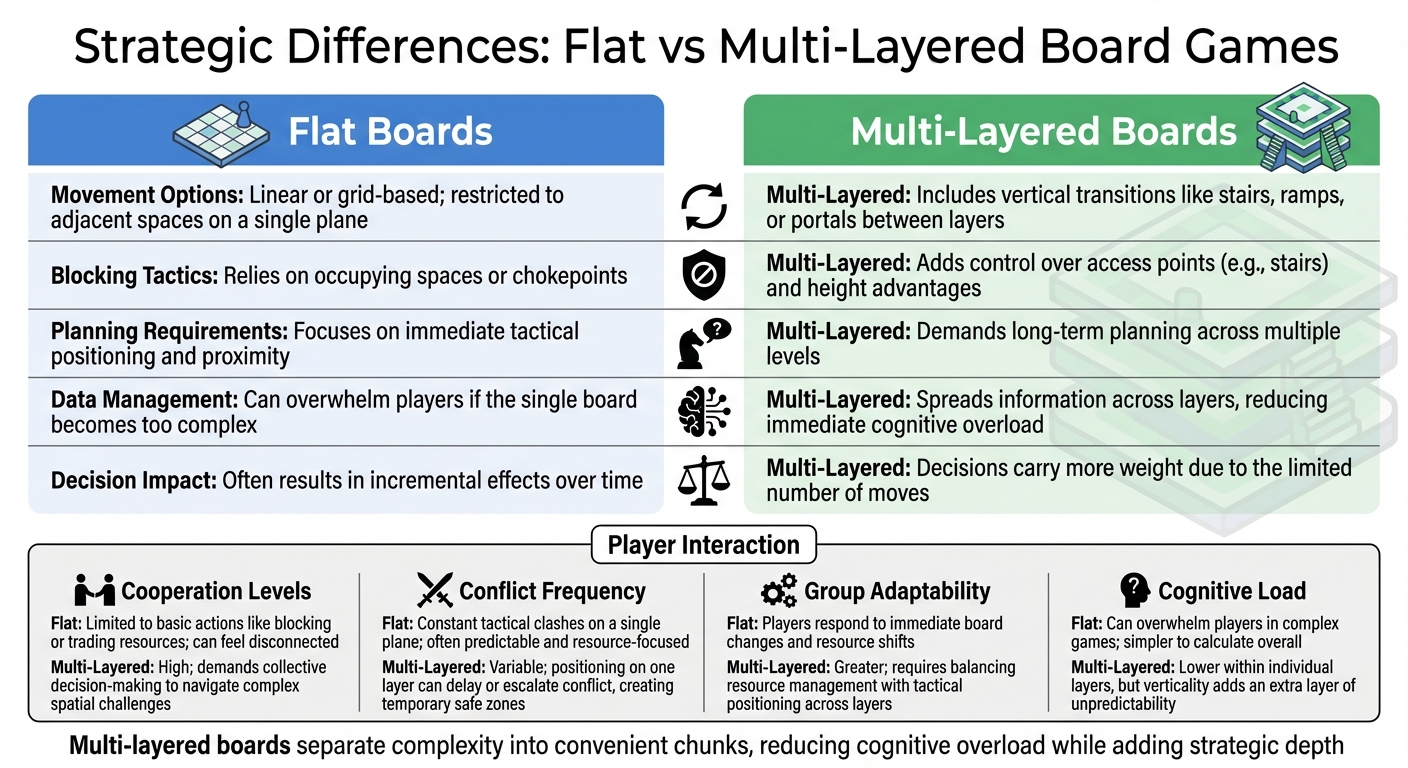
Flat vs Multi-Layered Board Games: Strategic Differences Comparison
When you add vertical dimensions to a game board, the entire gameplay landscape changes. Players aren't just thinking about moving pieces across a flat surface anymore - they’re analyzing elevation, planning transitions, and juggling actions that vary by layer. This introduces a fresh layer of complexity, forcing players to balance short-term tactics with long-term strategy. It’s a fascinating evolution that sets multi-layered boards apart from their traditional flat counterparts.
Added Cognitive and Spatial Challenges
Multi-layered boards challenge players to think in three dimensions, which is a big leap from the simpler two-dimensional gameplay. Now, players have to visualize patterns across different planes, calculate tricky line-of-sight angles from elevated positions, and plan movements while accounting for vertical obstacles. These added dimensions demand more mental effort, but they also make the game richer and more engaging.
The increased cognitive load doesn’t stop at elevation - it extends to managing unique mechanics tied to different layers. For example, frontline units might get two actions, like moving and attacking, while backline units are limited to a single supportive action. These mechanics force players to rethink strategies, adding depth to every move they make.
What’s especially interesting is how these challenges reshape strategic thinking. Veteran game designer Ernest Adams highlights how multi-layered gameplay can help players focus by breaking down complexity into manageable chunks:
The benefit of multi-level games is that they separate this material into convenient chunks, and while you're in one gameplay mode, you don't have to worry too much about the other one.
Research also backs up the cognitive benefits of navigating multi-dimensional environments. In a 2010 study by the University of Rochester, non-gamers spent 50 hours playing either fast-paced action games like Call of Duty 2 or slower strategy games like The Sims 2. The action game players, who had to navigate complex 3D environments, became 25% faster at making accurate decisions in visual and auditory tasks. As Professor Daphne Bavelier put it:
Action game players make more correct decisions per unit time. If you are a surgeon or you are in the middle of a battlefield, that can make all the difference.
Strategy Comparison: Flat vs. Multi-Layered Boards
The strategic shift from flat to multi-layered boards goes far beyond changes in movement mechanics. Multi-layered designs introduce new challenges, such as deciding how to efficiently use limited actions across multiple levels. Every move carries greater weight, and players must carefully prioritize which layer to engage with, often sacrificing opportunities on one level to gain an advantage on another.
| Feature | Flat Boards | Multi-Layered Boards |
|---|---|---|
| Movement Options | Linear or grid-based; restricted to adjacent spaces on a single plane. | Includes vertical transitions like stairs, ramps, or portals between layers. |
| Blocking Tactics | Relies on occupying spaces or chokepoints. | Adds control over access points (e.g., stairs) and height advantages. |
| Planning Requirements | Focuses on immediate tactical positioning and proximity. | Demands long-term planning across multiple levels. |
| Data Management | Can overwhelm players if the single board becomes too complex. | Spreads information across layers, reducing immediate cognitive overload. |
| Decision Impact | Often results in incremental effects over time. | Decisions carry more weight due to the limited number of moves. |
In multi-layered games, the divide between local tactics and overarching strategy becomes even clearer. Players must juggle immediate combat on specific layers while keeping an eye on their overall positioning across the vertical structure. This dual focus adds a level of complexity that flat boards simply can’t replicate, making every decision feel more impactful and deliberate.
How Multi-Layered Boards Improve Immersion
Multi-layered boards go beyond just adding layers of strategy - they pull players deeper into the heart of the game's world. The use of raised platforms, textured surfaces, and stacked components creates a tactile and visual experience that flat boards simply can't replicate. Imagine the moment a tower rises above the board or the feel of a heavy, premium surface under your fingertips. These physical elements don't just look impressive - they heighten focus and immerse players by connecting what they see with what they touch.
Increased Visual and Physical Engagement
The first thing that grabs a player's attention is the game's overall aesthetic - the way it looks and feels. Game designer Jainan Sankalia puts it well:
Presentation Aesthetic represents the sensory information revealed to the player usually expressed through the audiovisuals. This is the core layer... as it is the first exposure the player has to the experience.
Multi-layered boards take this concept to the next level, transforming abstract ideas into tangible, three-dimensional features.
While standard boards are typically 1.5 mm to 3.0 mm thick, premium materials like wood introduce a sense of durability and craftsmanship. Designers often push these boundaries to create standout effects. For example, adding extra thickness or raised sections can simulate environmental elements like rugged stone plateaus or elevated terrain.
One modular board system showcased this brilliantly, using raised components and textured finishes to create striking terrain effects. The vertical design didn’t just look great - it allowed for dramatic gameplay moments, like warriors leaping from tall buildings, something impossible on a flat board.
Even the way boards are laminated plays a role. Matte finishes minimize glare from overhead lighting, while glossy lamination enhances colors and adds a polished shine. These thoughtful design choices combine to create a board that doesn’t just look good - it feels alive. The tactile details also influence gameplay, making decisions about positioning and strategy feel more grounded in the game world.
Examples of Thematic Integration
The true magic of multi-layered boards lies in how they bring a game's theme to life. When the physical layers of a board align with the story being told, they become more than just design elements - they become tools for storytelling. Elevations and textures aren’t just decorative; they reinforce the narrative and deepen the experience.
A great example of this is ELDEN RING: The Board Game, developed by Steamforged Games in November 2022. Lead Designer Sherwin Matthews set out to recreate the unforgettable "magnificent vista" moment from the video game - stepping out of a graveyard to see Stormveil Castle looming in the distance.
To capture that sense of anticipation and imminent discovery... we needed a world that could evolve based on player decisions,
Matthews explained. The solution? A modular tile system where players could construct a shared 3D map as they explored, perfectly mirroring the sense of discovery from the original game.
Similarly, in February 2024, Mihi Mini Studio reimagined Catan with 3D resource tiles. These tiles transformed the game's abstract mechanics into immersive dioramas, adding depth and life to the familiar gameplay.
These examples show how multi-layered boards can turn game mechanics into memorable narrative moments. When a board’s physical design reflects the world it represents - whether it’s a crumbling fantasy city or a windswept island - it draws players into a living, breathing environment. Every move feels more impactful, every decision more meaningful, and every game session unforgettable.
sbb-itb-7b84150
How Multi-Layered Boards Change Player Interaction
Multi-layered boards do more than just add depth to strategy and immersion - they completely shift how players interact. Instead of battling it out on a single flat surface, players must now navigate across multiple levels, adjusting their positions and responding to threats that can come from any direction. This added complexity transforms gameplay into a dynamic mix of strategic positioning, defense, and maneuvering, putting a spotlight on how players interact with each other during the game.
Encouraging Dynamic Positioning and Negotiation
Adding layers introduces what game designers call "action differentiation." Essentially, a piece’s position on the board determines the actions it can perform. For instance, in games with distinct frontline and backline zones, frontline units might have access to extra actions, while backline units stay protected until the frontline is cleared. This setup forces players to make tough choices - do they go all-in on offense or focus on conserving resources? It also creates tension, as players must adapt their strategies to the evolving positional dynamics.
The vertical aspect of layered boards not only demands new strategic thinking but also encourages negotiation and teamwork. In cooperative games with layered designs, players often need to communicate and collaborate on piece placement to block certain routes or secure key positions. This transforms spatial decisions into a collective challenge.
Teale Fristoe, Founder of Nothing Sacred Games, highlights the importance of interaction for meaningful gameplay:
A game needs to provide interaction for a player to truly have agency.
Game developer Heathrileyo further emphasizes the need for clarity in these more complex systems:
By making every card's role and position clear, you eliminate confusion, reduce mistakes, and allow players to focus on strategy instead of rule-checking.
Interestingly, these spatial dynamics also influence social behaviors. In a study involving 11 pairs of older adults and children, competitive games were found to encourage more pro-social actions - like offering help, sharing, and giving compliments - compared to cooperative games. The physical act of negotiating space serves as a kind of "social glue", promoting communication and fostering connections among players.
This contrasts sharply with the more straightforward and predictable interactions typical of flat boards, as shown below.
Player Interaction Comparison: Flat vs. Multi-Layered Boards
| Feature | Flat Boards | Multi-Layered Boards |
|---|---|---|
| Cooperation Levels | Limited to basic actions like blocking or trading resources; can feel disconnected | High; demands collective decision-making to navigate complex spatial challenges |
| Conflict Frequency | Constant tactical clashes on a single plane; often predictable and resource-focused | Variable; positioning on one layer can delay or escalate conflict, creating temporary safe zones |
| Group Adaptability | Players respond to immediate board changes and resource shifts | Greater; requires balancing resource management with tactical positioning across layers |
| Cognitive Load | Can overwhelm players in complex games; simpler to calculate overall | Lower within individual layers, but verticality adds an extra layer of unpredictability |
Veteran game designer Ernest Adams explains the advantage of multi-layered games:
The benefit of multi-level games is that they separate this material into convenient chunks, and while you're in one gameplay mode, you don't have to worry too much about the other one.
This layered approach doesn’t reduce player interaction - it refines it. Players can focus on making thoughtful decisions without being bogged down by unnecessary complexity. Every move on one layer affects the others, creating a dynamic, ever-changing three-dimensional battlefield. While these enhanced interactions elevate the gaming experience, they also introduce unique design challenges that require careful consideration.
Design Considerations for Multi-Layered Boards
After discussing the strategic and interactive elements of multi-layered boards, let’s dive into how thoughtful design choices support these advancements.
Creating a multi-layered board requires careful planning to balance gameplay depth, durability, and affordability. Designers must juggle the need for engaging mechanics while ensuring the game remains accessible. On top of that, manufacturing these intricate designs presents technical challenges that can heavily influence production costs and deadlines.
Balancing Usability and Complexity
One of the toughest hurdles with multi-layered boards is ensuring players don’t feel overwhelmed. Clear visibility of progress is essential - players need to easily track their status without mentally juggling multiple layers. Features like built-in scoring tracks or markers make this seamless. As Evan Sunwall, a UX Specialist at Nielsen Norman Group, puts it:
Board games should always keep players informed of their status in the game.
Another key design element is real-world mapping, where mechanics mimic physical laws, making them more intuitive. For instance, climbing to higher levels should feel harder than descending, aligning with how we perceive effort in real life. This approach reduces the need for players to memorize arbitrary rules. Games like Santorini take this a step further: domes physically block spaces, eliminating ambiguity by letting the components themselves enforce the rules.
To reduce rulebook dependency, designers often include handy reference tools like player mats or quick guides. For more complex games, progressive reveal mechanics - where players unlock new layers or rules gradually through envelopes or stickers - can simplify learning. This method, often seen in legacy games, allows players to master core concepts before tackling advanced mechanics, spreading the complexity across multiple sessions.
Accessibility is another critical consideration. Relying solely on color to distinguish pieces can alienate players with color-vision deficiencies. By incorporating thoughtful vertical design and inclusive visual cues, designers can create engaging gameplay without unnecessary frustration.
Manufacturing Challenges
While user experience shapes design, manufacturing constraints dictate what’s practical and affordable.
Producing multi-layered boards isn’t as straightforward as making flat ones. Adhesion and warping are common issues - ensuring the printed paper adheres permanently to the chipboard core without deforming requires specialized industrial adhesives that can handle temperature shifts. Most board games use chipboard or grayboard, with standard board thickness at 2.0mm and tiles typically at 1.5mm.
Die-cutting precision is equally important. When components span multiple layers, even a tiny error - like one millimeter - can disrupt assembly. Dull cutting tools can lead to delamination or cracks in the cardboard. Hersh Glueck, CEO of Hero Time, warns:
When your artwork isn't designed properly for printing, it can result in quality issues and game components that don't look the way you expected them to.
For foldable or stackable boards, fold line integrity is a major concern. Repeated folding can wear down materials, so manufacturers often use heavier paper (like 157 GSM C1S) and reinforce fold lines with additional strips. Surface durability also plays a role - matte finishes reduce glare but are more prone to scratches, especially on darker colors. Options like anti-scratch matte lamination or gloss finishes in high-use areas can address this issue.
The cost implications of these challenges are significant. Raw materials alone account for about 30% of production costs. Standard grayboard costs $600–$900 per ton, while premium chipboard ranges from $1,200–$1,500 per ton. Manufacturing costs per unit typically fall between $3–$6 for standard folding boards and $5–$10 for premium mounted boards in bulk.
To avoid costly mistakes, designers should always order physical proofs before mass production. This ensures components fit together properly and that materials meet quality expectations. Adding a 3mm bleed area around artwork accommodates the slight imprecision of industrial cutting, preventing visible white edges. Ensuring artwork is at least 300 DPI and designed in CMYK (rather than RGB) avoids pixelation and color mismatches during printing. These production details don’t just influence costs - they also play a huge role in delivering an immersive and polished game experience.
Examples of Multi-Layered Board Games
These examples showcase how multi-layered boards and mechanics can elevate gameplay.
Santorini: Tower-Building Mechanics
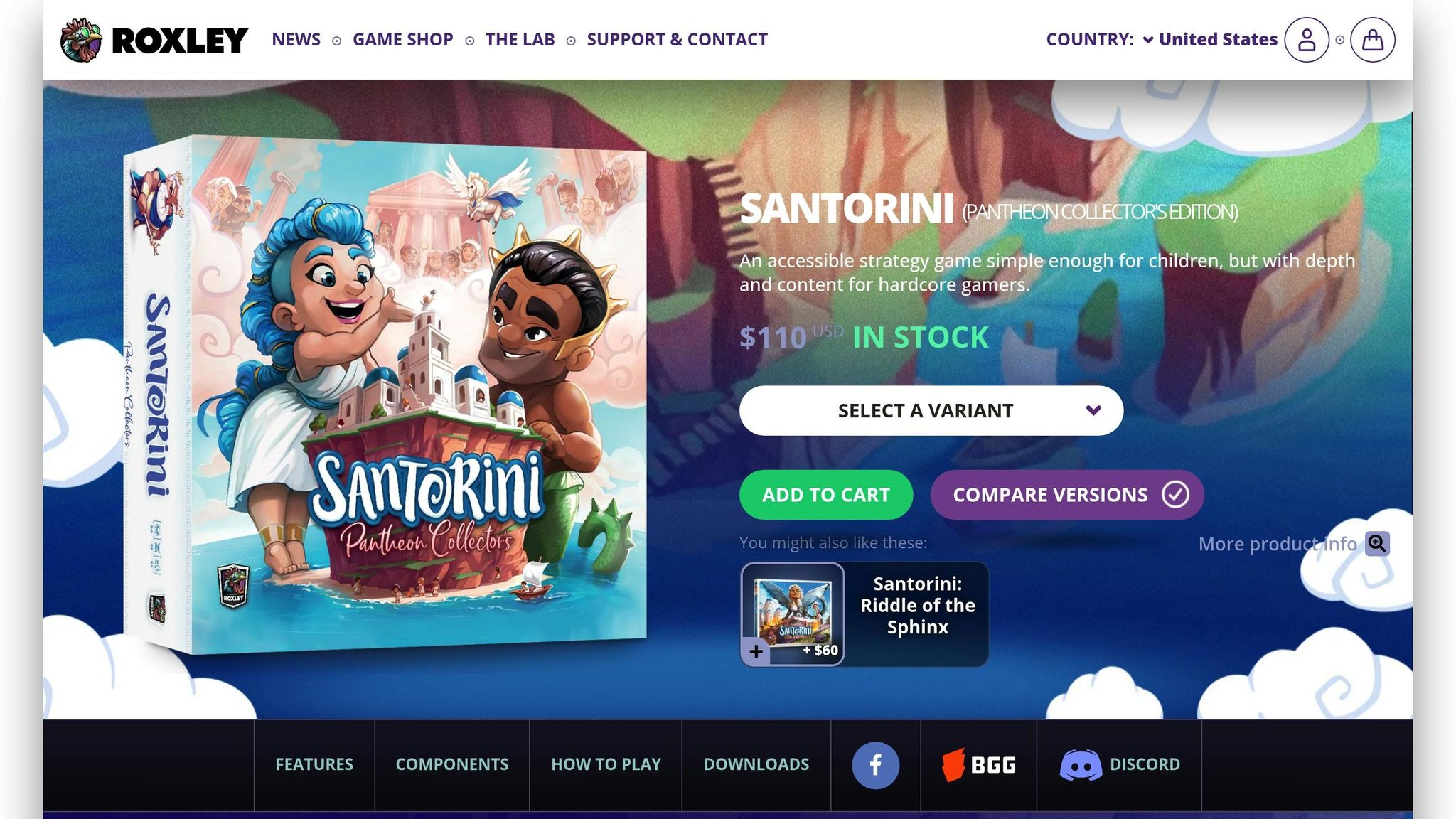
Santorini is a great example of how adding verticality to a game can completely change its strategy. The game features a 3D board made up of an Ocean Board, a Cliff Pedestal, and an Island Board. On this 5×5 grid, players stack blocks to create towers with three levels, capping them with domes. The goal? To move one of your workers to the third level of a tower, earning an instant win. However, there’s a catch: workers can only climb up one level per turn, though they can descend multiple levels.
Game developer Brandon Rollins captures the essence of Santorini perfectly:
"It's like chess on a tic-tac-toe board."
The addition of domes adds a layer of strategy by permanently blocking spaces. For instance, if your opponent is about to reach the third level, you can place a dome on that tower to stop them in their tracks. The game also incorporates God Power cards, which add unique abilities to each player, creating even more strategic possibilities - all within a quick 20-minute play session. Ranked among the top 100 board games, Santorini proves that multi-layered boards can balance simplicity with strategic depth.
While Santorini focuses on physical layers, other games achieve complexity through dynamic rule changes.
MINIFINITI's Red Tape: Humor Meets Strategy
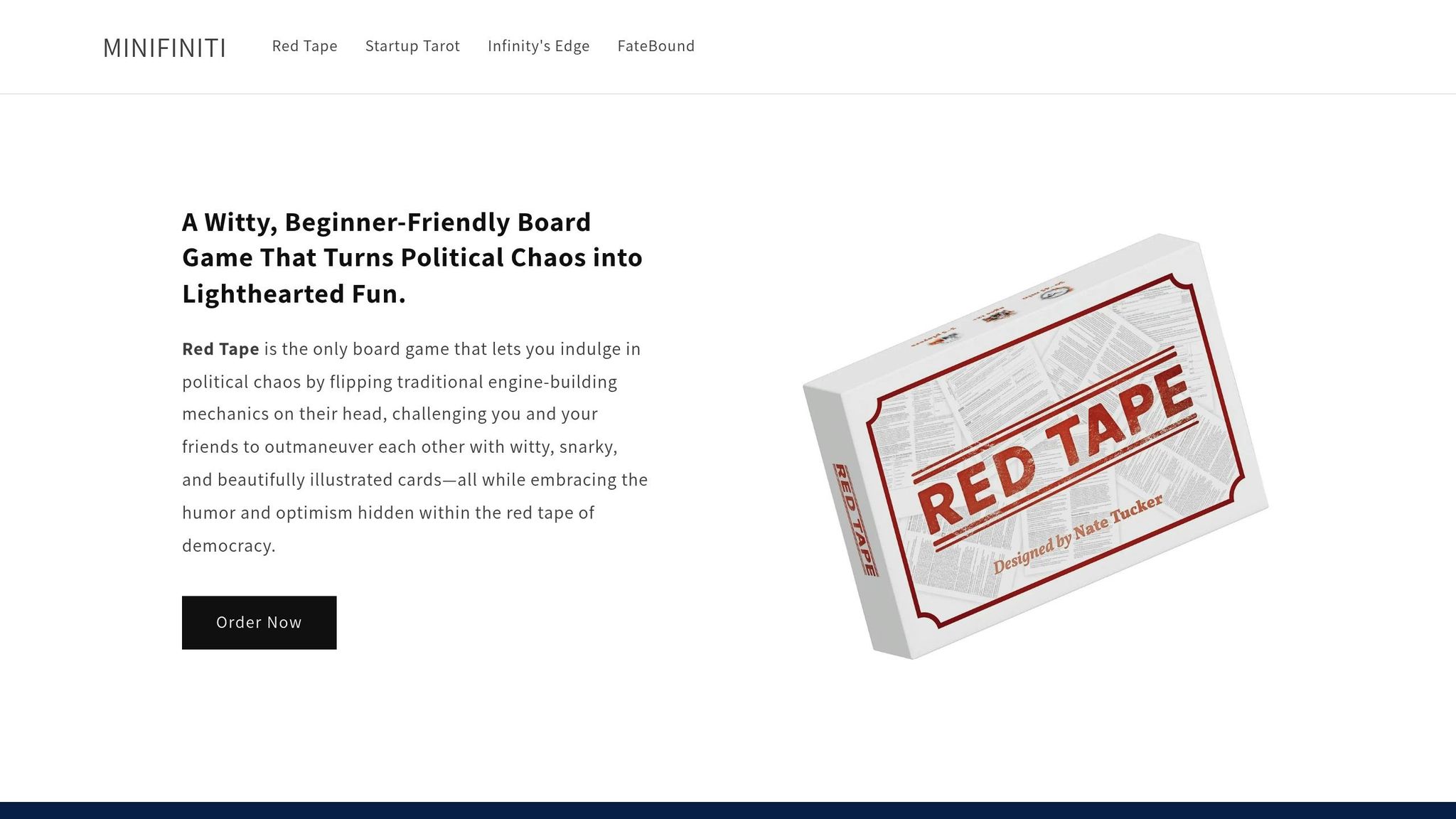
Unlike Santorini, which emphasizes physical layers, MINIFINITI's Red Tape introduces complexity through its mechanics. Instead of building your own strategy, this game flips the script with reverse engine building. The goal? To dismantle your opponents’ plans while navigating the chaos of bureaucracy. Department cards add layers of "red tape" by interrupting turns and altering the rules of play, making it increasingly difficult to use Policy cards.
The game’s dynamic design ensures that complexity grows naturally from player interactions rather than relying on physical board elements. With its blend of strategic depth and absurd humor - like dealing with ridiculous bureaucratic hurdles - Red Tape offers a unique and laugh-out-loud experience. The prototype is currently available for preorder at $39.99.
Conclusion
Multi-layered boards bring a fresh approach to tabletop gaming by breaking down complex information into layers that are easy to navigate, offering strategic depth without overwhelming players. Features like gravity-driven mechanics and recessed surfaces not only make gameplay smoother but also heighten the overall experience with tactile and visual elements that draw players deeper into the game.
These boards don’t just add layers to the gameplay - they also strengthen a game’s internal logic. From tower-building mechanics that reinforce rules to surfaces designed to keep components firmly in place, they make even intricate mechanics feel natural and accessible. This combination of thoughtful design and functionality transforms both the strategic and social aspects of gaming.
FAQs
How do multi-layered boards make tabletop games more engaging?
Multi-layered boards bring an exciting dimension to tabletop games by adding multiple levels or zones for players to explore and interact with. This setup pushes players to think strategically across various areas, opening up more avenues for thoughtful decision-making and long-term planning.
These boards often feature distinct pathways, zones, or objectives that shift based on player choices, ensuring every game session feels fresh and unpredictable. They also draw players deeper into the game by offering a visually engaging and tactically rich environment, sparking creativity and keeping everyone hooked. In short, multi-layered boards enrich gameplay by combining strategy, variety, and interaction into a more engaging and immersive experience.
What makes multi-layered game boards unique?
Multi-layered game boards bring a whole new dimension to tabletop gaming by combining multiple components or zones into one cohesive surface. These boards often use stacked or carved layers to create distinct spaces for player actions, resources, or unique game mechanics, adding depth and making gameplay more engaging.
This layered approach doesn’t just keep things organized - it also pulls players deeper into the game by highlighting its most important elements. With sturdy materials and imaginative designs, these boards provide a tactile and visually striking experience, making every gaming session more immersive and enjoyable.
How do multi-layered boards enhance gameplay and player engagement?
Multi-layered boards take tabletop gaming to the next level by introducing more complexity, strategy, and a deeper sense of involvement. These boards often incorporate multiple levels or sections, creating unique opportunities for dynamic gameplay. Features like elevated zones, hidden areas, or tiered layouts push players to think in three dimensions, encouraging more thoughtful and calculated moves.
But it's not just about strategy - multi-layered boards also make the game world feel more alive. Detailed designs with textured landscapes or intricate cityscapes pull players into the story, making the setting feel tangible and immersive. These visual elements don’t just look good; they also help direct attention and keep the gameplay flowing smoothly. By blending strategic depth with creative artistry, multi-layered boards transform tabletop games into truly engaging experiences.