
Progression Systems: Balancing Fun and Challenge
Progression systems in games are all about tracking growth and rewarding players over time. Whether it’s leveling up in RPGs, expanding territories in strategy games, or unlocking new content in campaign games, these systems keep players engaged by offering a mix of power upgrades and fresh options.
The key challenge? Finding the right balance. If progression feels too easy, players lose interest. If it’s too slow or punishing, frustration sets in. The best systems combine steady rewards with challenges that grow alongside player skills, ensuring the experience stays engaging.
Here’s a quick breakdown of progression types:
- Horizontal Progression: Adds variety by introducing new abilities or strategies without increasing raw power.
- Vertical Progression: Focuses on increasing stats, making players feel stronger over time.
- Cyclical/Reset-Based Progression: Resets progress periodically to keep things fresh and fair for everyone.
To design balanced progression systems, focus on pacing, align challenges with player growth, and gather feedback to refine the experience. Whether it’s a long RPG campaign or a quick party game, progression should support the core gameplay and keep players coming back.
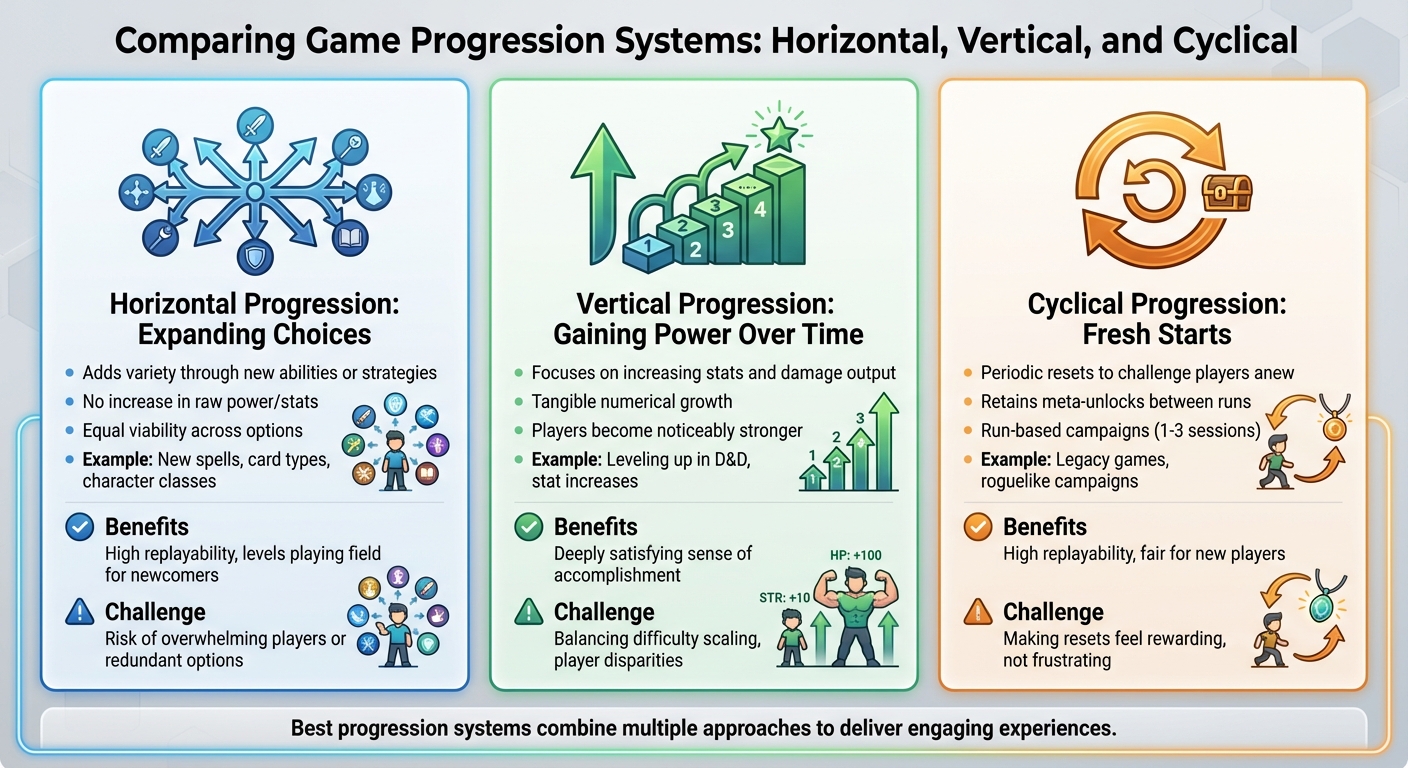
Three Types of Game Progression Systems: Horizontal, Vertical, and Cyclical
Leveling Up Progression Systems
Main Types of Progression Systems
Designing progression systems requires a mix of approaches to deliver unique experiences while keeping the game challenging and engaging.
Horizontal Progression: Expanding Choices
Horizontal progression introduces new abilities, roles, or strategies without increasing raw stats. Instead of simply growing stronger, players gain access to diverse options, each offering a unique way to play. The key is to ensure these choices feel distinct and equally viable, avoiding the trap of creating options that feel redundant or watered down.
For example, in tabletop RPGs, players might choose between spells with different purposes - one enhancing defense, another improving mobility. Card games and deck-builders often use horizontal progression by unlocking new character classes or card types, offering fresh strategies without relying on stat boosts. This approach expands the strategic landscape, keeping gameplay fresh and dynamic.
One major advantage is replayability. Players can experiment with different builds and playstyles without worrying about being underpowered. It also levels the playing field for newcomers, as everyone operates at a similar power level. However, designers must tread carefully - too many options can overwhelm players, or worse, result in choices that feel too similar to one another, diluting the sense of variety.
Shifting from diverse options to sheer power, vertical progression takes a different approach to growth.
Vertical Progression: Gaining Power Over Time
Vertical progression emphasizes numerical growth. Players experience a tangible sense of achievement as their stats climb, damage output increases, and they become noticeably stronger. It’s a classic model, particularly in games like Dungeons & Dragons, where progression is tied to leveling up, gaining power, and hitting major milestones.
The challenge lies in balancing this growth with the game’s difficulty. If enemies don’t scale alongside the players, earlier content becomes trivial. On the flip side, if enemies scale too aggressively, players might never feel the satisfaction of becoming more powerful. Striking the right balance is crucial to maintaining the sense of accomplishment.
The appeal of vertical progression is clear: it’s deeply satisfying to watch your character evolve from a novice into a powerhouse. But this approach isn’t without its pitfalls. It can create disparities between players, especially if someone joins late and struggles to catch up. Designers must constantly adjust encounters to ensure they remain engaging for all players, regardless of their progression level.
Some systems take an entirely different route by embracing resets to keep things fresh.
Cyclical and Reset-Based Progression
Cyclical progression introduces periodic resets to challenge players anew. This approach keeps gameplay replayable and ensures each run feels fresh. It also allows new players to jump in without feeling left behind, as resets level the playing field.
In tabletop games, this often takes the form of run-based campaigns. These short arcs, typically lasting one to three sessions, end with a reset while players retain certain meta-unlocks, like new character classes or permanent rule changes for future runs. Legacy-style games sometimes use partial resets, where some components are retired or transformed at the end of a chapter, while others carry over.
The challenge lies in making resets feel rewarding rather than frustrating. If players lose everything with no lasting benefits, resets can feel pointless. On the other hand, overly powerful meta-rewards can create new imbalances, undermining the reset’s purpose. The trick is to offer meaningful long-term bonuses that enhance future runs without overshadowing the current gameplay experience. Balancing these elements ensures resets feel like a fresh start, not a setback.
How to Design Balanced Progression Systems
Creating progression systems that encourage growth while keeping players engaged is no small feat. The key lies in striking the right balance - rewarding progress without overwhelming players. Let’s dive into how to pace progression and match challenges to player growth effectively.
Setting the Right Pace for Player Retention
The pace of progression can make or break a player's experience. If growth feels too slow, players may feel stuck in a grind; too fast, and they’re bombarded with options before mastering the basics. To keep players invested, introduce new elements gradually - one or two per session is ideal. This gives players enough time to absorb and internalize what they’ve learned before introducing additional layers of complexity.
Group minor upgrades into meaningful milestones to create a sense of accomplishment. For instance, rather than scattering small stat boosts, bundle them into tiers like novice, competent, and expert. These tiers should unlock new tactical options, such as area spells or reaction abilities in RPGs, or new unit types in strategy games. The goal is to offer fresh gameplay possibilities without trivializing earlier challenges. If a tier makes old content irrelevant or fails to noticeably impact gameplay, it’s either too strong or too weak.
Once you’ve established a balanced pace, the next step is to ensure the challenges evolve alongside player growth.
Matching Difficulty to Player Growth
As players become stronger or more skilled, the game’s challenges need to keep up. Scaling opposition isn’t just about increasing numbers - it’s about crafting encounters that push players to think and adapt.
Start by setting baseline stats for each tier, then refine them through playtesting. Track metrics like average rounds to defeat enemies, damage taken, and resource usage to fine-tune the balance. But don’t rely solely on numbers. Instead, vary encounter designs by introducing diverse enemy types that interact in ways requiring tactical adjustments. This keeps gameplay fresh and prevents players from relying on brute force alone.
Limit any single upgrade to a 25% boost in total damage output to avoid breaking the game’s balance. Test edge cases where players maximize power paths to ensure the system holds up. Also, consider the resource economy - how much currency, healing, or other resources players gain versus what challenges demand. To prevent fatigue, alternate intense encounters with easier “breather” moments. These pauses give players a chance to feel powerful, experiment with new abilities, and recharge for the next big test.
Finally, player feedback is essential for refining these systems.
Using Player Feedback
No matter how carefully designed, progression systems need player input to truly shine. Playtest data is invaluable, especially when paired with direct feedback. Ask players questions like, “Did you feel you progressed enough?” or “Did anything change too quickly?” to identify areas where pacing or difficulty might need adjustment.
Keep a campaign log to track player feedback on difficulty - whether encounters felt too easy, just right, or overly hard. Combine this with hard data, such as survival rates or resource usage, to identify patterns. If multiple groups struggle at the same point, it’s a sign your difficulty scaling needs tweaking. Conversely, if players breeze through sections meant to challenge them, progression may be outpacing difficulty.
A great example of this approach is MINIFINITI’s Red Tape. The designers used weekly game nights and player feedback to refine their progression system, ensuring it resonated with players. This kind of iterative process bridges the gap between theoretical design and real-world engagement, creating systems that keep players coming back for more.
sbb-itb-7b84150
Progression Systems Across Different Game Genres
Tabletop games come in all shapes and sizes, and their progression systems need to reflect that diversity. A year-long RPG campaign demands a very different approach than a casual party game. By aligning progression mechanics with a game’s core experience, designers can create systems that feel natural and engaging for players. Let’s explore how progression works across a few popular genres.
Role-Playing Games (RPGs): Character Growth Over Time
In RPGs, progression is all about character development. Players typically grow their characters through systems like experience points (XP), milestone leveling, or advancement-by-use. For example, Dungeons & Dragons 4th Edition breaks gameplay into heroic, paragon, and epic tiers, each offering new narrative challenges and scaling threats.
- Milestone Leveling: Advancement is tied to key story moments, making progression feel connected to the narrative.
- Advancement-by-Use: Skills improve naturally through repeated use, as seen in Call of Cthulhu and Burning Wheel.
A well-crafted RPG progression system balances vertical growth (increasing stats) with horizontal growth (unlocking new abilities or tactics). For instance, introducing a new area-effect spell just before a battle that highlights its potential can make the progression feel both satisfying and purposeful. This combination of narrative and mechanical growth is what keeps players invested in their characters' journeys.
While RPGs thrive on character arcs, strategy games take a different angle, rewarding players for their tactical decisions.
Strategy Games: Expanding Strategic Options
Progression in strategy games focuses on unlocking new tools and choices rather than simply making players more powerful. Systems like tech trees, research tracks, and resource management allow players to expand their strategic arsenal. The goal? Rewarding clever planning and tactical skill.
Rather than offering linear power increases, strategy games emphasize horizontal progression - introducing new unit types, technologies, or resource systems that broaden gameplay options. For example, players might face trade-offs between economic growth, military power, and technological advancement.
To keep the competition fair, designers often include mechanics like diminishing returns on upgrades or caps on vertical growth. This prevents early advantages from snowballing and ensures that players remain competitive throughout the game. The result is a progression system that encourages adaptability and rewards strategic thinking.
Party and Social Games: Keeping It Light and Fun
Party and social games have a completely different vibe. Here, progression systems need to be simple and self-contained, allowing new players to join in without feeling left behind. Instead of focusing on persistent power growth, these games prioritize shared experiences and fun moments.
Progression in this genre often comes in the form of unlockable content, like new card decks, changing roles, or escalating scenarios. For instance, Red Tape by MINIFINITI transforms engine-building into a fun, beginner-friendly experience built around witty card interactions. Through regular playtesting, the designers struck a balance that keeps the game accessible for newcomers while remaining fresh for returning players.
To maintain the focus on social interaction, any ongoing progression elements - like achievement trackers or log sheets for funny moments - are optional and non-intrusive. This ensures that the emphasis stays on creating memorable experiences rather than chasing numbers or stats.
Each genre’s progression system reflects its unique priorities, whether it’s character growth, tactical mastery, or social connection. By tailoring these systems to the core experience, designers can craft games that resonate deeply with their players.
Conclusion
Creating progression systems that strike the perfect balance between fun and challenge isn't a straightforward process - it demands a deep understanding of your players and the unique qualities of your game. Whether you're crafting an epic year-long RPG campaign or a fast-paced party game, the core principles remain the same: blend horizontal and vertical growth effectively, pace your challenges with care, and align progression with what makes your game enjoyable.
Key Takeaways for Designers
A well-rounded progression system combines vertical growth (boosting strength) and horizontal growth (unlocking new options). Vertical growth satisfies players by letting them feel stronger and tackle tougher challenges, while horizontal growth keeps things interesting by introducing fresh abilities, scenarios, or strategies.
Thoughtful pacing is just as important as the mechanics themselves. Design your difficulty curve to match player growth, ensuring new abilities feel impactful and purposeful. This balance keeps the game engaging without overwhelming or underwhelming players.
Player feedback is essential for fine-tuning progression systems. As mentioned earlier, ongoing input from your audience helps refine and improve your systems. For example, MINIFINITI actively involves their community to enhance games like Red Tape, ensuring progression remains accessible for newcomers while offering depth for seasoned players.
These principles are the building blocks for keeping players invested over time.
Building Long-Term Player Engagement
A great progression system fosters a strong connection between players and your game. When progression deepens the player's understanding of the game world, encourages creative strategies, and rewards tactical thinking, it transforms a single session into a memorable, ongoing experience. The classic RPG experience point system, for instance, was born because early D&D players wanted their characters to persist and grow - they were "having too much fun" to let the adventure end after just one game.
The most engaging progression systems inspire players to return, explore new strategies, and create lasting memories. Whether through campaign arcs, unlockable content, or evolving tactical choices, progression should enhance the core gameplay loop that makes your game stand out. Focus on offering meaningful choices rather than unnecessary complexity to maintain the delicate balance between fun and challenge that makes tabletop gaming so rewarding.
FAQs
How can game designers create progression systems that are enjoyable and fair for both beginners and experienced players?
To create progression systems that resonate with players of varying skill levels, it's important to focus on scalability and flexibility. Begin by setting up clear, attainable goals for newcomers. At the same time, introduce deeper layers of complexity to keep seasoned players engaged. This way, everyone stays hooked - neither overwhelmed nor bored.
Incorporating dynamic difficulty adjustments or optional challenges can make a big difference. These features let players tweak the game to match their abilities, ensuring a more personalized experience. And when it comes to rewards, aim for a balance. Both casual players and hardcore competitors should feel that their efforts are worthwhile and their progress matters.
Don’t skip playtesting. Gathering feedback from a wide range of players is crucial to refining the system. This helps strike the right balance between fun and challenge for everyone.
What’s the difference between horizontal and vertical progression in tabletop games?
Horizontal and vertical progression represent two different paths for players to advance in a game. Vertical progression is all about becoming stronger as the game goes on - think higher stats, more powerful abilities, or upgraded equipment. It gives players a sense of growth and accomplishment, especially as they overcome tougher challenges along the way.
Horizontal progression, however, takes a different approach. Instead of focusing on raw power, it introduces new options - like unlocking unique abilities, strategies, or tools. These additions don't necessarily make a character stronger but open up fresh ways to tackle the game. This keeps things interesting and encourages players to experiment and adapt.
Striking the right balance between these two systems is crucial in tabletop games. It ensures players feel rewarded for their efforts while keeping gameplay challenging and avoiding repetition or imbalance.
How do cyclical progression systems keep players engaged over time?
Cyclical progression systems keep players engaged by creating a repeating loop of achievements and challenges that evolve or reset over time. This approach ensures the gameplay stays engaging and rewarding, as players constantly have new goals to pursue while enjoying a sense of accomplishment.
Take tabletop games, for instance. Many of them rely on these systems, where players collect resources or unlock abilities during one phase, only to encounter fresh challenges in the next. This structure not only promotes strategic thinking but also keeps players invested in the game’s progression. By carefully balancing rewards and difficulty, these systems allow the fun and challenges to grow hand in hand, maintaining player interest over the long haul.