
How to Reward XP Without Breaking the Game
When it comes to rewarding XP in tabletop RPGs, balance is everything. Poorly designed systems can lead to grinding, uneven power levels, and players prioritizing combat over creativity. To keep your game engaging and fair, here’s what you need to know:
- Avoid Common XP Pitfalls: Combat-only rewards encourage "murderhobo" behavior, while uneven XP distribution can create tension and imbalance within the party.
- Use Better XP Models: Milestone leveling, objective-based rewards, and session-based XP are great alternatives to traditional systems, each offering different ways to control progression and encourage diverse playstyles.
- Practical Tips for XP Distribution: Reward group achievements over individual actions, align XP with desired behaviors (like exploration or problem-solving), and establish clear XP policies during session zero.
- Advanced Adjustments: Scale rewards by challenge difficulty, use streamlined XP calculations, and recognize non-combat contributions like character backstories or campaign journals.
Common XP Problems That Hurt Game Balance
Unequal XP Distribution
Uneven XP distribution can spark tension at the table. Some Game Masters (GMs) hand out bonus XP for things like "good roleplaying" or "clever ideas", but this often comes down to subjective judgment rather than clear, objective criteria. As The Angry GM puts it:
"There are ZERO good, rational reasons not to [evenly divide XP], even if some players miss some sessions or some characters miss some encounters."
This kind of imbalance can quickly spiral into bigger issues. Subjective XP awards often lead to math mistakes, slow down sessions, and discourage teamwork. For example, a thief might leave an injured ally behind to grab loot, prioritizing personal XP gains over group success. When players feel like their character growth is arbitrary or disconnected from their choices, it undermines their sense of agency and control.
Next, let’s look at how poorly aligned XP rewards can push players toward counterproductive behaviors.
Rewarding the Wrong Player Actions
The way XP is awarded directly influences how players approach the game. If you only hand out XP for combat, you're essentially teaching players that fighting is the only way to progress. The Angry GM explains:
"If I only award XP for killing monsters dead, I'm discouraging the players from sneaking past monsters, routing monsters, negotiating surrenders, or avoiding combats."
This leads to what’s often called "murderhobo" behavior - players focus solely on combat, ignoring stealth, problem-solving, or roleplay because these actions don’t offer tangible rewards. Similarly, systems that tie XP to gold can shift the group’s focus entirely to hoarding wealth. Instead of engaging with the story or tackling major conflicts, players may prioritize looting and farming treasure.
These misaligned incentives can also lead to uneven power dynamics as characters level up too quickly for their players to fully grasp new abilities.
Out-of-Control Power Curves
When characters level up too fast, players often struggle to master their new abilities. The Angry GM suggests that players should spend at least two sessions at each level - one to learn their new skills and another to use them confidently. If progression happens too quickly, players may feel overwhelmed and unprepared, which can throw off their ability to manage resources effectively.
Exponential growth also creates imbalances within the party. For instance, in Dungeons & Dragons, high-level wizards can eventually take over the roles of other party members, leaving specialized characters feeling unnecessary. A survey on the r/DnD subreddit revealed that 86% of players prefer milestone leveling over traditional XP systems because it gives GMs more control over pacing. Additionally, when party members have vastly different power levels due to uneven XP distribution, it becomes nearly impossible to design encounters that are challenging for everyone.
Keeping progression balanced is essential for maintaining an engaging and fair gameplay experience.
Better XP Models for Balanced Progression
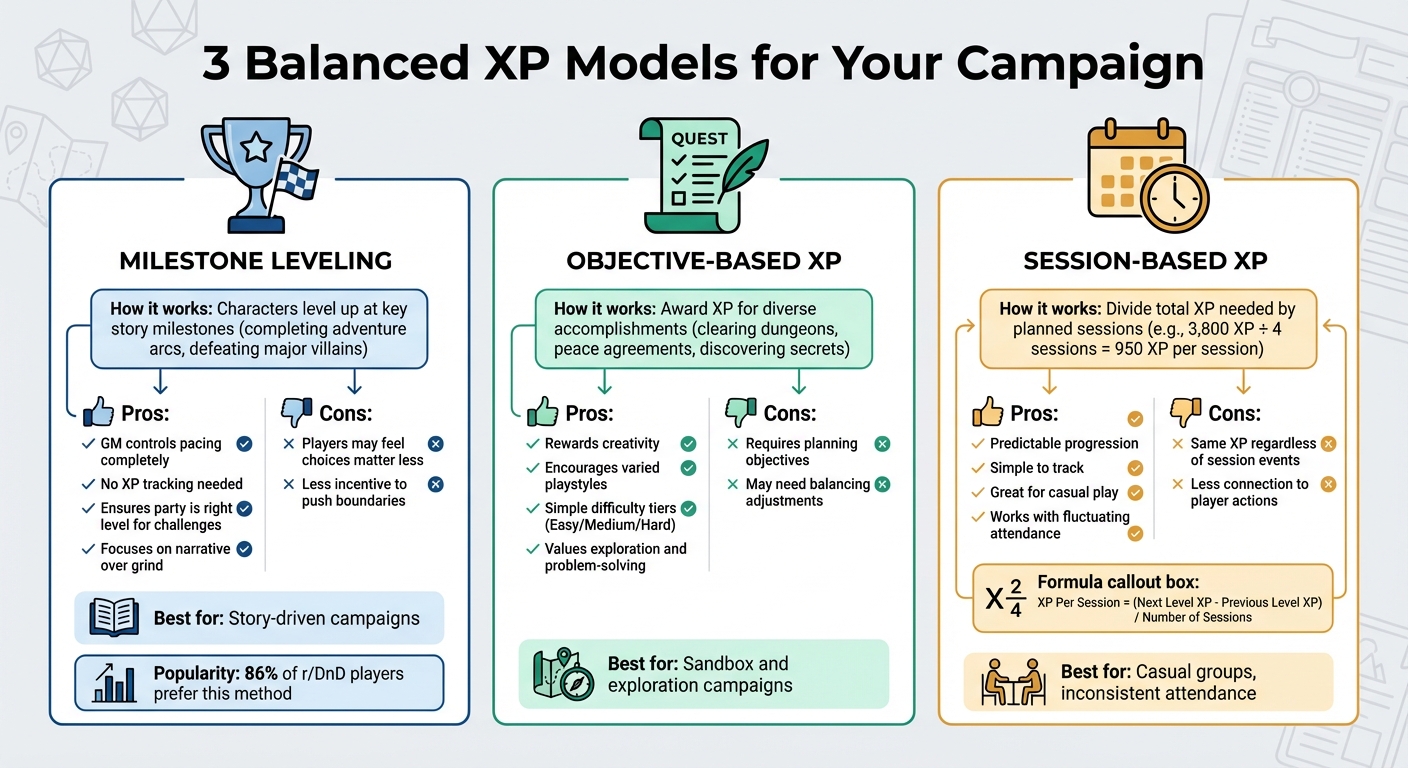
XP Models Comparison: Milestone vs Objective-Based vs Session-Based Leveling
If you’re tired of the usual XP pitfalls, switching to alternative models can bring balance and excitement to your game’s progression system. Let’s explore some options that shift the focus from grind-heavy gameplay to meaningful advancement.
Milestone Leveling
With milestone leveling, you skip the hassle of tracking XP altogether. Instead, characters level up when they hit key story milestones, like wrapping up an adventure arc or taking down a major villain.
This method gives you complete control over pacing. It ensures your party is at the right power level for upcoming challenges, avoiding the problem of players grinding their way to overpowered status. Plus, it shifts the emphasis from repetitive combat to advancing the narrative, keeping the game flowing smoothly.
However, there’s a potential downside: players might feel that their individual choices matter less. As Tim Sutherland from Nerdarchy puts it:
"If players smell the promise of XP, they'll often chase it. Conversely, if they know that their leveling is more or less preset, there's less incentive for them to push the boundaries".
For more flexibility, you could incorporate point-based milestones, assigning specific XP values to major story achievements.
Objective-Based XP Awards
Unlike milestone leveling, which ties progress to big narrative beats, objective-based XP rewards a broader range of accomplishments. Players can earn XP for diverse challenges - clearing a dungeon, brokering a peace agreement, or uncovering ancient secrets. This model encourages creativity and rewards players for thinking outside the box.
To keep things simple, you can categorize objectives by difficulty - Easy, Medium, or Hard - rather than calculating XP based on individual monster stats. For campaigns that lean heavily on exploration, you might award XP for actions like decoding ancient texts, identifying artifacts, or piecing together environmental clues. This approach deepens engagement with the game world and values a variety of play styles.
Session-Based XP Gains
If you’re looking for a steady and predictable progression system, session-based XP gains might be the way to go. Here’s how it works: divide the XP needed to level up by the number of planned sessions. For example, if players need 3,800 XP to advance and you plan four sessions, award 950 XP per session. This ensures a consistent progression pace, making it ideal for casual play or groups with fluctuating attendance.
Mike Shea recommends this method, saying it works well "when milestone experience seems too abstract and full experience rewards take too much work". The trade-off? The XP reward remains the same regardless of what happens during the session. Whether your players slay a dragon or spend the evening planning their next move, the XP doesn’t change.
Practical Tips for Awarding XP
Now that we've covered balanced XP models, let's dive into some practical tips to bring those systems to life in your game.
Reward Group Achievements Over Individual Actions
When it comes to awarding XP, keeping things fair and collaborative is key. Split XP evenly among all party members, even if some players missed a session or their characters sat out certain encounters. This avoids unnecessary math headaches, keeps the game flowing smoothly, and prevents competitive behavior at the table.
If a player has a standout moment - like pulling off a clever plan or delivering a perfectly timed joke - reward the entire group for it. This encourages everyone to stay engaged and reinforces the idea that the game is a team effort. Plus, it allows quieter players to feel just as valued, creating a more inclusive and collaborative gaming environment. This group-centered method naturally ties into rewarding the creative strategies you want to see in your campaign.
Align XP with Desired Play Behaviors
XP isn't just a reward - it's a tool for shaping how your players approach the game. If you only hand out XP for combat, you might find your players leaning toward solving every problem with violence. To encourage more creative approaches, reward XP for alternative solutions like negotiation, stealth, or other inventive strategies.
You can also inspire exploration by granting XP for discoveries. Whether it's deciphering ancient texts, identifying a mysterious artifact, or piecing together environmental clues, these rewards make exploration feel just as rewarding as combat. This approach creates a balance, showing players that clever, out-of-the-box thinking can drive character growth just as much as swinging a sword.
Establish Clear XP Policies
Set expectations from the start by discussing XP rules during session zero. Be upfront about what earns XP in your campaign - whether it’s combat, social interactions, exploration, or a mix of all three. This transparency ensures everyone knows the rules and avoids misunderstandings. Tim Sutherland from Nerdarchy highlights the importance of fairness:
"Using XP as a reward for individual feats or role-playing can be gratifying... but can also make others feel left out or like they aren't as important".
To keep things organized, you might assign a player to track the group's XP during sessions. Wrapping up each session with a quick XP recap - highlighting key victories and memorable moments - can also help reinforce the connection between player actions and rewards. This not only keeps everyone on the same page but also builds excitement for your next adventure. Clear and consistent policies are the backbone of a fair and engaging campaign.
sbb-itb-7b84150
Advanced XP Adjustments for Experienced Game Masters
If you’re a seasoned Game Master looking to fine-tune your campaign, these advanced XP adjustments can help you align progression with your campaign's unique challenges and player dynamics. By tweaking how XP is awarded and distributed, you can create a more balanced and engaging experience for your players.
Adjusting Progression Curves
The pace at which your players level up can define the rhythm and tone of your campaign. D&D 5e typically uses an exponential curve, where each level demands significantly more XP than the last. This system works well for campaigns designed to span many sessions, giving players time to explore each power tier thoroughly.
For shorter campaigns or scenarios where maintaining level parity is key, a session-based approach might be more effective. You can calculate XP per session using this formula:
XP Per Session = (Next Level XP - Previous Level XP) / Number of Sessions.
This method ensures that lower-level characters can catch up more quickly. As Mike Shea from Sly Flourish explains:
"While players who miss sessions will never have as many experience points as those who play all the time, they will still catch up quickly since the amount of experience rewarded each session goes up".
It’s also crucial to give players time to fully explore their new abilities. The Angry GM advises:
"Players should spend two sessions at every level. During the first session, they are all shaking out their new abilities... By the next session, they are comfortable with their new abilities".
If you rush players through levels too quickly, they might miss out on understanding their characters' full potential.
Scaling XP Rewards by Challenge Difficulty
Rather than calculating XP for each individual monster, you can simplify things by using a fixed XP amount based on a medium-difficulty encounter per player character (PC). This streamlined method lets you focus on storytelling while still rewarding players appropriately. Consider these guidelines:
- Award full XP for clear victories.
- Give half XP for tough wins where the party struggles significantly.
- Assign no XP for outright failures.
Here's how to scale XP based on the quality of the victory:
"If the party barely wins... I will only give them half the XP. If half the party ended the encounter unconscious... or the party had to burn a lot of resources to get through".
| Award Type | XP Multiplier | When to Use |
|---|---|---|
| Standard Award | 1.0x | Clear victory in a planned encounter |
| Major Milestone | 2.0x | Completing a primary adventure goal |
| Half Award | 0.5x | Pyrrhic victory or bypassing threats |
| Zero Award | 0x | Failure or resource-drain encounters |
For expansive environments like megadungeons, you can assign flat XP values based on level ranges. For example, all encounters for levels 1–4 might be worth 50 XP, regardless of the specific monsters involved. This approach simplifies bookkeeping and keeps the party within a balanced power range.
Rewarding XP for Downtime and Meta-Goals
XP rewards don’t have to come solely from combat or traditional encounters. You can also recognize player-driven contributions that enhance the campaign. For example, reward players who:
- Maintain a campaign journal.
- Create character art.
- Develop rich, detailed backstories.
These contributions allow quieter players to shine and add depth to the game world.
To avoid creating power gaps, consider awarding the entire group a bonus when one player makes an exceptional contribution. For balance, you can cap meta-reward XP - such as limiting these bonuses to 3 points per session. Alternatively, you could offer non-XP rewards like inspiration tokens or re-roll dice. These options encourage engagement without inflating character power.
Another way to reward exploration and creativity is by assigning XP for discoveries. For instance, translating ancient texts, identifying religious artifacts, or uncovering hidden lore can all earn XP. This not only incentivizes players to interact with the world in non-combat ways but also deepens their connection to the story.
Conclusion: Keeping Your Game Balanced While Rewarding XP
An XP system isn’t just a tool for tracking character growth - it’s a way to shape how players interact with your campaign. As The Angry GM explains, "Experience points are actually a psychological trick designed to help players associate certain game events with victory in order to help them create lasting impressions." By rewarding the behaviors you want to see - whether it’s exploration, clever problem-solving, or teamwork - you naturally encourage players to embrace those playstyles.
For example, in a campaign focused on political intrigue, it makes sense to reward XP for uncovering secrets or forming alliances instead of just handing it out for combat wins. When XP aligns with the goals of your campaign, players are less likely to treat every encounter as a battle and more likely to engage with the story on a deeper level.
Striking the right balance is key. Challenges shouldn’t be so easy they’re dull or so difficult they become frustrating. As The Angry GM puts it, "The best games aren't the ones that are perfectly balanced, but the ones that have a bit of wobble to the balance... proper balance should keep the game from going into the so easy it's boring or so hard it's frustrating territories." Regularly checking in with your players can help you fine-tune this balance. If things feel too easy, you might tighten up XP rewards. If progression feels like a slog, consider adding subgoals or tying XP to discoveries to keep things engaging.
These tweaks, combined with open communication, ensure your XP system stays as dynamic as your campaign itself.
On top of balanced rewards, having clear XP policies builds player trust. Systems that clearly show progress help players connect their choices to their character’s growth. Wrapping up sessions with recaps of XP earned reinforces that sense of progress and sets the stage for the next adventure, keeping everyone excited for what’s ahead.
FAQs
How can I balance XP rewards to encourage different playstyles?
To promote a variety of playstyles, think of XP as a tool to reward the actions and behaviors you want to encourage - not just a tally for combat victories. Start by creating a few reward categories, such as Combat (e.g., standard XP for defeating enemies), Role-Playing (e.g., making impactful, character-driven choices), Exploration (e.g., uncovering hidden areas or lore), and Creative Problem-Solving (e.g., resolving situations without violence). Set a baseline XP value for combat encounters, then offer comparable or slightly higher rewards for these other categories to signal their equal importance.
For balance, consider using milestone or session-based XP as a backup system. For instance, you could grant a lump sum of XP when the group hits a major narrative milestone, adjusting the amount based on how varied their contributions were. Regularly check in with your players for feedback and fine-tune the XP distribution to ensure no single playstyle overshadows the rest.
Beyond XP, spice things up with other rewards like treasure, unique titles, or story-based perks. For example, players who broker a peace treaty might earn a special title, while dedicated explorers could uncover rare maps or hidden secrets. This combination of incentives keeps gameplay fresh and balanced, motivating players to experiment with different strategies while maintaining steady progression.
What are the advantages of milestone leveling compared to traditional XP systems?
Milestone leveling streamlines the game by eliminating the need to track experience points (XP). Instead, the Dungeon Master grants level-ups during pivotal story moments. This approach removes the grind of earning XP through repetitive encounters and ties character growth directly to the narrative's progress.
With milestone leveling, every character levels up at the same time, ensuring balanced progression across the party. This keeps the focus on role-playing, exploration, and creative problem-solving, rather than encouraging players to prioritize combat just to rack up XP. The result? A more immersive, story-driven adventure that engages the whole group.
How can I keep XP rewards fair and avoid player conflicts?
To ensure XP distribution remains fair and avoids unnecessary conflicts, it's essential to start by setting clear ground rules. Decide upfront how XP will be awarded - whether it’s per session, tied to milestones, or based on specific behaviors - and communicate these guidelines to your players. For example, awarding a flat amount of XP at the end of each session can shift the focus toward group participation rather than individual performance. On the other hand, tying XP to story milestones can encourage teamwork and reduce competition over combat-related rewards.
You might also want to introduce alternative rewards to recognize contributions beyond combat. Small XP bonuses, unique items, or narrative perks like reputation boosts can highlight role-playing, problem-solving, or creative ideas. Another option is to use a system where players earn narrative tokens for pursuing personal goals. These tokens can later be exchanged for XP or other in-game benefits, adding a layer of personalization to the rewards.
Transparency and consistency are key to keeping things fair. Keep track of the group’s accomplishments and distribute XP either evenly or based on the agreed-upon criteria at the end of each session. By focusing on shared successes and rewarding a variety of contributions, you can create an environment where cooperation thrives and everyone has fun.