
How Simple Rules Enhance Game Flow
Minimalist rule systems in tabletop games focus on simplicity, cutting unnecessary complexity to keep gameplay smooth and engaging. These systems often rely on a single resolution mechanic that handles all scenarios, reducing the need for constant rule lookups. By focusing on core mechanics, they eliminate subsystem overload, shorten learning curves, and allow players to dive into storytelling and decision-making without distractions.
Key takeaways:
- Unified rules: One core mechanic for all actions (e.g., combat, exploration).
- Faster learning: Single-page rules help new players start quickly.
- Improved flow: Reduced interruptions and quicker resolutions keep the game moving.
- Creative freedom: Players focus on the story, not technicalities.
Examples of minimalist games include Index Card RPG, EZD6, and MINIFINITI's Red Tape, all of which prioritize simplicity without sacrificing depth. These systems prove that streamlined mechanics can deliver immersive and enjoyable gaming experiences.
Designing minimalist RPGs with Binary Star Games
Core Principles of Simple Rules
Creating a minimalist rule system is all about stripping down to the essentials - keeping just the mechanics that drive gameplay forward. These mechanics are designed to handle a variety of situations smoothly. At its heart, this approach relies on three main ideas: using a single, unified resolution method, ensuring that method can adapt to different scenarios, and steering clear of adding complicated subsystems for every niche situation. Together, these principles create a framework for seamless and engaging gameplay.
Unified Core Mechanics
A single, unified mechanic simplifies everything - from combat to social interactions. Take games like Cairn and 24XX, which use an easy-to-grasp D6 system to resolve outcomes. This eliminates the need to constantly refer to different rule sections, making gameplay faster and less mentally taxing. The simplicity also allows these rules to fit on a single page, making it easy for new players to jump in. Similarly, minimalist RPGs like Risus demonstrate how streamlined systems can shift the focus from crunching numbers to crafting stories. Next, let’s look at how adaptability enhances these systems even further.
Flexibility and Adaptability
With a unified system in place, flexibility ensures the rules can handle a variety of in-game challenges. Instead of creating separate mechanics for every scenario, a flexible system adapts by framing challenges within the same core rules. For example, MINIFINITI’s Infinity's Edge maintains simplicity while tackling complex concepts like Hilbert's Hotel or Zeno's Arrow. It achieves this by reinterpreting existing mechanics rather than piling on new ones. By equipping players and GMs with tools to fill in the gaps dynamically, the system remains accessible and avoids unnecessary clutter.
Avoiding Subsystem Overload
Subsystem overload happens when designers create specific rules for every possible situation - combat, skills, social interactions, magic, vehicles, and more. This approach often leads to bloated rulebooks, as seen in non-minimalist games like Savage Worlds or BRP, which can span 300 to 400 pages before even touching adventure content. Such complexity can bog down gameplay, with players spending more time debating rules than immersing themselves in the story. On the other hand, minimalist systems like Mörk Borg focus on core actions, keeping gameplay snappy and intuitive. By relegating specialized rules to optional modules, these games provide a toolkit that prioritizes player creativity over mechanical complexity.
Benefits of Minimalist Rules for Game Flow
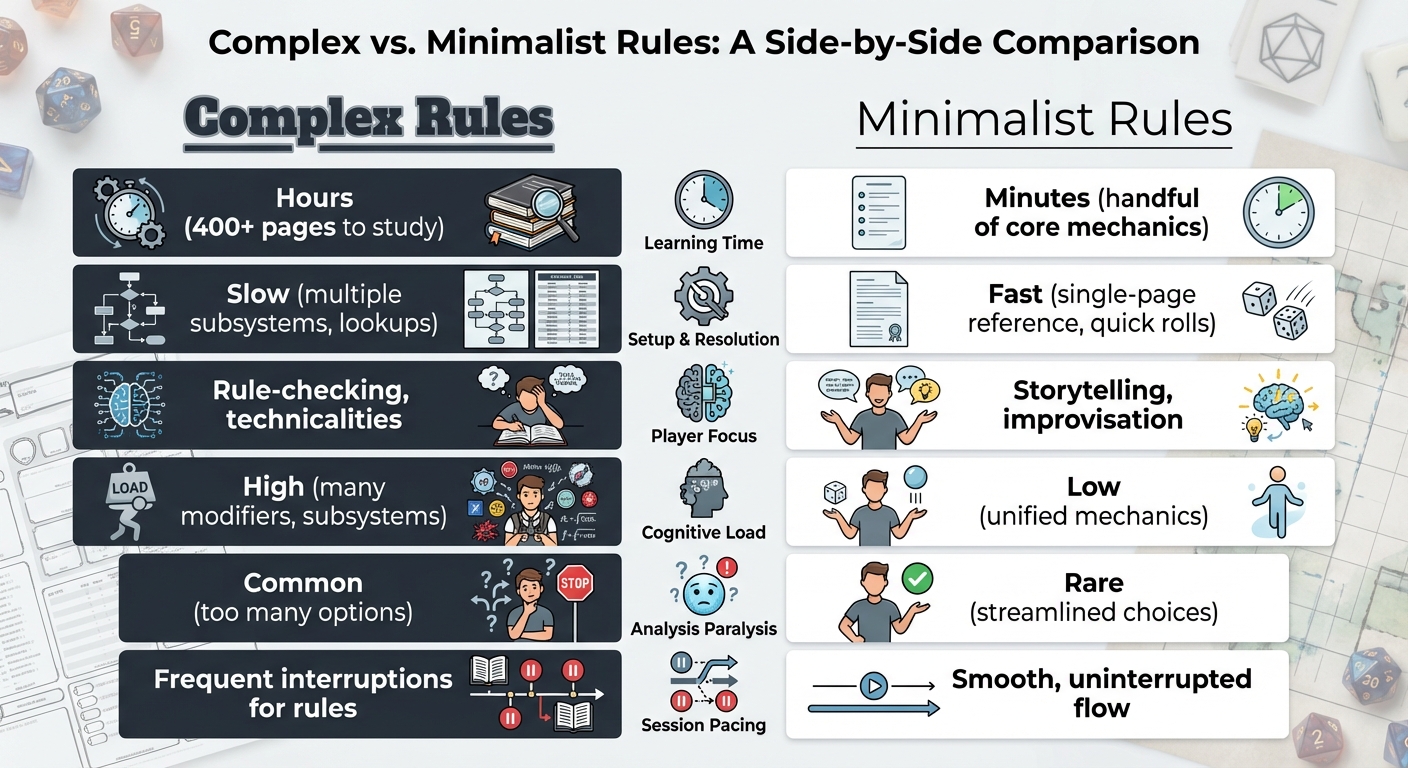
Complex vs Minimalist RPG Rules Comparison
Minimalist rules bring immediate advantages to gameplay by cutting out unnecessary complexity. This approach allows players to spend less time flipping through rulebooks and more time immersed in the story. With faster resolutions and clearer decisions from the get-go, streamlined mechanics ensure smoother sessions without the burden of subsystem overload.
Faster Learning Curve
Games like Cairn and Knave are perfect examples of how minimalist designs can dramatically shorten the learning process. Thanks to single-page rule summaries, new players can grasp the basics in minutes, bypassing the need to study dense, 400-page manuals. This accessibility is a game-changer - many groups report starting sessions up to 50% faster compared to traditional RPGs, diving straight into the action without tedious tutorials. Similarly, MINIFINITI's Red Tape embraces this philosophy, offering a beginner-friendly experience that tackles complex themes with simple, streamlined rules.
Reduced Analysis Paralysis
Too many options can overwhelm players, leading to decision fatigue and stalled gameplay. When faced with endless modifiers, bonuses, and subsystems, players may freeze up, spending more time debating their next move than actually playing. Minimalist systems like 24XX sidestep this issue entirely by removing granular math. Quick dice rolls replace multi-step calculations, keeping the game flowing and preserving immersion. With fewer interruptions for rule consultations, players can make confident, decisive choices, resulting in a more engaging and fast-paced experience.
More Player Freedom
Streamlined mechanics don't just speed things up - they also open the door to greater creativity and collaboration. With fewer rules to memorize, players can focus on storytelling instead of technicalities. Games like Risus and Over the Edge/WaRP strike a balance between structure and flexibility, offering just enough guidance to keep everyone on the same page without stifling improvisation. This freedom encourages players to come up with inventive solutions, roleplay more naturally, and contribute to the narrative without being bogged down by stat optimization. The mechanics fade into the background, letting the story take center stage.
Comparison Table: Complex vs. Minimalist Rules
| Aspect | Complex Rules | Minimalist Rules |
|---|---|---|
| Learning Time | Hours (400+ pages to study) | Minutes (handful of core mechanics) |
| Setup & Resolution | Slow (multiple subsystems, lookups) | Fast (single-page reference, quick rolls) |
| Player Focus | Rule-checking, technicalities | Storytelling, improvisation |
| Cognitive Load | High (many modifiers, subsystems) | Low (unified mechanics) |
| Analysis Paralysis | Common (too many options) | Rare (streamlined choices) |
| Session Pacing | Frequent interruptions for rules | Smooth, uninterrupted flow |
sbb-itb-7b84150
Designing Streamlined Mechanics
Turning theoretical principles into practical gameplay starts with crafting streamlined mechanics. The idea is to create a structure where players can dive into strategy and storytelling without being overwhelmed by dense rulebooks or overly complex systems. Here’s how to design mechanics that stay simple yet engaging.
Start with One Core Mechanic
The foundation of any game is its core mechanic - a single resolution system that handles most in-game scenarios. For instance, you might use something like "roll 1d20 + relevant trait vs. target number" or "roll a dice pool, count successes." This approach can cover everything from combat to social interactions with minimal tweaks. The key is to keep it quick, easy to remember, and adaptable to various gameplay elements like exploration and negotiation.
To ensure your core mechanic works, test it across 20–30 typical actions - think fighting, sneaking, or researching. If it can handle 80–90% of these situations without needing extra rules, you’re on the right track. If not, watch out for subsystem creep, where additional rules start piling up. Ideally, your core mechanic should be simple enough to fit on a single reference card.
Use Visual or Simplified Tracking
Instead of relying on traditional character sheets or long lists of resources, consider using visual tools to track status and progress. Slot-based inventories, tokens, or beads can make it easier to manage elements like hit points, stress, or other resources. These tools are especially handy for casual game nights where quick adjustments keep the game moving.
Progress bars, such as 4- or 6-segment clocks, can visually represent progress or danger. For example, filling in a segment after each key action gives players an immediate sense of how close they are to success - or failure. In the U.S., designers often use poker chips or coins as resource markers because they’re inexpensive, familiar, and easy to handle. Games like MINIFINITI’s Red Tape take this a step further with beautifully illustrated cards that simplify gameplay while enhancing the experience.
Focus visual tracking on elements that frequently change and are strategically important, such as health, initiative, or shared resources. If players keep asking, “How many of X do I have left?” it’s a sign that a visual tracker might help. On the other hand, details that rarely change can stay abstract to avoid clutter. These tools work hand-in-hand with your core mechanic, ensuring smooth gameplay and paving the way for productive playtesting.
Iterate Through Playtesting
Short, focused playtests - lasting 60–90 minutes with 3–5 players - are essential for refining your mechanics. Each session should focus on a specific design question rather than testing the entire system at once. Set clear metrics beforehand, such as how long it takes to resolve an action or how often players need to consult the rulebook.
After the session, debrief with the players. Ask questions like, “Was there a moment when you had to stop and figure out the rules?” or “Which parts of your character sheet did you ignore?” This feedback can highlight areas where the mechanics feel clunky or unclear. For pacing issues, ask if turns felt too long - especially important in the U.S., where game sessions often need to fit into a few hours.
Use the feedback to make small adjustments between playtests. If a rule doesn’t add to the fun or outcomes, consider cutting it or turning it into an optional variant. Simplification doesn’t mean losing depth; it’s about keeping meaningful choices like risk versus reward or narrative consequences while avoiding unnecessary complexity. When players can make strategic decisions without pausing to decode the rules, you’ve likely struck the perfect balance between clarity and depth. Focused playtesting ensures your mechanics deliver the fast, engaging experience that minimalist systems aim to achieve.
Examples of Games with Minimalist Systems
Index Card RPG

Created by Runehammer Games, Index Card RPG (ICRPG) proves that you don’t need a thick rulebook to run a game. In fact, the entire system can fit on a single index card. The core mechanic is refreshingly simple: roll a d20, add your effort, and compare it to a scene’s target number (usually between 10 and 15). Whether you’re battling a monster, sneaking past guards, or haggling with a merchant, the same rule applies. This streamlined approach eliminates the constant question of “What’s the DC?” since the game master sets just one target number per scene. As a result, gameplay flows more smoothly and keeps everyone focused on the action. With over 10,000 downloads in its early years and a stellar 4.8/5 rating on DriveThruRPG, ICRPG has been praised as the "gold standard for minimalist flexibility" by EN World.
EZD6
Released in 2023 by Barrel Rider Games, EZD6 is another shining example of a minimalist system that prioritizes quick and engaging play. Like ICRPG, it trims away unnecessary complexity. Players roll a pool of three to five d6s, taking the two highest results and comparing them to a target number, typically between 6 and 10. The beauty of EZD6 lies in its simplicity - its entire ruleset fits on just one page. Combat, exploration, and social interactions are all handled with the same straightforward mechanics, avoiding the need for intricate calculations. Playtests have shown that sessions run at twice the speed of Dungeons & Dragons 5th Edition, making it a great choice for groups who value efficiency. With a 4.9/5 rating on itch.io from over 1,200 reviews, EZD6 was even nominated for a 2024 ENNIE Award for Best Rules. One standout feature is how poor rolls introduce narrative twists rather than stalling the game, ensuring the story keeps moving forward.
MINIFINITI's "Red Tape"
Taking minimalist design into the realm of board games, MINIFINITI's Red Tape offers a clever and comedic take on political bureaucracy. The game revolves around a few straightforward actions - submitting forms, blocking requests, and rerouting approvals - that players can grasp in minutes. Strategy comes from deciding how to allocate limited resources and choosing who to support or obstruct, rather than mastering complicated systems. The humor of Red Tape shines through its depiction of absurd office scenarios and bureaucratic chaos, making it both relatable and entertaining. Illustrated cards make the rules instantly clear, so players can dive right into the fun. By blending simple mechanics with strategic depth and social interaction, Red Tape has become a favorite at MINIFINITI’s weekly game nights, where the focus is on connection and immersive experiences.
Conclusion: Why Simplicity Wins
Minimalist rule systems have a way of transforming tabletop gaming by lightening the mental load and allowing players to zero in on what truly matters - the story, the strategy, and the shared adventure. With single-page mechanics, there’s no need for constant rulebook interruptions. This streamlined setup means players can pick up the game quickly and jump straight into the action, avoiding the dreaded "analysis paralysis."
The power of simplicity lies in how it encourages player creativity and collaborative storytelling. Instead of getting bogged down in endless calculations, players are free to make bold decisions and interact with each other in more dynamic ways. Games like Cairn and Into the Odd are perfect examples of how concise, one-page rule systems can deliver unforgettable gaming experiences by shifting the focus from technicalities to immersive narratives.
Creating minimalist systems is no small feat - it’s about cutting out unnecessary complexity while still keeping the gameplay engaging and strategic. Take MINIFINITI's Red Tape, for instance. It’s a great example of how a simple framework can still offer plenty of depth and room for strategy.
For both game designers and game masters, the takeaway is obvious: clear, straightforward rules reduce confusion and enhance gameplay. This approach minimizes downtime, boosts replayability, and ensures that the most memorable moments come from the story and the players - not debates over the rulebook. Whether you’re hosting a quick one-shot or diving into a long campaign, minimalist mechanics keep the energy high and the fun front and center.
FAQs
How do simple rule systems improve storytelling in tabletop games?
Simple rule systems make storytelling smoother by cutting down on complexity, letting players and Game Masters (GMs) concentrate on the story and character interactions. By keeping mechanics simple, these systems open the door for more creativity, improvisation, and emotional depth during gameplay.
This simplicity allows stories to unfold more naturally, even in fast-changing or unexpected situations. Players can dive fully into the game world without getting bogged down by complicated rules, creating a more engaging and cooperative experience for everyone involved.
What are the key challenges in creating a single core mechanic for a game?
Designing a single core mechanic is no small feat - it’s all about finding that sweet spot between simplicity and depth. The best mechanics are those that players can grasp quickly but still offer enough layers to keep them hooked for the long haul.
Some of the biggest hurdles? Making sure the mechanic feels natural to players, steering clear of too much randomness that might overshadow skill, and keeping the overall game from becoming too complicated. The challenge lies in crafting a system that remains enjoyable and rewarding without leaving players feeling lost or frustrated.
How do visual tracking tools enhance gameplay in minimalist tabletop games?
Visual tracking tools enhance the experience of minimalist tabletop games by providing clear, straightforward indicators for game states, progress, and resources. These aids cut down on the mental load, letting players concentrate on strategy and decisions rather than getting tangled in overly complex mechanics.
By presenting information in a simple and intuitive way, these tools keep gameplay smooth and immersive. They help maintain the game's rhythm, reducing interruptions caused by confusion or overly intricate rules.