
Game Talk
How Tabletop Games Improve Problem-Solving
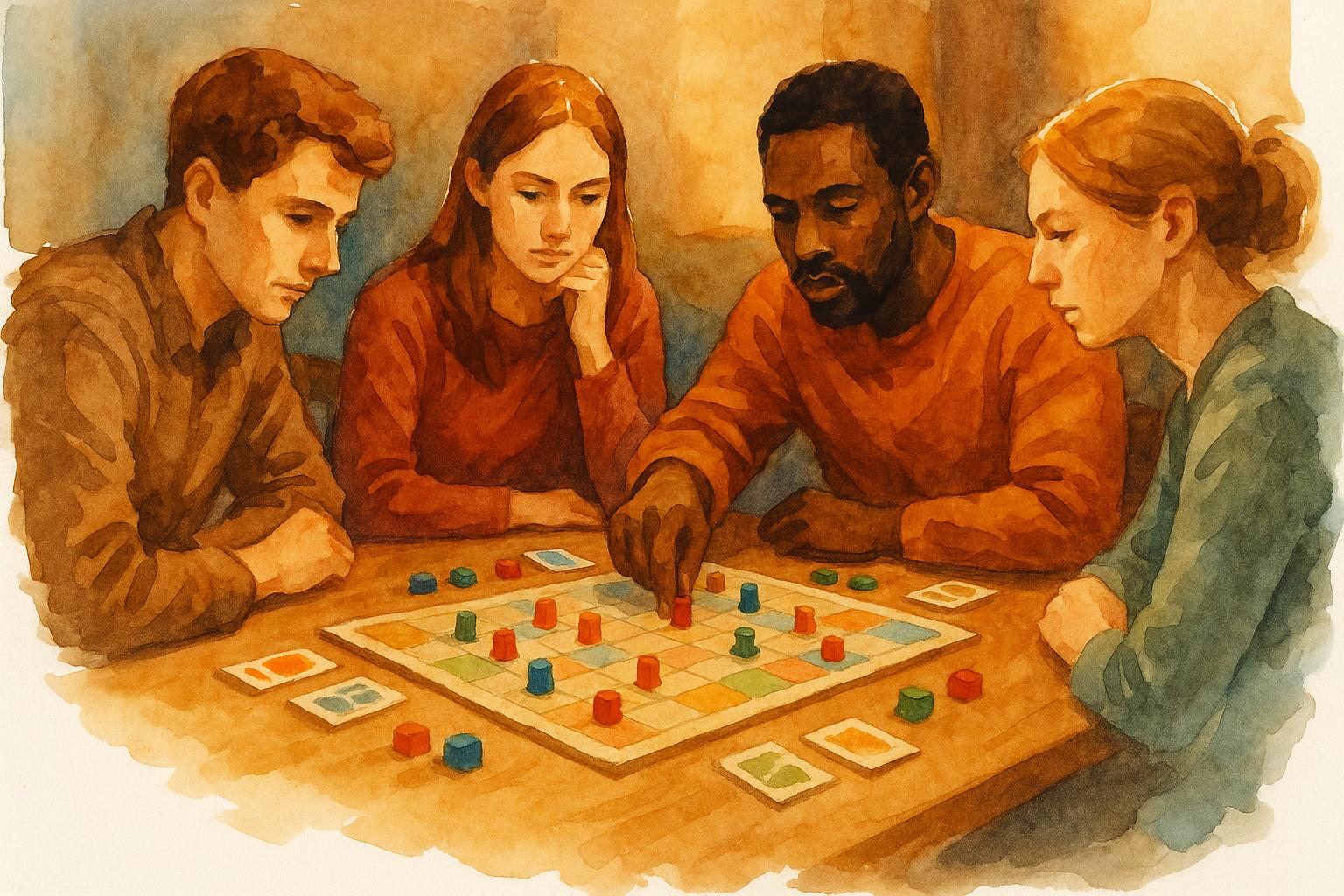
Tabletop games are more than just a fun activity - they help you build problem-solving skills in a hands-on way. Whether it’s managing resources in Settlers of Catan, solving mysteries in Clue, or collaborating in Pandemic, these games challenge you to think critically, plan ahead, and work with others. Research shows they improve skills like logical reasoning, decision-making, and teamwork, while also boosting focus and reducing stress.
Here’s why tabletop games are great for problem-solving:
- Decision-Making: Every move requires weighing short-term benefits against long-term strategies.
- Logical Thinking: Games like Infinity’s Edge push you to analyze clues and test ideas.
- Teamwork: Cooperative games like Forbidden Island teach collaboration and communication.
- Resilience: Losing a game encourages learning from mistakes and trying new strategies.
To get started, pick beginner-friendly games like Ticket to Ride or Carcassonne. Set aside a weekly game night, keep the atmosphere light, and reflect on key decisions after playing to connect game lessons to everyday challenges. Tabletop games not only sharpen your mind but also bring people together for shared experiences.
What Problem-Solving Means in Tabletop Games
Problem-Solving During Gameplay
In tabletop games, problem-solving is all about assessing a situation, making choices within a set of rules, and taking action to move closer to a win or a shared goal. Every turn presents a new challenge - whether it’s picking the right card, plotting your path on a board, or managing scarce resources.
Each decision requires balancing short-term gains and long-term strategy. For example, should you use a card now for an immediate benefit, or save it for a potentially bigger payoff later? Similarly, when an opponent blocks your move, you’re forced to rethink your approach, honing skills like resource management, adaptability, and quick decision-making.
Planning several steps ahead helps develop long-term thinking, while analyzing probabilities and cause-and-effect relationships sharpens logical reasoning. And when the game takes an unexpected turn, quick thinking becomes essential.
Different games highlight different skills. Strategy games like Settlers of Catan focus on resource management and reading your opponents. Cooperative games emphasize teamwork and shared planning, while narrative-driven games encourage creative problem-solving and storytelling.
Take a game like Red Tape by MINIFINITI, which blends humor with strategy. Players navigate a fictional bureaucracy, juggling limited actions and incomplete information. The game flips traditional mechanics on their head, challenging players to outwit each other with clever, satirical cards. It’s a playful yet skill-building experience, teaching resource planning, negotiation, and adaptability - all wrapped in a lighthearted, social atmosphere.
These in-game decisions aren’t just fun - they build skills you can use in real life.
Core Skills Developed Through Gameplay
Tabletop games are a workout for your brain. They push you to think critically, break down complex situations, and make thoughtful decisions. The ability to weigh trade-offs and question assumptions during gameplay translates directly to everyday problem-solving - whether you’re managing a work project or planning a family outing.
They also sharpen decision-making and pattern recognition. Over time, you start spotting trends in opponents’ behavior or recurring game events, adjusting your strategies based on what worked - or didn’t - in the past. For example, in Clue, solving the mystery requires deductive reasoning, a skill that strengthens your logical and analytical thinking.
Games naturally improve communication, negotiation, and conflict resolution too. Many require you to explain your ideas clearly, listen to others, and work together on shared strategies. Disagreements - whether about tactics or rules - become opportunities to practice resolving conflicts constructively, a skill that’s just as valuable outside the game.
Research backs this up. Studies show that board games can boost cognitive and mathematical skills in children, improve attention, and enhance executive function. Strategy and role-playing games, in particular, have been linked to gains in creativity, collaboration, and problem-solving. They’ve even been tied to better academic performance in areas like math and reading comprehension.
Beyond the table, these skills apply to real-life challenges. Losing a game after a bold move teaches resilience and adaptability, lessons that come in handy when dealing with setbacks like missed deadlines or unexpected expenses. The ability to carefully weigh options and make decisions is just as useful when preparing for a test, making a business choice, or resolving a family conflict.
If you want to actively build problem-solving skills while playing, choose games that clearly define decisions and their outcomes. Take a moment after a few turns to discuss what worked and what didn’t. At the end of a session, reflect on key choices, consider alternative moves, and think about what you’d do differently next time. This approach turns casual play into a powerful way to sharpen your problem-solving abilities.
Top 10 Strategy Board Games - That Tests Your Patience
How Tabletop Games Build Problem-Solving Skills
Tabletop games provide a fun and low-pressure way to sharpen your problem-solving skills. Each game session lets you experiment, make mistakes, and learn from them, all while building strategies you can use both in gameplay and in everyday situations. Thanks to their replayability, these games offer endless chances to identify patterns, try out new tactics, and reflect on what worked - or didn’t. Let’s dive into how planning, deduction, and teamwork in tabletop games can help you become a better problem solver.
Planning Ahead and Long-Term Thinking
Tabletop games often challenge you to think beyond the present moment. Whether you’re managing limited resources or strategizing several turns ahead, you’re constantly weighing short-term needs against long-term goals. For example, in turn-based games, you have to pause and consider the ripple effects of your next move: “If I do this, what will my opponent do in response?” This level of reflection sharpens skills like prioritization, risk management, and strategic planning - skills that come in handy for tasks like budgeting or project management.
Games that focus on building systems or investing for future rewards take this even further. Take Red Tape by MINIFINITI, for instance. It challenges players to create efficient systems over time, turning traditional resource management mechanics upside down. In these games, success isn’t about a single move but rather about crafting a series of actions that work together to create lasting advantages. Practicing “if-then” thinking - where you anticipate outcomes a few steps ahead - becomes a habit over time, making forward-thinking second nature.
Logical Reasoning and Deduction
Once you’ve planned ahead, logic takes center stage. Deduction games push you to analyze partial information and draw conclusions based on what you know. You test hypotheses, compare them against available clues, and adjust your thinking as new details emerge. This mirrors real-world problem-solving, where breaking down data step by step leads to clearer solutions.
A standout example is Infinity’s Edge, a D&D one-shot by MINIFINITI. Players tackle paradoxes like Hilbert’s Hotel and Zeno’s Arrow, requiring deep understanding of game mechanics and creative multi-turn strategies. These aren’t just puzzles - they’re exercises in reasoning through complex scenarios. Writing down your thoughts or explaining your logic aloud can further refine your approach, making your reasoning clearer and more effective.
Collaboration and Negotiation
Cooperative games take problem-solving in a different direction by emphasizing teamwork. To succeed, players must share information, agree on a plan, and coordinate their actions, often under time or resource constraints. This setup hones skills like active listening, clear communication, and compromise - skills that are just as useful in real-life group settings as they are around the game table.
Negotiation-heavy games add another layer, teaching you how to express your needs while balancing assertiveness with empathy. Whether you’re trading resources or forming alliances, these moments mimic real-life scenarios like family decisions or group projects. In fact, a 2024 study showed that structured board game sessions can boost kids’ cognitive and math skills, proving that tabletop games are more than just entertainment - they’re a tool for growth.
To get the most out of these games, try setting small, personal goals for each session. Maybe you’ll test a new strategy, explain your reasoning aloud, or focus on better collaboration with your teammates. Humor-filled strategy games are especially great for beginners or mixed-age groups. Their lighthearted narratives make them approachable while still encouraging planning, negotiation, and creative thinking.
These experiences reinforce a key takeaway: tabletop games aren’t just for fun - they’re a hands-on way to develop problem-solving skills you can use in everyday life.
sbb-itb-7b84150
Choosing Games That Develop Problem-Solving Skills
Not all tabletop games are equally effective at sharpening problem-solving abilities. The best ones strike a balance by offering clear goals, meaningful choices, and just the right amount of challenge to keep you engaged without feeling overwhelmed. When browsing games at a local store or online, focus on those that require players to weigh multiple viable options, manage limited resources, or adapt to ever-changing scenarios. Ideally, the rules should be simple enough to learn in 10–15 minutes, yet the gameplay should sustain engaging decision-making throughout.
Playtime is another important factor, especially for newcomers. Games that last around 30–60 minutes are often ideal - they’re long enough to develop strategies but short enough to keep attention and allow for multiple rounds in an evening. Many U.S. publishers include helpful details like complexity ratings (commonly on a 1–5 scale) and suggested age ranges on the box, making it easier to match a game to your group’s experience level. Below, we’ll explore a few types of games that are particularly good at building problem-solving skills.
Entry-Level Strategy Games
Different genres of games cater to various aspects of problem-solving, appealing to both beginners and seasoned players. For those just starting out, look for games that introduce planning and decision-making without overwhelming complexity. For instance:
- Ticket to Ride challenges players to plan several turns ahead as they claim railway routes, balancing the risk of waiting for ideal cards with the possibility of losing key connections.
- Carcassonne involves placing tiles to create a medieval landscape, forcing players to decide whether to focus on completing their own features or blocking opponents.
- Splendor and Azul focus on resource collection and pattern recognition, rewarding players who can anticipate their needs a few turns in advance.
These games share a common thread: each turn presents meaningful choices with clear trade-offs. While traditional abstract games like chess emphasize deep, long-term strategy, modern gateway games are more approachable, with simpler rules and engaging visuals. A 2024 peer-reviewed study even found that playing short, simple board games regularly improved children’s working memory, processing speed, and math skills compared to control groups.
Cooperative and Puzzle-Based Games
Cooperative games take a different approach by encouraging teamwork to tackle challenges. In Pandemic, players race against time to stop global disease outbreaks, requiring constant communication and strategic coordination. Forbidden Island offers a similar experience on a smaller scale, with players working together to retrieve treasures before the island sinks. These games are excellent for building teamwork, information sharing, and collaborative decision-making, as success depends on well-coordinated plans - skills that mirror real-world communication and negotiation.
For puzzle enthusiasts, games like Sherlock Holmes: Consulting Detective and Codenames offer rich deduction-based experiences. Research supports the idea that regular tabletop gaming enhances cognitive skills. Many players also highlight the satisfaction of solving puzzles together and the thrill of seeing a coordinated strategy pay off. When choosing cooperative games, prioritize ones that emphasize sharing information, negotiating strategies, and adapting to escalating challenges. Many of these games also assign unique roles to players, requiring thoughtful coordination. In the U.S., cooperative family games in this category typically cost between $20 and $50.
Humor and Strategy Combined: Red Tape
Adding humor to strategy games can make learning and problem-solving more enjoyable. Red Tape by MINIFINITI is a great example of how strategy and humor can blend seamlessly. This beginner-friendly board game challenges players to outwit each other using witty, cleverly illustrated cards, while turning traditional engine-building mechanics on their head. Set in a world of political chaos, the game uses humor and optimism to make strategic decisions feel like playful storytelling rather than a brain-training exercise.
What makes Red Tape effective for developing problem-solving skills is its balance of thoughtful strategic choices and a lighthearted tone. Players must plan several moves ahead, manage limited resources, and adapt to opponents’ actions, all within an accessible and fun framework. Priced at $39.99 for the prototype, it fits comfortably within the typical price range for entry-level modern strategy games and offers plenty of replayability to experiment with new tactics.
MINIFINITI also hosts weekly game nights, creating opportunities to connect socially and experience the game firsthand before buying. For the best learning experience, choose games that suit your group’s age range, have clear components, and feature engaging themes. To take things a step further, encourage reflection after each game: discuss what strategies worked, what didn’t, and how setbacks were handled. These discussions can reinforce problem-solving skills and make the experience even more rewarding.
Adding Tabletop Games to Your Routine
Bringing tabletop games into your weekly schedule doesn’t have to feel like a chore. The trick is to make game nights a natural and enjoyable part of your routine, rather than just another task on your list. Studies on play and mental health show that regular, low-pressure gaming sessions can help ease stress and encourage relaxation. This makes them easier to stick with because they feel like a reward instead of an obligation. Plus, these sessions don’t just reduce stress - they also help sharpen strategic thinking skills developed during gameplay.
One way to make game nights fit seamlessly is by tying them to something you already do. For instance, a family could swap one evening TV show for a 45–60 minute game after dinner but before bedtime. College students might block out a couple of hours one evening each week, while adults with busy schedules could dedicate Friday nights or Sunday afternoons to gaming, creating a consistent plan everyone can count on.
If you’re just starting out, a weekly or biweekly game night lasting 60–120 minutes is a great way to build focus, planning, and decision-making skills. Shorter games, running 15–30 minutes, can also be stacked into one evening. This lets players try different types of challenges - like solving a mystery in one game and managing resources in another - without overwhelming anyone new to the hobby.
Getting into tabletop games doesn’t have to break the bank. Many excellent problem-solving games cost under $40. For U.S.-based players, libraries, game cafes, or borrowing from friends can help keep costs down. Some communities even offer free lending programs or host public events where you can try out games without buying them. To make things even easier, keep a small, ready-to-play shelf stocked with pre-sorted games and quick rule summaries. This cuts down on setup time, which is often a stumbling block for sticking to a routine.
Setting Up Beginner-Friendly Game Nights
To get the most out of game nights, it’s important to make them welcoming and easy for everyone, especially newcomers. Not all game nights are created equal - those designed for beginners focus on clear expectations, simple logistics, and a positive, supportive atmosphere. Encouraging a playful, low-pressure environment where learning is more important than winning can help ease anxiety and make the experience more enjoyable. Research shows that such environments promote skill development, resilience, and social bonding.
Start with games that have simple rules and playtimes under an hour. When explaining the rules, use examples instead of complicated jargon, and pair experienced players with newcomers to guide them through the first few turns. If you have a larger group, set up multiple tables with games of varying difficulty levels - this way, players can choose between “casual,” “standard,” and more challenging games as they grow more confident. Cooperative games or team-based modes work particularly well, as experienced players can take on roles like “rules explainer” or “options summarizer” while still letting newer players make the final decisions. Research indicates this approach strengthens both teamwork and problem-solving skills.
Switching roles during each session is another way to keep things fresh and ensure everyone gets a chance to practice different skills. For example, one person might explain the rules this week, another might keep score next week, and someone else could track objectives the week after. This rotation helps participants develop leadership, organization, and communication skills.
Community-hosted game nights can also eliminate common barriers like finding space, buying games, or gathering enough players. Weekly events run by companies like MINIFINITI often provide an easy entry point. They curate approachable games, offer facilitators to teach the rules, and mix in humorous titles like Red Tape alongside strategy and cooperative games. This creates a fun, low-pressure setting that aligns with research showing how tabletop games can build cognitive skills and social confidence.
Using Reflection to Reinforce Learning
Taking a few minutes after each game night to reflect on decisions made during play can significantly boost the skills you’re building. While playing regularly sharpens problem-solving abilities, reflecting on those experiences helps cement the lessons. A simple 5–10 minute debrief can make a big difference. Ask questions like: “What was one decision that really mattered?”, “What options did you consider?”, and “What would you try differently next time?” This keeps the discussion concise and engaging, much like effective educational practices.
Keep the tone light and conversational - perhaps chat while putting away the game components. This creates a natural connection between in-game choices and everyday habits, such as managing time, planning projects, or resolving disagreements. Targeted prompts work particularly well, such as, “Did you face a situation where you had limited information? How is that like making decisions at work or school?” or “When did the team disagree, and how did you resolve it?” These questions echo findings from studies on tabletop games, which highlight benefits like improved perspective-taking, collaboration, and decision-making.
Another great question to ask is, “Where in your life could trying multiple strategies - like you did in the game - help more than sticking to one plan?” This encourages players to apply the flexible thinking and resilience they’ve practiced to real-world challenges. For families, connecting game scenarios to everyday situations can be especially helpful. For example, budgeting in a resource-management game mirrors managing household expenses, while planning moves in a game can resemble organizing errands or trips.
Beginners might also enjoy keeping an informal “game journal.” After each session, they can jot down one interesting dilemma they faced, what they tried, and what they’d do differently next time. This kind of reflection has been linked to better executive function and metacognition. Groups could also revisit the same game every few weeks, noting improvements like better planning, quicker rule recall, or smoother teamwork. These small but noticeable changes align with studies showing gains in cognitive flexibility and collaborative problem-solving from repeated tabletop play. Reviewing these notes monthly can make progress more visible and encourage a growth mindset.
The idea isn’t to turn game night into a lecture or a classroom session. Instead, brief, casual conversations after playing help solidify the problem-solving lessons you’ve practiced, making it easier to apply those skills to challenges at work, school, or home.
Conclusion
Tabletop games are more than just a fun pastime - they’re a workout for your brain. Playing these games helps you practice planning ahead, weighing different options, adjusting when things don’t go as planned, and learning from mistakes - all in a low-pressure environment. These mental exercises mirror the skills you use in daily life, like managing a budget, coordinating a team project, or planning a family outing. Research even shows that regular tabletop gaming can boost problem-solving, focus, and emotional well-being across various age groups.
The benefits become even more impactful when the games themselves are enjoyable. Titles like MINIFINITI’s Red Tape and Infinity’s Edge combine humor with strategy, making the learning process engaging and fun. When a game keeps you entertained, you’re more likely to stick with it, giving you more opportunities to hone these valuable skills.
But it’s not just about cognitive growth - tabletop games also bring people together. They offer a screen-free way to connect, communicate, and celebrate small victories. Regular game nights can reduce stress, foster positive communication, and help players bounce back from setbacks. The shared laughter and teamwork create meaningful memories that go beyond what passive entertainment can offer. These moments of connection and growth can easily be integrated into your routine.
Getting started is simple. Dedicate one evening a week - Friday nights are a great choice - for a game night. Choose beginner-friendly games that work for two to four players, set up a cozy space with snacks and drinks, and focus on having fun rather than worrying about perfect play. Mistakes and early losses are all part of the learning curve. If you’re looking for a community experience, check out a local game night. These events are a great way to learn new games, pick up strategies from experienced players, and meet new people - all while sharpening your skills.
To make game night even more effective, focus on developing one skill at a time, like planning, clear communication, or flexibility. After each session, take a moment to reflect on your decisions and how you can improve. This simple habit turns game night into a tool for personal growth, helping you apply these skills to challenges at work, school, or home.
FAQs
How do tabletop games help improve decision-making and logical thinking?
Tabletop games offer an engaging way to boost decision-making and logical thinking skills. These games often challenge players to assess situations, consider different options, and anticipate outcomes, all while navigating dynamic and unpredictable scenarios.
Take strategy games, for instance. They frequently involve tasks like solving puzzles, managing limited resources, or crafting long-term plans. These elements encourage players to think critically and make quick decisions. The best part? These skills don’t just stay on the game board - they can enhance your ability to tackle real-life challenges with confidence and creativity.
What are some cooperative tabletop games that build teamwork and communication skills?
Cooperative tabletop games offer an incredible mix of fun and teamwork. Take Pandemic, for instance - players join forces to prevent global outbreaks, making it a race against time and strategy. Or consider Forbidden Island, where your team must recover treasures and escape before the island sinks. These games are all about working together, sharing ideas, and thinking strategically. They push players to communicate effectively, delegate roles, and adapt as challenges arise - skills that are essential for solving problems as a group.
If you’re just dipping your toes into cooperative games, start with something straightforward and engaging. It’s a great way to ease in, build confidence, and connect with your group while having a blast.
How can I use tabletop games to boost my problem-solving skills?
Incorporating tabletop games into your weekly routine can be a fun and engaging way to sharpen your problem-solving skills. Dedicate a specific time - whether it’s a family game night or a hangout with friends - to dive into games that challenge your mind. Opt for titles that encourage critical thinking, strategic planning, and creativity. Puzzles, strategy games, or cooperative adventures are excellent choices to get started.
To get the most out of your gaming sessions, pick games that push you to make decisions and adjust your approach as situations change. After playing, take a moment to reflect on the strategies you used and consider how they might translate to real-life challenges. Over time, you may find yourself tackling problems with a fresh perspective, both on and off the game board.