
Top Games with Resource Generation
Resource generation mechanics make games engaging by allowing players to collect and manage assets like materials, currency, or actions. These systems encourage decision-making, trading, and planning, adding depth to gameplay. Here’s a quick look at popular games with resource generation:
- CATAN: Dice rolls determine resource collection. Players trade and build to earn points.
- Everdell: Combines worker placement with recurring income through cards.
- Power Grid: Simulates energy markets with dynamic pricing and resource scarcity.
- Terraforming Mars: Features six production tracks tied to project cards and planet development.
- Race for the Galaxy: Uses cards as resources, currency, and goods for tight decision-making.
- Gizmos: Players use marbles to trigger chain reactions for efficient resource use.
- Keyflower: Balances auctions and worker placement for resource generation.
These games showcase different systems like fixed income, action-based, and engine-building mechanics. Fixed income is predictable and beginner-friendly, while action-based systems emphasize tactical choices. Engine-building rewards long-term planning but requires careful strategy.
If you're new, start with CATAN or Splendor for simpler mechanics. For more complex games, try Terraforming Mars or Brass: Birmingham. These games not only entertain but also teach planning and resource management skills.
Game Mechanics: Resource Management
sbb-itb-7b84150
Popular Board Games with Resource Generation
These games showcase different ways resource generation can shape strategic decision-making.
CATAN
In CATAN, resource generation hinges on dice rolls and terrain hexes. At the start of each turn, two dice are rolled, and players with settlements or cities adjacent to a hex matching the rolled number collect resources. The island features five terrain types: Hills (Brick), Forests (Lumber), Mountains (Ore), Fields (Grain), and Pastures (Wool). Settlements provide one resource, while cities double that output.
The game’s probability system adds a layer of strategy. Numbers like 6 and 8 are rolled most often in a standard 36-roll cycle (five times each), while 2 and 12 are the least common (once each). Rolling a 7 triggers the Robber, which blocks production on a hex and forces players with more than seven cards to discard half. As the Financial Times remarked:
Settlers has its own elegant economy, in which the supply and demand for five different commodities are determined by tactics, luck and the stage of the game.
Trading is another key element of resource management. Players can negotiate trades with each other or trade with the bank at a 4:1 ratio - or at better rates if they control harbors. These mechanics allow players to gather the resources needed to build roads, settlements, and cities on their way to earning 10 victory points.
Everdell
Everdell combines worker placement with recurring income through Green Production cards. Players start with two workers (increasing to six by the end of the game) and gather resources like twigs, resin, pebbles, and berries. Green Production cards trigger resource generation at the start of each new season.
The game also introduces a clever "occupied" token mechanic, letting players play Critter cards for free if the corresponding Construction card is already in their city. With 128 unique cards offering countless synergies, players can refine their strategies over multiple games. Everdell holds an average rating of 8.0/10 from 67,000 ratings on BoardGameGeek and is ranked #43 overall.
Power Grid
Power Grid captures the dynamics of energy markets with a tiered resource track where prices increase as supplies are depleted. To balance the game, players in last place gain early access to resources during the purchasing phase. Additionally, players can store up to twice their power plants' consumption capacity, enabling strategic stockpiling when prices are favorable. As Meeple Mountain aptly put it:
Power Grid is a marvel of economic and resource management; a PhD thesis in board game form.
The game evolves through three "Steps", which adjust resource refill rates to reflect changing global energy availability. This shifting market keeps players adapting their strategies throughout the game.
Games with Different Resource Generation Systems
Some games break away from traditional fixed-income systems, introducing unique and active ways to generate resources. These approaches add layers of strategy and variety, keeping players engaged.
Terraforming Mars
In Terraforming Mars, players manage six production tracks: MegaCredits, Steel, Titanium, Plants, Energy, and Heat. These resources fuel project cards and other in-game actions. Your Terraform Rating determines both your income and your victory points, creating a direct link between economic growth and success in the game.
The system introduces fascinating strategic dilemmas. For instance, Energy automatically converts to Heat at the end of each generation. While Heat can be used to raise the planet's temperature, Steel and Titanium serve as specialized currencies for construction and space-related projects. Nate Anderson, Deputy Editor at Ars Technica, sums it up perfectly:
Terraforming Mars is an engine-building exercise - and I mean that in an entirely positive way. I love a good engine-builder, amping up my production levels so that on each turn I can buy and do more, more, MORE!
However, once the global temperature reaches its maximum of 46°F (8°C), Heat production becomes obsolete, forcing players to pivot their strategies. The game concludes when three conditions are met: oxygen levels reach 14%, the temperature hits 46°F (8°C), and all 9 ocean tiles are placed. With a BoardGameGeek ranking of #8 in Strategy Games and an 8.168 rating from 111,218 voters, this 90–180 minute game is a favorite among enthusiasts.
Race for the Galaxy
Race for the Galaxy takes a completely different approach by eliminating traditional currency altogether. Here, cards serve multiple purposes - they act as developments, goods, and currency. Resource production occurs during the Produce phase, which players must strategically select.
Goods, represented by face-down cards, are generated on production worlds. To gain benefits, players must use a "Consume" action to convert these goods into either victory points or additional card draws. Production worlds create resources during each Produce phase, while Windfall worlds provide one-time bonuses. With a 10-card hand limit and games lasting 7 to 11 rounds, this system emphasizes tight decision-making. The game holds a solid 7.74/10 rating from 58,489 voters on BoardGameGeek.
Gizmos

In Gizmos, players use a marble dispenser to collect resources. Each marble color triggers specific cards in a player’s tableau, creating cascading effects. These combos allow players to generate multiple resources from a single action, building highly efficient engines that ramp up scoring potential.
Keyflower
Keyflower blends tile auctions and worker placement in a unique way. The same meeples used for bidding on tiles are also required to activate those tiles for resource generation. This dual-purpose mechanic creates competition, as players must carefully balance bidding and activation to maximize their resources.
These resource generation systems bring variety and depth to gameplay, offering alternatives to the more predictable fixed-income methods. Each game challenges players to adapt and strategize in fresh and engaging ways.
How Resource Generation Mechanics Compare
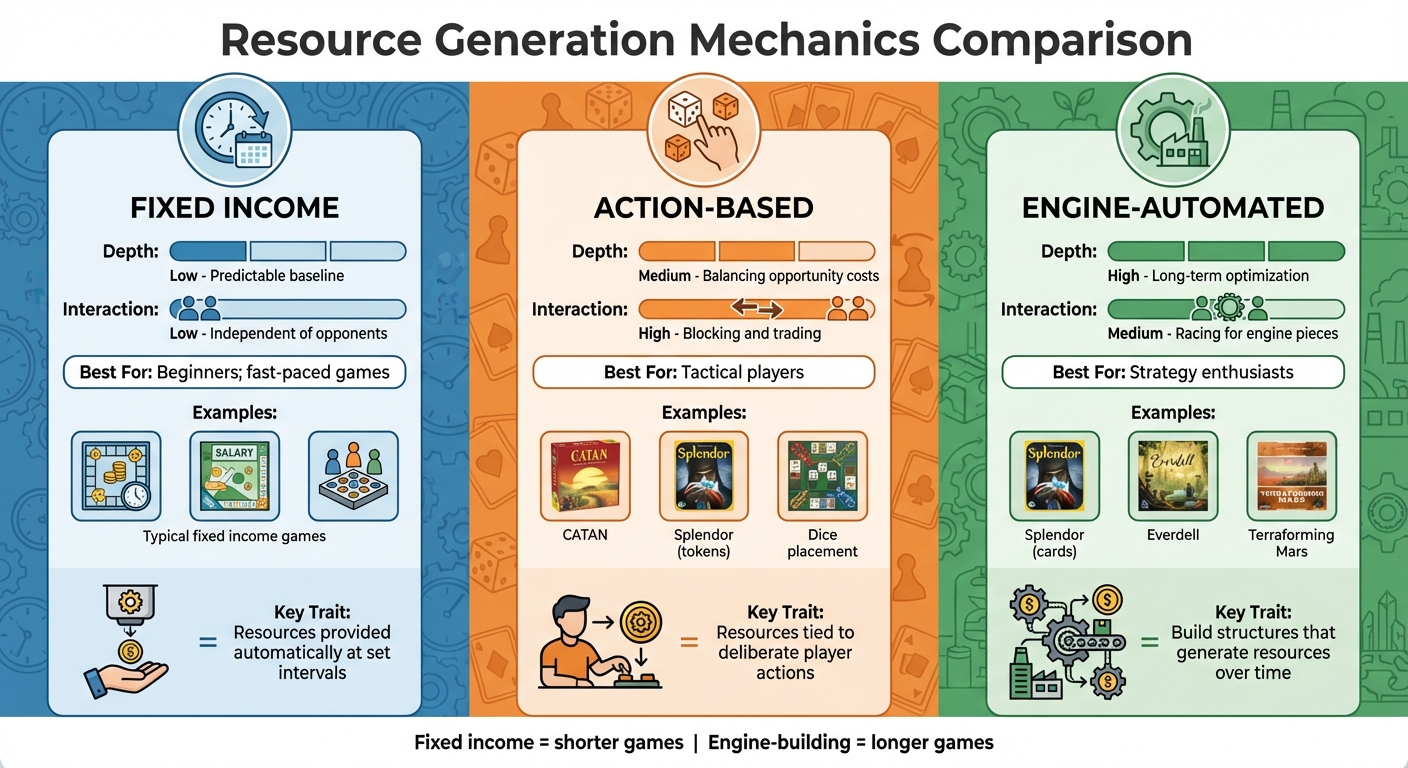
Comparison of Resource Generation Mechanics in Board Games
Fixed Income vs. Action-Based vs. Engine-Automated Systems
Resource systems in games vary widely, influencing strategy and planning in distinct ways.
Fixed income systems provide resources automatically at set intervals, often at the start of each turn. This steady and predictable flow encourages efficient spending without overwhelming players. These systems are beginner-friendly, as they reduce complexity and help avoid the "runaway leader" problem. Plus, they simplify bookkeeping, making them ideal for faster-paced games.
On the other hand, some systems tie resource generation to deliberate player actions, adding a layer of tactical choice.
Action-based systems require players to make specific moves or rely on probability-based triggers to gain resources. For example, Splendor uses a hybrid approach: players collect poker-style tokens through actions, while purchased cards offer ongoing discounts. These systems shift the focus from simply collecting resources to weighing whether an action is worth the opportunity cost, often leading to lively player interaction, such as blocking or trading.
Lastly, engine-automated systems reward players for building structures or cards that generate resources over time. Games like Everdell and Terraforming Mars shine here, as they encourage early investments in production capacity that compound into powerful returns. As Fristoe explains:
Single-use resources follow a cyclical pattern as players collect resources, spend them, then restart the cycle.
However, these systems demand long-term planning and carry the risk of early snowballing, where one player pulls ahead quickly.
Here's a quick comparison of these mechanics:
| Mechanic | Depth | Interaction | Best For | Examples |
|---|---|---|---|---|
| Fixed Income | Low: Predictable baseline | Low: Independent of opponents | Beginners; fast-paced games | Typical fixed income games |
| Action-Based | Medium: Balancing opportunity costs | High: Blocking and trading | Tactical players | CATAN, Splendor (tokens) |
| Engine-Automated | High: Long-term optimization | Medium: Racing for engine pieces | Strategy enthusiasts | Splendor (cards), Everdell, Terraforming Mars |
Susan Han, CEO of QinPrinting, highlights how these mechanics impact gameplay length:
The choice and complexity of mechanics can significantly influence the duration of gameplay.
Fixed income systems usually result in shorter games, while engine-building games tend to run longer as players refine intricate production chains. As Smoothie Wars Blog humorously notes:
If it feels like accounting homework, you've failed.
Ultimately, your preference for simplicity versus strategic depth will help determine which system suits your gaming style.
Conclusion
Resource generation mechanics add layers of strategy and depth to board games, transforming them into engaging challenges. Whether you prefer the steady rhythm of fixed income systems, the tactical decisions of action-based mechanics, or the rewarding progression of engine-building games, there's something for every kind of player.
These mechanics create moments of meaningful choice. As the Smoothie Wars Blog explains:
Resource management is the purest form of strategic decision-making. You have limitations, opportunities, and choices.
The constant balancing act between your ambitions and your resources keeps gameplay fresh and exciting, even after multiple sessions.
If you're new to resource generation games, consider starting with beginner-friendly titles like Splendor or CATAN. These games introduce the core principles without overwhelming complexity. Once you're ready for more intricate systems, dive into games like Brass: Birmingham (rated 9.7/10 for decision satisfaction) or Terraforming Mars, which showcase the depth of engine-building mechanics.
Beyond entertainment, these games also teach valuable skills like budgeting, planning, and systems thinking. They encourage social interaction through trading and negotiation, making them perfect for game nights with friends or family. Whether you're looking to challenge your strategic mind or simply connect with others, resource generation games deliver on both fronts.
Find a game that fits your group’s preferences, gather around the table, and immerse yourself in the strategic experiences that have captured the hearts of players worldwide.
FAQs
What makes resource generation mechanics valuable in board games?
Resource generation mechanics bring layers of strategy and decision-making to board games. They push players to think ahead and carefully manage limited resources, creating a balance between scarcity and opportunity as they work toward their goals.
These mechanics also maintain the game's momentum by ensuring resources flow steadily, minimizing downtime, and encouraging players to adjust their strategies on the fly. When players effectively navigate these systems, they gain a rewarding sense of achievement, adding to the game's enjoyment and making it one you'll want to revisit time and time again.
What’s the difference between action-based and fixed income resource systems in board games?
Action-based resource systems require players to take specific actions to generate resources, adding an extra layer of strategy to gameplay. Players must carefully decide what actions to take and when to take them to align with their goals and adapt to the evolving game state. For instance, a player might prioritize trading, building, or harvesting depending on their immediate objectives and the overall progress of the game. The flow of resources in these systems is dynamic, directly influenced by player choices.
On the other hand, fixed income systems offer a steady, predictable flow of resources each turn. These resources are typically generated automatically, based on predefined rules or conditions within the game. While this consistency simplifies resource management and planning, it may reduce the opportunities for strategic flexibility. Fixed income systems are often found in games where resource generation happens passively, allowing players to focus on other aspects of gameplay.
Both approaches bring their own flavor to the table. Action-based systems shine by encouraging strategic thinking and adaptability, while fixed income systems appeal to players who value reliability and straightforward resource management. Each offers a distinct experience, catering to different playstyles and preferences.
What are some good board games for beginners interested in resource generation mechanics?
If you're just stepping into the world of board games with resource generation mechanics, Catan is an excellent place to begin. The rules are straightforward: players collect resources based on dice rolls and trade them to build settlements and roads. It's a game that blends simplicity with strategy, making it an approachable choice for newcomers.
Another solid pick is 7 Wonders. In this game, players draft cards to develop their civilizations. The resource management element is easy to understand, and the focus on planning keeps the complexity low. It's perfect for easing into the genre without feeling overwhelmed.
For those ready to tackle more intricate gameplay, Everdell and Terraforming Mars are worth exploring. These games involve managing multiple resources and offer deeper strategic layers. While they may take a little longer to learn, they deliver a satisfying experience for players eager to delve further into resource-based board games.