
Game Talk
We Designed and Shipped a Startup Tarot Deck in ~1–2 Days
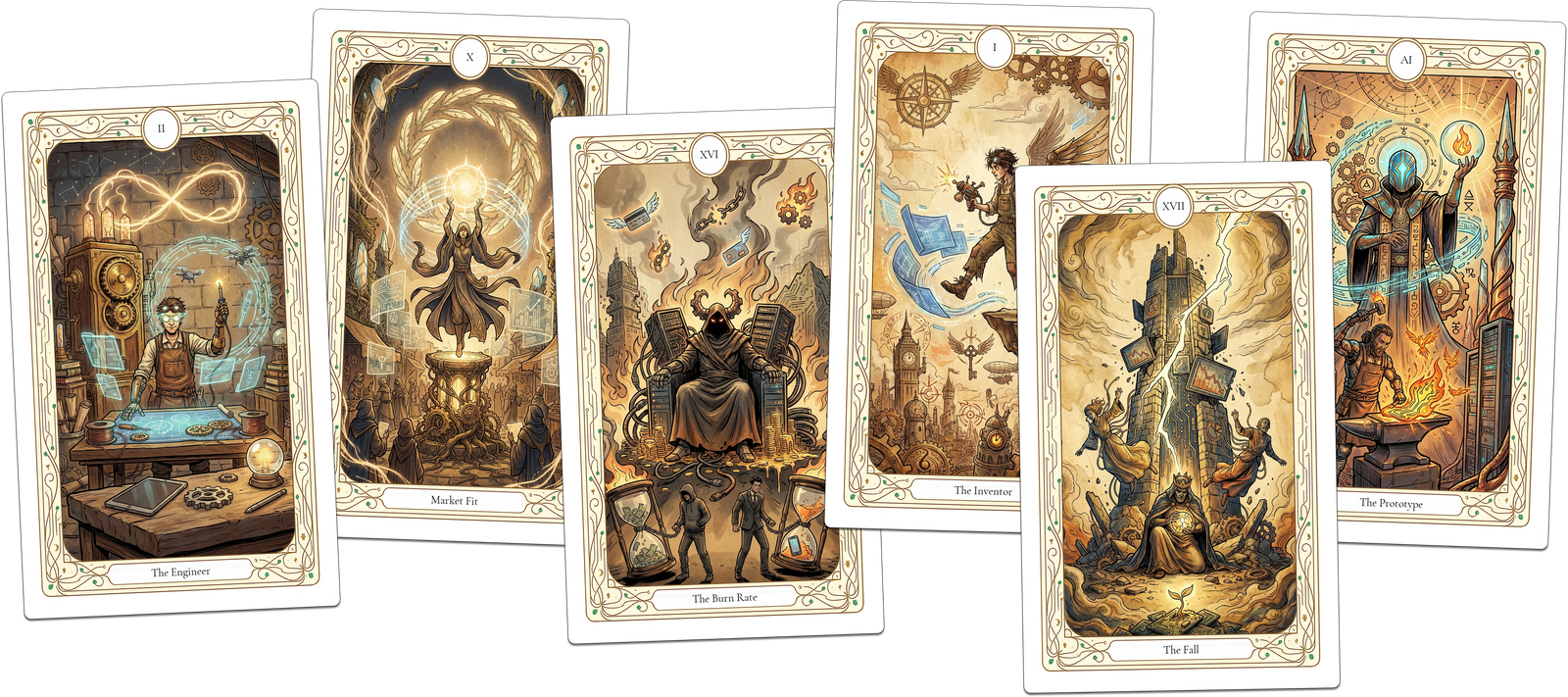
Sometimes the fastest way to understand a system is to just ship something.
Over the course of roughly a day (okay, maybe two, depending on how you count sleep), we designed, generated, and sent a Startup Tarot card deck to print. This wasn’t a carefully planned product launch. It was a tight, creative sprint fueled by curiosity, AI tools, and a shared desire to see if this was even possible.
Here’s how it came together.
Step 1: Understanding the Medium (Thanks, Nate)
The whole thing kicked off when Nate showed us a board game he had designed called Red Tape. More importantly, he walked us through how card printing actually works.
He explained the practical constraints:
-
Card sizes and bleed areas
-
Borders (and why they matter more than you think)
-
Packaging options
-
How The Game Crafter works end to end
This was crucial. Designing a deck without understanding print constraints is how you end up with something that looks fine on screen and unusable in reality. Nate effectively compressed years of trial-and-error into a short explanation.
At that point, the project went from “fun idea” to “we could actually ship this.”
Step 2: Learning Tarot (Egor Reads Our Fortunes)
Next, Egor grounded us in reality by explaining how Tarot actually works.
He walked us through:
-
The Major Arcana vs the Minor Arcana
-
What suits represent
-
How Tarot is about archetypes, not prediction
-
Why symbolism and consistency matter more than literal meaning
Then he read our fortunes, which was both entertaining and—uncomfortably—on point.
This step mattered more than it sounds. Tarot has internal logic. Without understanding it, we’d just be making a deck of startup jokes. With it, we could map startup archetypes onto something that already had narrative and structure.
Step 3: Designing the Physical Object (Egor Again)
Egor didn’t stop at theory. He also designed a custom box for the deck.
Using the relevant design tools, he put together packaging that looked intentional rather than “AI slop printed on cardboard.” The box immediately elevated the project from experiment to artifact.
This was the moment it felt real.
Step 4: Card Art at Scale (Where Python Met Pain)
Jared and Alex tackled card image generation using nano banana, but Nat played a critical role here too.
Card generation wasn’t just prompting an image model and calling it a day. It involved a lot of image manipulation in Python:
-
Cropping and centering artwork consistently
-
Enforcing uniform borders and bleed-safe areas
-
Resizing and normalizing outputs across dozens of cards
Some hard-earned lessons:
-
AI is very bad at respecting borders
-
AI is shockingly bad at generating the correct number of items
-
“Centered with a clean border” is apparently an advanced research problem
Most of the work here wasn’t creativity, it was constraint wrangling. Prompting, regenerating, rejecting, fixing in Python, and repeating. Over and over.
Eventually, though, we got a set of images that could actually survive printing.
Step 5: Writing the Deck (Major Arcana, Suits, and Structure)
Finbarr focused on the Major Arcana, mapping classic Tarot archetypes onto startup equivalents: founders, markets, capital, collapse, transformation.
At the same time, Gemini and ChatGPT were used to explore and draft the structure of the suits. This was very much a co-creation process: AI generated options, humans judged taste and coherence.
Jared was a major contributor here and ultimately finished off the suits, tightening their themes and making them feel internally consistent rather than loosely connected startup memes.
Step 6: Letting AI Interpret Itself (The Booklet)
One of the stranger and more interesting parts of the project was the interpretation booklet.
Nate and Egor generated written interpretations for the cards by having AI look at and interpret its own images.
Instead of writing meanings first and generating art to match, we inverted the process:
-
Generate the card imagery
-
Feed the images back into AI models
-
Ask them to explain what they “meant”
The result was surprisingly coherent. In some cases, the interpretations surfaced symbolism that none of us had consciously designed, but that still fit the deck’s themes.
It felt less like authoring and more like archaeology.
Step 7: Gengen Everything
Once the structure was in place, we leaned fully into AI.
Text, art, layout passes—everything went through some form of generation, refinement, and regeneration. This wasn’t “AI replaces humans.” It was:
-
Humans define taste and constraints
-
AI explores the combinatorial space
-
Humans prune aggressively
Repeat until acceptable.
Or until it’s 2am and good enough is good enough.
Step 8: Send It to Print
At some point, you just have to stop.
We packaged the files, uploaded them to The Game Crafter, sanity-checked everything one last time, and hit order.
No endless polish.
No roadmap.
No Notion doc.
Just ship.
Why This Matters
The interesting part isn’t the Tarot deck. It’s the process.
In ~1–2 days, a small group of people:
-
Learned a new physical medium
-
Designed a real, printable product
-
Used AI as a force multiplier, not a crutch
-
Went from idea to artifact without ceremony
This is what creative work looks like now if you let it be fast.
We used AI to gengengen the whole thing.
Profit.