
Game Talk
Dynamic Resource Allocation in Strategy Games
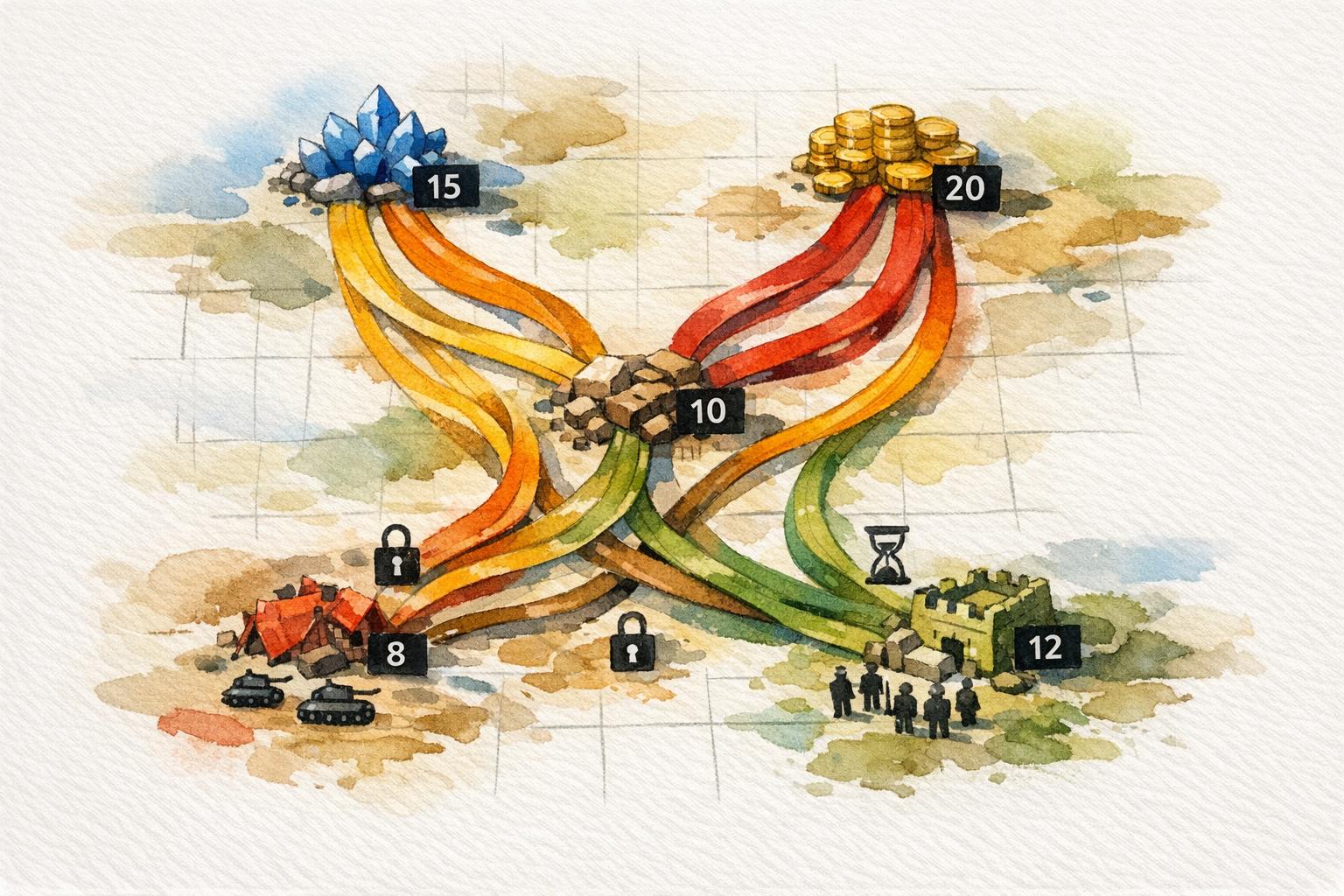
Dynamic resource allocation is the process of constantly redistributing resources in response to changing game scenarios. Unlike static strategies, it requires ongoing decision-making, balancing immediate needs with long-term goals. This concept adds depth to games by forcing players to manage scarcity, make trade-offs, and respond to opponents’ actions.
Key Takeaways:
- Types of Resources: Games use tangible (currency, materials) and intangible (time, moves) resources.
- Redistribution Mechanics: Includes systems like worker placement, engine-building, and logistics-based management.
- Constraints: Resource limits create meaningful decisions with consequences.
- Effective Strategies: Balance short-term gains with future planning, adjust to opponents, and manage risks with limited information.
- Game Design Impact: Keeps gameplay engaging by evolving challenges and scaling difficulty for players of all skill levels.
This system not only challenges players but also ensures games remain engaging and unpredictable, offering diverse paths to success.
Core Components of Dynamic Resource Allocation
Types of Resources and Mechanics in Strategy Games
Types of Resources
Strategy games revolve around two main types of resources: explicit and implicit. Explicit resources are tangible assets - things like currency, building materials, and fuel - that players can collect and spend. On the other hand, implicit resources are intangible factors that limit or shape player actions. These include elements like time, the number of moves allowed per turn, or even the player’s own attention span.
“Effectively, ‘resources’ are a system of agency for the player. With resources, a player accumulates available options and is given agency to act and react to the evolving systems and conditions of the game.” – Wayward Strategy
Modern games often combine multiple resource systems to add depth. Take Daitoshi, for example: its resource economy spans five tiers, from Basic Materials to Premium Assets, requiring players to manage these layers strategically. In worker placement games, workers themselves act as resources, with players assigning them to specific tasks. Some resources, like fuel or ammunition, are finite and demand careful rationing, while others regenerate automatically each round.
These categories of resources set the foundation for understanding how they are redistributed and constrained.
Mechanics of Redistribution
Redistribution mechanics determine how resources move, transform, or are allocated throughout gameplay. In worker placement games, players must adjust their strategies as limited task slots are claimed. Engine-building mechanics add another layer by enabling players to create systems that generate resources automatically over time.
Upkeep systems introduce a balancing act. For instance, Company of Heroes 2 reduces income as a player’s growth increases, forcing players to adapt. This contrasts with StarCraft 2, where units represent permanent investments of minerals and gas. In high-level matches, players often dedicate 80 to 90 of their 200-unit population cap just to resource gathering.
Logistics-based redistribution adds further complexity. In the Wargame series, fuel and ammunition must be physically transported to units on the battlefield, requiring players to manage supply lines effectively. Similarly, Daitoshi’s Great Shard system lets players convert basic commodities into advanced assets, offering flexibility when adapting to changing game conditions.
These redistribution systems naturally lead to constraints that shape player decisions.
Dynamic Constraints
Constraints are what give resources their strategic importance. They ensure that every choice has weight and consequences. Mechanics like “Land” in Magic: The Gathering or “Ages” in Age of Empires enforce structured progression, challenging players to plan carefully.
“A strategy game without resources would effectively be a game without consequence.” – Wayward Strategy
Logistical constraints often force players to rethink their tactics. For example, in Wargame, running low on ammunition might require players to halt an offensive or retreat to resupply, rewarding those who plan ahead. In Dawn of War: Dark Crusade, some factions gain an advantage by capturing resource nodes, which reduces unit training times instead of directly boosting currency. Similarly, Company of Heroes 2 introduces victory points as a separate resource, allowing players to secure strategic positions and win even if their military strength falters.
These constraints ensure that resource management remains a core part of strategic decision-making, encouraging players to weigh every action carefully.
sbb-itb-7b84150
Strategies for Effective Resource Management
Effective resource management thrives on aligning immediate actions with broader, longer-term goals. By understanding how to adapt dynamically, you can make smarter decisions that maximize both current gains and future opportunities.
Balancing Short-Term and Long-Term Goals
Resource management often feels like walking a tightrope between meeting immediate needs and building for the future. A smart approach involves reinvesting early gains into production systems that can amplify your output over time. It’s also crucial to recognize key moments - those inflection points - where it’s better to secure what you’ve gained rather than risk pushing further.
Timing is everything when deciding whether to transform basic resources into advanced ones. Sometimes, holding onto resources instead of converting them can better serve your long-term goals. For example, in worker-placement scenarios, prioritizing high-value slots that set you up for later phases - even if they don’t yield the highest short-term returns - can be a game-changer. This approach requires a balance: allocate enough resources to protect against setbacks while maintaining momentum toward your ultimate objectives.
Striking this balance prepares you to adapt to changing circumstances, especially as your opponents’ strategies evolve.
Adapting to Opponent Actions
Flexibility is key when responding to your opponents. Instead of sticking rigidly to your plans, stay alert to their moves and adjust your strategy accordingly. For instance, monitor their positioning and evaluate the likelihood of success before committing your limited resources to contested tasks. If an opponent makes an unexpected move, reassess whether to hold resources or convert them based on the new game state.
Eliminating bottlenecks is another way to stay adaptable. Shift resources to areas where delays or high demand threaten your progress. And when using high-risk, high-reward mechanics, always keep a reserve to absorb potential setbacks. The goal is to balance flexibility with stability - timing your moves carefully to stay resilient against surprises while keeping your strategy intact.
This adaptability becomes even more critical when you’re operating with incomplete information.
Using Limited Information to Your Advantage
Uncertainty is a constant challenge in resource management, but it can also be an opportunity. When faced with limited information, focus on managing risks carefully. For example, before committing additional resources, weigh the odds of success against potential losses. This “press-your-luck” mindset is essential when decisions hinge on incomplete data.
Pay attention to opponents’ visible actions and positioning to infer their strategies, even when their full plans remain hidden. Use this insight to decide whether to reinvest your gains into boosting production or to prepare for emerging threats. In scarcity-driven situations, recognizing when a high-value opportunity is up for grabs - and acting decisively when the odds are in your favor - can make all the difference.
Impact of Dynamic Resource Allocation on Game Design
Game designers use dynamic resource allocation not just to challenge players but to keep them engaged and ensure a balanced progression. By shifting resources throughout gameplay, they create systems that maintain interest from start to finish.
Creating Engaging Challenges
Dynamic resource systems often heighten strategic tension by introducing constraints that evolve over time. Take MINIFINITI’s Red Tape as an example. In this game, “Departments” gradually impose bureaucratic hurdles, limiting how players can use Policy cards as the game progresses. The climax occurs when these constraints leave only one player able to act, effectively dismantling opponents’ strategies instead of just building one’s own.
Game designer JB Oger used a similar concept in Drop Duchy. In September 2025, he introduced a slot system for buildings that transformed simple decisions into moments of high tension. Gold, the game’s central resource, served multiple purposes, forcing players to choose between upgrading cards or refilling defenses. This created a constant trade-off between immediate needs and long-term risks. As Oger explained:
“Spending resources became less about what you gain and more about what you won’t get: that tension is a powerful motivator.”
This design approach not only increases the intensity of gameplay but also ensures that the challenge adapts to players with varying levels of expertise.
Scaling for Different Skill Levels
Dynamic resource systems naturally adjust to different skill levels by requiring players to juggle collecting and spending limited resources. Scarcity forces players to think carefully about their decisions, making each choice meaningful. This creates opportunity costs that discourage repetitive, predictable gameplay and reward thoughtful strategies.
Experienced players can dive into complex optimizations, while newcomers still have accessible options to remain competitive. The secret lies in effects that scale - avoiding simple yes/no mechanics in favor of systems that grow in complexity. Features like randomness or irreversible decisions (e.g., pieces that can’t be moved once placed) add layers of uncertainty, requiring players to plan ahead. This distinction between strategic planning and rote memorization keeps the game engaging for all skill levels.
With these scalable dynamics, games offer diverse and evolving strategies, as seen in several modern tabletop examples.
Examples in Popular Tabletop Games
Many contemporary games showcase how dynamic resource allocation enhances player engagement. For instance, Red Tape by MINIFINITI combines simplicity with depth. It features 100 unique cards and can be learned in just 2 minutes, yet its Department mechanics shift rules mid-game, creating a complex and competitive experience as players navigate bureaucratic challenges while undermining each other’s strategies.
Another example is Factory 42 by Dragon Dawn Productions, which uses a “Bureaucracy Tower” to introduce unpredictability. The tower sometimes holds back resources, releasing them only in later rounds. As Mike Case, a software engineer and gamer, describes:
“The Bureaucracy Tower… is designed to sometimes keep resources inside. When dropping in resources, sometimes they get stuck in the tower and don’t come out until later rounds.”
This randomness forces players to manage steam power and government mandates while competing in games that last 90–120 minutes.
In Daitoshi, players face a steam economy combined with supernatural “Yokai” mechanics. These elements introduce a risk-reward system where accelerating resource production can destabilize strategies. The game’s worker placement system adds further pressure, as only one adventurer can occupy a task slot at a time, demanding careful foresight and adaptability.
These examples highlight how dynamic resource allocation can create rich, engaging challenges that adapt to players’ skills while keeping gameplay fresh and unpredictable.
Conclusion: Mastering Dynamic Resource Allocation
Dynamic resource allocation transforms strategy games into arenas where skill and foresight reign supreme. As Cactus from CardBoardGamers aptly notes: “Resource management stands as the cornerstone of strategic board gaming, separating decisive victories from chance-driven outcomes.” The ability to navigate scarcity and balance immediate needs with long-term positioning is what separates casual players from true strategists.
Success hinges on timing and efficiency. Skilled players craft production chains that deliver cascading benefits, turning basic resources into powerful assets when it matters most. They identify pivotal moments where the balance of risk and reward shifts, adjusting their strategies to counter opponents’ moves and adapt to the game’s evolving constraints.
Striking the right balance is key: overextending can lead to setbacks, while excessive caution can stall progress. Whether you opt for aggressive expansion, steady development, or a balanced mix of both, each approach requires constant evaluation and adjustment to stay competitive.
This principle doesn’t just define player success - it also shapes great game design. By introducing evolving constraints, game designers create environments where no single strategy dominates, ensuring a dynamic and engaging experience. Resources become a tool of player agency, enabling diverse pathways to victory and maintaining the tension that keeps players coming back.
FAQs
How do I know when to spend resources now versus save them for later?
Deciding whether to spend or save resources is all about finding the right balance between short-term benefits and long-term goals. To make the best choice, you’ll need to assess the current situation in the game, anticipate future needs, and weigh potential opportunities.
Spending resources can give you an edge right away - whether that’s gaining a tactical advantage or seizing a fleeting opportunity. On the other hand, holding onto resources might allow you to make more powerful moves later when the timing is just right.
Smart players always factor in how scarce the resources are, the importance of timing, and how their decisions fit into their overall strategy. By doing so, they can maximize their chances of success both now and in the future.
What’s the fastest way to spot and fix a resource bottleneck mid-game?
To tackle a resource bottleneck during a game, keep a close eye on resource usage to pinpoint where things are getting stuck. Look for overloaded areas that are slowing everything down. Once you’ve identified the issue, take action - this might mean reallocating resources, tweaking your strategies, or changing the order in which resources are accessed. By studying usage patterns and making thoughtful adjustments, you can boost efficiency and keep the game running smoothly.
How can I manage risk when I don’t have full information about opponents?
Managing risk when information is scarce means finding the balance between being cautious and staying flexible. It’s crucial to manage your resources wisely, pay close attention to how opponents behave, and carefully assess the trade-offs between short-term rewards and long-term advantages. Think in terms of probabilities - this helps you decide whether to play it safe or take calculated risks. By blending strategic planning with an understanding of human behavior, you can cut through uncertainty and make more informed decisions.