
Game Talk
Origins of Go: Philosophy on the Board
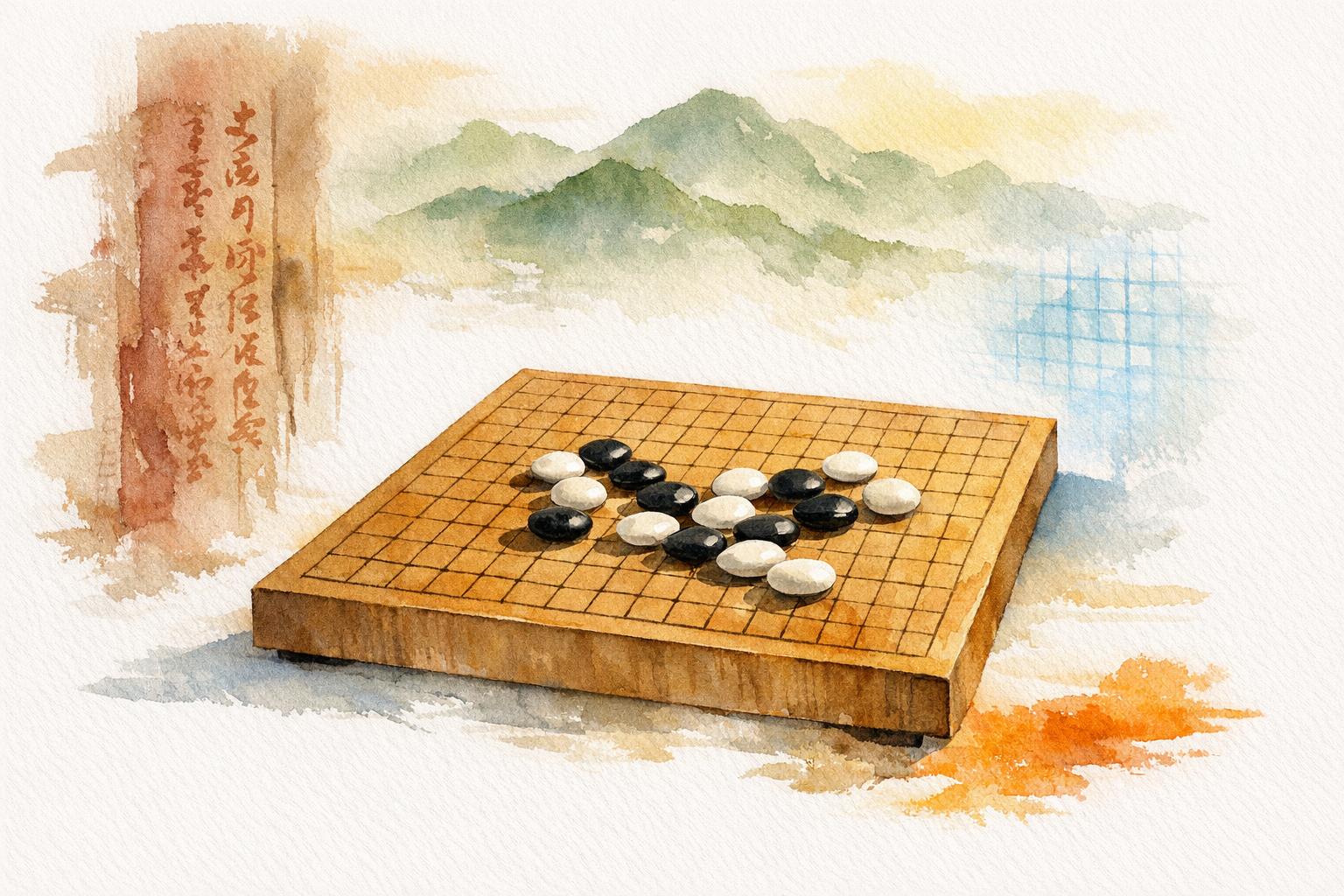
Go, or Weiqi, is a game with over 4,000 years of history, deeply tied to ancient Chinese philosophy. Played on a 19×19 grid with black and white stones, its goal is to claim more territory than your opponent. While its rules are simple, Go’s complexity is immense, with an estimated 2.1×10¹⁷⁰ possible board configurations, far exceeding the number of atoms in the universe.
Historically, Go was considered one of the Four Essential Arts for Chinese scholars, alongside calligraphy, painting, and the guqin. Beyond entertainment, it served as a tool for self-discipline, strategy, and moral reflection. The game symbolizes balance, with its black and white stones representing Yin and Yang. Legends attribute its invention to Emperor Yao, who used it to teach his son focus and leadership, though myths also link it to military strategy and cosmic harmony.
Go’s influence extends beyond its origins. It’s mentioned in ancient texts like the Zuo Zhuan (548 BCE) and was used as a metaphor for governance and warfare. Philosophies like Confucianism and Daoism shaped its role, emphasizing discipline, harmony, and adaptability. The game’s evolution - from a 17×17 grid during the Han Dynasty to the modern 19×19 format - parallels its growing depth and significance.
Even today, Go remains relevant. In 2016, Google DeepMind’s AlphaGo defeated world champion Lee Sedol, showcasing AI’s ability to tackle one of humanity’s most complex games. Go continues to teach lessons about balance, sacrifice, and decision-making, blending ancient wisdom with modern relevance.
Myths About Go’s Creation
Emperor Yao and the Invention of Go
One popular legend credits Emperor Yao (c. 2356–2255 BCE) with creating Go as a way to guide his son, Dan Zhu. Dan Zhu was seen as unruly and undisciplined, and Yao intended the game to teach him focus, balance, and self-discipline. Han Dynasty scholar Zhang Hua even stated, “Yao created Weiqi.” The game was envisioned as a tool for personal growth and refinement.
Despite mastering Go, Dan Zhu failed to develop the leadership qualities Yao hoped for. This led Yao to pass over his son in favor of Shun, highlighting the belief that merit should outweigh lineage in choosing a successor. A similar story attributes the game’s invention to Emperor Shun, who supposedly used it to educate his own son, Shang Jun.
Another variation of the story tells of Emperor Yao dreaming about the Yellow Emperor playing Go with a fairy named Yong Cheng. In this version, the game is portrayed as a metaphor for strategic military movements against Chi You, emphasizing its role as a tool for strategy rather than just moral or intellectual growth. These legends collectively reflect the dual purpose of Go: a means for self-improvement and a symbol of strategic thinking.
What Early Myths Tell Us
Beyond these royal tales, early myths about Go highlight its deeper connections to morality and cosmic order. Ancient Chinese culture placed immense importance on harmony, discipline, and balance. By associating Go with sage kings, these stories gave the game moral weight, countering Confucian criticisms that dismissed it as a mere pastime.
The legends also reveal a cosmological dimension to Go. Historian Ban Gu interpreted the board’s square shape and the interplay of stones as symbols of Earth’s laws and the balance between yin and yang. This perspective tied the game to the natural order of the universe.
Some theories propose that Go may have its roots in Shang Dynasty shamanistic practices, where casting stones onto grids was used for divination, such as predicting harvest outcomes. These myths and theories show that Go was never just about entertainment - it was seen as a practice deeply intertwined with philosophy, morality, and the cosmos.
sbb-itb-7b84150
Go in Ancient Chinese Texts
Go During the Zhou Dynasty
The Zuo Zhuan (4th century BCE) provides one of the earliest records of Go, dating back to 548 BCE. During the Zhou Dynasty, the game was referred to as yì (弈) in the states of Qi and Lu. It wasn’t until the Han Dynasty that the term weiqi (圍棋), translating to “surrounding game”, became the standard name.
A passage from the Zuo Zhuan highlights how Zhou-era thinkers saw Go as more than just a pastime. Wen Zi used the game as a metaphor for political strategy, explaining:
“If a go player establishes his groups without making them safe, he will not defeat his opponent. How much worse if he establishes a ruler without making him safe.”
This illustrates how Go’s principles were applied to governance and strategy. Additionally, the philosopher Mencius mentioned a player named Qiu, described as the “best player in the land”, which marks one of the earliest references to a professional instructor. Mencius also commented on the dedication required to master Go:
“Now the art of go is but a minor art. Yet if one does not apply one’s mind to it and bend one’s will, one cannot master it.”
Go in Classical Chinese Literature
Go’s influence extended beyond historical records into classical literature, shedding light on its role in Chinese culture. In The Analects, Confucius mentioned Go while discussing leisure activities, stating:
“Are there not people who throw dice and play Go? Even doing those would be better [than doing nothing]!”
This comment reveals Confucius’s mixed view of Go. While he expressed concern about distractions from a gentleman’s responsibilities, he acknowledged the intellectual stimulation the game provided. This dual perspective highlights Go’s unique position as both a form of entertainment and a tool for mental discipline in ancient China.
History of the Ancient Game of Go
Philosophy in Go: Confucianism and Daoism
Go has grown into more than just a game - it’s a reflection of China’s philosophical heritage. The board and its stones symbolize cosmic harmony, offering a lens through which Confucianism and Daoism come to life. These philosophies didn’t just influence Go; they helped shape its role as both an educational tool and a moral framework.
Confucian Principles in Go
Confucianism deeply influenced Go by linking it to self-improvement and moral growth. According to legend, the game was invented not just for entertainment but to teach strategic thinking and ethical behavior - key pillars of Confucian ideals.
By the classical era, Go was recognized as one of the Siyi (Four Accomplishments), essential skills for a refined scholar-gentleman. Alongside music, calligraphy, and painting, Go represented intellectual and moral refinement. Playing the game wasn’t just about strategy; it was a way to embody virtues like discipline and self-cultivation. This aligns with Confucius’s belief that “no one is perfect, but anyone can be excellent by continuously working to become better”. Through Go, players practiced these values in both personal growth and leadership, echoing themes found in ancient Confucian texts.
Daoist Balance and Flow in Go
While Confucianism brought structure and ethics to Go, Daoism introduced a sense of adaptability and natural flow. The Daoist principle of wu wei - effortless action - translates into playing with the rhythm of the game rather than forcing outcomes [17, 18]. Laozi’s words, “When nothing is done, nothing is left undone”, capture this idea. Go, with its constant push and pull, mirrors the Daoist view of life’s natural balance.
During the Tang Dynasty, Wang Jixin’s Ten Golden Rules of Go highlighted this Daoist influence. His first rule, “Avoid Greed or you Won’t Win”, warns against letting ego and desire cloud judgment. Another rule, “Sacrifice Stones to Seize the Initiative”, reflects the Daoist concept of yielding to gain - a reminder that small sacrifices can lead to larger victories. The game’s strategy often involves balancing concrete gains (territory) with abstract potential (influence), a direct nod to Daoist harmony between opposites [6, 17].
Zhuangzi’s parable of Chef Ding illustrates this philosophy beautifully. Chef Ding kept his knife sharp for nineteen years by cutting along natural joints rather than forcing his way through bone. In Go, this translates to flexibility - responding to an opponent’s moves like a reed bending in the wind, rather than resisting rigidly like an oak that might break. Laozi’s teaching, “The soft overcomes the hard”, echoes this sentiment. With approximately 2.1×10¹⁷⁰ possible board positions - far more than the estimated 10⁸⁰ atoms in the observable universe - Go demands a mindset of adaptability and flow rather than rigid calculation.
Go Through Chinese History
Evolution of Go Through Chinese Dynasties: Board Size, Rules, and Cultural Significance
Go evolved over centuries, transforming from a simple military metaphor into an intellectual art form.
Go’s Popularity in the Han Dynasty
The Han Dynasty (206 BCE–220 CE) marked a defining era for Go. During this time, the game was played on a 17×17 grid with 289 points, using 150 black and 150 white stones. These details were documented by Handan Chun in the Classic of Arts:
“The go board has 17 lines along its length and breadth, making 289 points in all. The black and white stones each number 150”.
It was also during the Han Dynasty that the term yi (弈) evolved into weiqi (圍棋), meaning “the surrounding game”, reflecting its growing strategic depth. Han philosopher Huan Tan highlighted this shift in his New Treatise:
“When starting, the best strategy is to spread the pieces far apart and stretch them out, to encircle and attack the opponent… The worst strategy is to defend the borders and corners”.
Go gained social prestige during this period, especially by the Eastern Han, where it replaced the luck-based game Liubo and became associated with military strategy and intellectual refinement. Poet Ma Rong captured this sentiment, stating:
“A board three chi square becomes a battlefield”.
Interestingly, Go wasn’t limited to the elite. Archaeological evidence, such as a pottery Go board fragment found in Emperor Jing Di’s mausoleum (reigned 156–141 BCE), shows that even tomb guards and commoners played the game. However, for the upper classes, it served as a tool for strategic thinking. These developments in board design and terminology laid the groundwork for Go’s philosophical and cultural significance in later dynasties.
Go in the Tang and Song Dynasties
The Tang Dynasty (618–907 CE) brought further refinement and official recognition to Go. The 19×19 grid became the standard board size, replacing the earlier 17×17 format. During this time, the imperial court established the position of Qídàizhào (Go Attendant), appointing master players to serve as companions and instructors to the emperor. One notable figure, Tang master Yang Jiying, was even sent as an envoy to Korea in 737 CE, where his skill reportedly outmatched all local players.
Another Tang master, Wang Jixin, compiled the “Ten Golden Rules of Go” during the turbulent An Lushan Rebellion, principles that remain influential today. Go also became one of the “Four Accomplishments” (Siyi) that every scholar-gentleman was expected to master, alongside calligraphy, painting, and guqin playing.
The Song Dynasty (960–1279 CE) expanded Go’s philosophical significance, intertwining it with Confucian, Daoist, and Buddhist thought. In 1050 CE, Wang Ni authored The Classic of Weiqi, a 13-volume work combining philosophical insights with game strategy. Scholars of the time linked the board’s 361 points to the lunar year, as described in the Qijing Shisan Pian (Go Manual in 13 Chapters):
“The points on the go board number three hundred and sixty plus one. One is the first of all living numbers… The other 360 points represent the number of days in a year”.
Prominent figures like Su Shi, Ouyang Xiu, and Sima Guang were celebrated for their Go expertise. Poetry and art of the era often depicted Go as a symbol of wisdom and cultured leisure. The Wàng Yōu Qīng Lè Jí (Collection of Carefree Pure Joy), the oldest surviving Go manual, introduced the first collection of tsumegos (Go puzzles), turning the game into a blend of art, strategy, and mental exercise.
Conclusion
Go’s journey from an ancient pastime to a modern strategic marvel reflects a philosophy that has stood the test of time. According to traditional legends, Emperor Yao created the game to teach discipline to his son, embedding life lessons into its very foundation . These origins, intertwined with cosmic symbolism, have helped Go maintain its influence on strategic thinking for centuries.
What sets Go apart is its ability to remain relevant for thousands of years. This blend of intuition and strategy has not only captivated human players but also tested the limits of artificial intelligence. A defining moment came in March 2016, when Google’s AlphaGo defeated world champion Lee Sedol, showcasing AI’s ability to master even the most intricate human pursuits.
Go’s modern prominence is deeply rooted in the ancient philosophy that shaped it. Hua Yigang, Secretary General of the China Go Association, expressed this beautifully:
“Go embodies a spirit of equality, in that every stone is equal. They don’t carry a preset role as in other games, such as chess”.
Hua Yigang’s insight highlights the unique nature of Go, where each stone’s value lies in its placement and purpose, fostering a mindset of equality and adaptability both on the board and in life.
From imperial courts to global competitions, Go continues to challenge and inspire. It teaches lessons about balance, sacrifice, and the wisdom of knowing when to advance or retreat. In this way, Go serves as a timeless link between ancient teachings and modern strategy, offering insights that resonate across generations.
FAQs
How did Go become tied to yin-yang and cosmic balance?
Go is often associated with yin-yang and the idea of cosmic balance. The black and white stones used in the game represent opposing forces working together in harmony. Its design mirrors ancient Chinese cosmology, symbolizing the interconnectedness and balance of the universe.
What philosophical habits does Go train in real life?
Go nurtures habits that go beyond the game itself. It sharpens strategic thinking, teaching players to plan ahead and weigh long-term outcomes. It also develops patience as success often requires waiting for the right moment to act. Through the game, players gain self-awareness, learning to recognize their own tendencies and improve decision-making.
Additionally, Go introduces ideas like emptiness and formlessness, encouraging players to think beyond rigid structures. These concepts can inspire mindfulness and introspection, influencing how one approaches challenges in daily life.
Why did Go’s board size change from 17×17 to 19×19?
The size of the Go board transitioned from 17×17 to 19×19 around the year 1000. The 19×19 board became widely favored because it struck a perfect balance between the need for territory and the importance of influence. This shift highlights the game’s philosophical underpinnings, emphasizing the pursuit of harmony even within the competitive nature of play.