
Game Talk
Printable vs. Digital Rulebooks: Key Differences
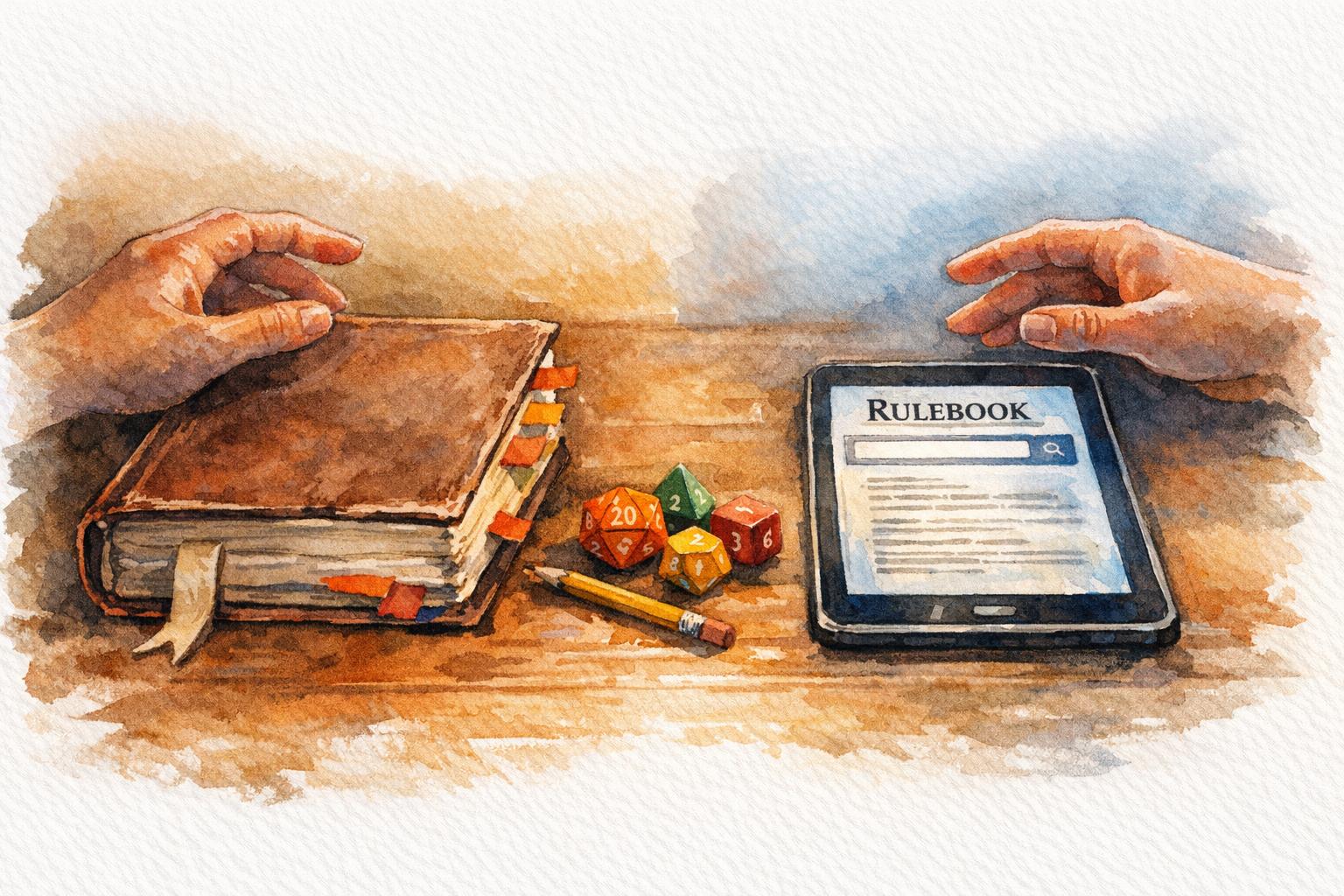
Choosing between printable and digital rulebooks comes down to your gaming style and priorities. Here’s a quick breakdown:
- Printed rulebooks offer a tactile, screen-free experience - great for in-person gaming, easy group sharing, and long-term ownership. They are a staple for any game night essentials checklist. They’re reliable, distraction-free, and ideal for collectors. However, they can be bulky, harder to search, and costlier to produce.
- Digital rulebooks excel in portability, quick navigation, and remote play. They’re lightweight, searchable, and often cheaper. But they rely on devices, batteries, and can be limited by licensing.
Quick Comparison:
Feature
Printable Rulebooks
Digital Rulebooks
Portability
Bulky, requires physical storage
Compact, all-in-one device storage
Searchability
Manual lookup
Instant keyword search
Durability
Long-lasting, no power needed
Dependent on devices and updates
Cost
Higher production costs
Minimal distribution costs
Group Use
Easy to share physically
Limited by screen size
Bottom line: Use printed rulebooks for immersive, hands-on gaming and digital ones for convenience and efficiency. Many gamers find a mix of both works best.
Printable vs Digital Rulebooks Comparison Chart
Accessibility and Portability
Digital Rulebooks: Instant Access and Multi-Device Use
Digital rulebooks make life easier by letting you access your entire library from virtually any device - whether you’re using a Nintendo Account, D&D Beyond, or Roll20. All you need to do is log in, and you’re good to go - no need to carry around bulky books.
Cloud syncing ensures that your progress and access remain consistent, no matter where you are. Jamey Stegmaier, Founder of Stonemaier Games, highlights the convenience:
They allow people to play a game a lot more often than the tabletop version because it’s faster and easier to set up.
These digital formats also shrink what would typically take up an entire tabletop into something as compact as a smartphone screen. This portability is perfect for gaming on the go or for events where space is tight. As Lap Full of Crumbs explains:
Digital versions provide seamless set up, no dealing out cards, no setting up boards, no separation of awkward trinkets between players.
Even in offline scenarios - like conventions with unreliable Wi-Fi - most PDF readers and apps allow you to download rulebooks in advance. This ensures uninterrupted access without needing an internet connection.
Printable Rulebooks: Physical Storage and Transport
Printed rulebooks, while nostalgic and tactile, come with their own set of challenges. They require physical storage and can be a hassle to transport. As Cubannerd observes:
Printed books… can be cumbersome to transport, especially for thick, multi-hundred page RPG manuals.
Heading to a gaming event with multiple systems? Be ready to pack several heavy books. The more games you collect, the heavier and bulkier your library becomes. On top of that, finding specific rules in printed manuals can be time-consuming since they lack the instant search functionality of digital formats. Unsurprisingly, over 60% of readers prefer digital formats for their portability and ease of access.
Comparison Table: Accessibility and Portability
Here’s a quick breakdown of the differences between digital and printed rulebooks:
Feature
Digital Rulebooks
Printable Rulebooks
Access Method
Apps, browsers, or offline PDFs
Physical possession of printed materials
Multi-Device Use
Accessible across multiple devices
Requires multiple physical copies
Portability
Entire libraries fit on one device
Heavy and bulky
Storage
Digital storage (MB/GB)
Requires physical shelving space
Travel Convenience
Instant setup, no extra effort
Takes up significant luggage space
Searchability
Instant search via tools
Manual lookup via table of contents
sbb-itb-7b84150
Usability During Gameplay
Printable Rulebooks: Physical Handling and Group Sharing
When it comes to sitting around a table with friends, physical rulebooks have a lot going for them. You can lay them flat for everyone to see, hand them around without worrying about hardware, and even keep your place on one page while flipping to another. This “dual-monitor” style of reading is perfect for games that require checking multiple sections, like combat tables and spell descriptions at the same time. Plus, print books make “recursive reading” - flipping back and forth between pages - much easier. This creates a mental “map” of the book, helping you remember where specific rules are located.
Interestingly, a 2018 OECD study revealed that students who read physical books scored 49 points higher on PISA tests compared to those who read digitally. That’s roughly equivalent to 2.5 years of learning. Physical rulebooks also come with fewer distractions. While 67% of students admitted to multitasking while reading digitally, only 41% said the same for print. Add to that the fact that print doesn’t rely on batteries or chargers, and you’ve got a reliable option for marathon gaming sessions.
While physical rulebooks offer familiarity and fewer distractions, digital formats bring speed and in-game integration to the table.
Digital Rulebooks: Search Functions and Hyperlinked Navigation
On the other hand, digital rulebooks shine when it comes to speed and convenience. With features like instant keyword searches and hyperlinked navigation, finding a specific rule is as simple as typing a word and hitting Enter. No more flipping through indexes or tables of contents. Hyperlinks allow you to jump between sections in seconds, and digital bookmarks make it easy to save frequently referenced pages.
Some platforms even take it a step further by automating complex tasks like tracking resources or calculating scores, which can cut down on errors and mental fatigue. However, there are trade-offs. Digital rulebooks depend on battery life and screen availability, which can be a hassle during long gaming sessions. Sharing a single device around the table can also get awkward, especially in games where each player needs access to different information. Additionally, reading digitally often encourages skimming for keywords instead of fully absorbing the content.
Comparison Table: Usability Features
Feature
Printable Rulebooks
Digital Rulebooks
Search
Manual via index or table of contents
Instant keyword search (Ctrl+F)
Navigation
Physical page flipping; hold multiple places
Hyperlinked jumps between sections
Group Reference
Easy to share and lay flat for multiple viewers
Limited by screen size and device ownership
Annotation
Margin notes and sticky tabs
Digital highlighting and notes (app-dependent)
Power Requirements
None (only needs light)
Requires battery and charging
Comprehension
Better for complex material
Lower; encourages skimming
RPG books: Print vs. PDF (or is there something better?)
Cost and Production
Cost plays a big role when deciding between printable and digital rulebooks, especially when considering their usability and ease of access.
Printable Rulebooks: Printing and Storage Costs
Creating physical rulebooks involves a significant upfront expense. For example, producing a standard 200-page black-and-white paperback typically costs $2.00 to $5.20 per copy, while full-color versions can range from $5.20 to $19.50 each. Before printing even begins, you’ll also need to budget for editing, proofreading, formatting, cover design, and ISBN acquisition - expenses that can total anywhere from $500 to over $3,000.
Printing in higher volumes can reduce the cost per book. For instance, printing 100 copies might bring the price down to $3.25 each, while ordering 1,000 copies could lower it to around $1.30 per unit. As Jamie Rand, Business Development Manager at Imprint Digital, explains:
The more books you print, the lower your per‑unit cost.
But there’s a catch: large print runs require storage. Warehousing fees range from $50 to $200 per month, and shipping adds another $0.65 to $2.60 per unit. On top of that, physical proof copies for quality checks can cost between $13 and $130 each.
On the other hand, digital rulebooks avoid most of these physical production costs.
Digital Rulebooks: Minimal Costs and Instant Distribution
Digital rulebooks eliminate many of the expenses tied to physical production, such as printing, storage, and shipping. Once a PDF or ePUB file is created, the cost per unit essentially drops to zero. Distribution is quick and easy - downloads can be shared via email or direct links, bypassing the need for physical inventory management.
The main expenses for digital rulebooks come from content creation and formatting, tasks that can be handled using tools like Canva or platforms like Rulebook.gg. A major advantage? If an error is found after release, digital formats allow for instant updates without the financial hit of reprinting.
Comparison Table: Cost Breakdown
Cost Factor
Printable Rulebooks
Digital Rulebooks
Initial Setup
$50–$500 (offset printing) or $0 (print‑on‑demand)
Minimal (formatting and conversion)
Per‑Unit Production
$2.00–$10.00+ (volume‑dependent)
$0
Distribution
$0.65–$2.60 per unit (shipping)
$0 (direct download)
Storage
$50–$200/month (warehousing)
$0 (cloud/server hosting)
Updates/Corrections
Full reprint required (high cost)
Instant file replacement (minimal cost)
Inventory Risk
High (unsold stock = loss)
None
Durability and Longevity
Printed rulebooks have a proven track record of lasting for centuries without losing their readability. On the other hand, digital rulebooks often have a much shorter lifespan. Brewster Kahle, Founder of the Internet Archive, puts it plainly:
Our paper books have lasted hundreds of years on our shelves and are still readable. Without active maintenance, we will be lucky if our digital books last a decade.
Unlike their digital counterparts, physical rulebooks don’t depend on batteries, software updates, or specific devices - they’re always ready to use. Digital rulebooks, however, rely on hardware that can fail, potentially leaving you stranded until you can replace the device.
Ownership is another key difference. When you purchase a printed rulebook, it’s yours outright - no one can take it away from you. Digital rulebooks, however, are governed by licensing agreements, meaning you don’t truly own them in the same way. As Bookish Wardrobe explains:
When you buy an eBook, you don’t truly ‘own’ it in the same way as a physical book, and there’s always a risk of losing access if a platform shuts down.
Digital formats also face challenges like obsolescence or the sudden shutdown of platforms. Physical rulebooks avoid these pitfalls entirely. They aren’t affected by software glitches, format changes, or “digital decay”. Plus, printed rulebooks often retain value over time, with resale prices ranging from 25-50% of their original cost - something digital options simply can’t match.
For those prioritizing long-term reliability and true ownership, printed rulebooks come out ahead. While digital versions offer convenience for everyday use, they require constant upkeep and come with risks that physical books eliminate.
Best Use Cases for Each Format
When to Choose Printable Rulebooks
Printable rulebooks are ideal for those who enjoy a screen-free, hands-on gaming experience. They’re especially suited for social deduction games like A Fake Artist Goes to New York or dexterity-based games such as Flick ‘Em Up, where in-person interactions and physical presence are key. Games like Monopoly, Splendor, or Ticket to Ride also benefit from the tangible and immersive atmosphere that physical rulebooks bring to the table.
Compact games like Scout or Cockroach Poker are another great match for printable rulebooks. These games are easy to carry around, making them perfect for trips or casual gaming at a pub. Physical rulebooks also allow players to jot down house rules or make notes directly on the pages - a level of customization that digital formats can’t match. For collectors, physical rulebooks often feature stunning artwork and add a decorative touch to any game shelf.
While print excels in fostering tactile engagement and face-to-face interaction, digital rulebooks shine in other areas.
When to Choose Digital Rulebooks
Digital rulebooks are a fantastic choice for complex games with intricate scoring systems, like Terraforming Mars or Wingspan. These formats simplify gameplay by automating calculations and managing rules, saving players from the hassle of manual math. They’re also indispensable for remote gaming sessions, enabling groups in different locations to connect through platforms like Roll20 or Tabletop Simulator.
Learning common board game rules is often easier with digital rulebooks, which frequently include interactive tutorials to help players quickly grasp complicated mechanics. They’re also a space-saver - perfect for crowded tables or players with limited storage, as one device can replace bulky manuals. Another advantage is their ability to handle updates effortlessly; players can access the latest errata without needing to reprint anything. Plus, the search function is a lifesaver during gameplay, allowing users to locate specific rules in seconds instead of flipping through pages.
Each format has its strengths, and the choice often depends on the specific gaming scenario.
The table below highlights which format works best in different situations:
Scenario
Best Format
Why
In-person party games
Printable
Encourages social interaction and easy sharing among players
Complex strategy with heavy math
Digital
Automates calculations and enforces rules
Pub or travel gaming
Printable
Portable and doesn’t rely on hardware
Remote or asynchronous play
Digital
Connects players across locations
Games with frequent updates
Digital
Provides instant access to updated rules
Collectible display items
Printable
Features high-quality artwork and aesthetic appeal
Conclusion
Deciding between printable and digital rulebooks comes down to what your gaming group values most. Physical rulebooks offer a hands-on, immersive experience that encourages note-taking, easy sharing, and a collectible appeal. They’re perfect for unplugged social settings, like casual pub games, where the absence of screens enhances the fun. Plus, they don’t rely on batteries or internet access, so they’re always ready to go.
On the flip side, digital rulebooks excel in efficiency and handling complexity. Features like instant search, hyperlinked navigation, and automated rule enforcement make them a go-to option for games with detailed scoring or heavy bookkeeping. They’re also a lifesaver for remote play, letting friends in different locations connect effortlessly. Updates are easy too, eliminating the need for reprints.
Cost is another factor to weigh. Digital rulebooks are typically about 20% cheaper but often come with DRM restrictions. Physical rulebooks, while more expensive upfront, offer the perk of permanent ownership.
Many gaming groups find a mix of both works best. For instance, digital tutorials can simplify learning intricate mechanics, while physical rulebooks enhance face-to-face interactions. Alternatively, keeping a digital version handy for quick rule checks can complement the tactile enjoyment of a printed manual.
FAQs
Which format is better for long campaigns?
Digital rulebooks shine in long campaigns because they offer features like search functions, bookmarking, and quick navigation. These tools make it easy to access large amounts of information and even let players print out specific sections when needed.
On the other hand, printed rulebooks provide a hands-on experience that many players enjoy. They also help keep the focus on the game by reducing digital distractions. However, they can be cumbersome and less practical for quickly referencing rules during extended gameplay.
Can I use digital rulebooks offline?
Yes, you can download digital rulebooks as PDFs or flipbooks to use offline. This way, you’ll always have access, even when you’re not connected to the internet.
Do I actually own a digital rulebook I buy?
When you buy a digital rulebook, what you’re actually getting is a license to access and use it - not full ownership. This means the provider has the ability to revoke or limit your access, particularly if the rulebook is part of a subscription service or protected by a digital rights management (DRM) system.