
Game Talk
Viticulture World Expansion Review
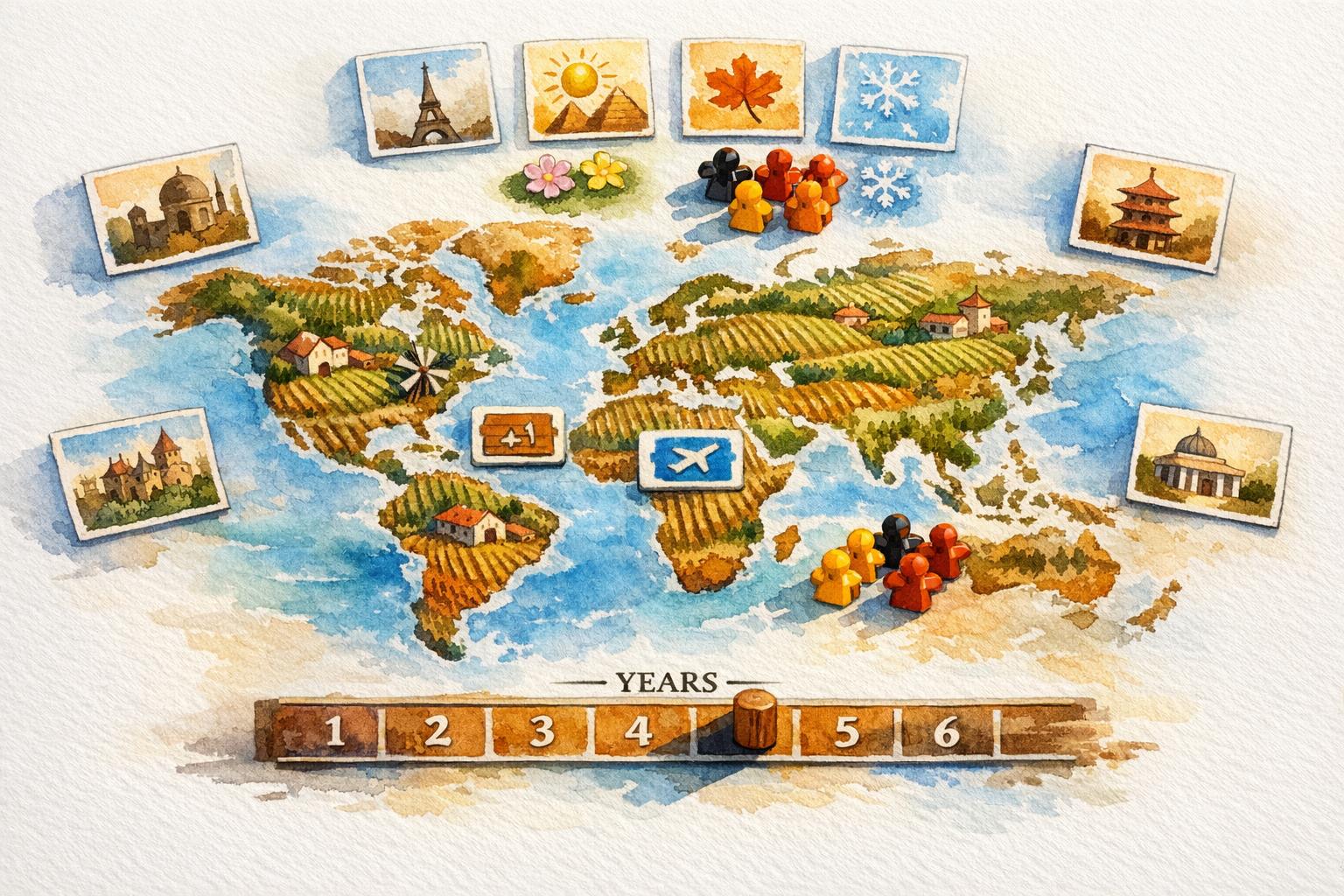
Viticulture World transforms the competitive wine-making game, Viticulture, into a cooperative experience for 1–6 players. The goal? Work together to earn at least 25 points per player and advance a shared influence token to 10 within six in-game years. It introduces new mechanics like seasonal worker hats, innovation tiles, and continent-specific challenges.
Key highlights:
- Teamwork-focused gameplay: Players trade resources and strategize together.
- New mechanics: Innovation tiles upgrade actions, while worker hats limit actions by season until trained.
- Seven regional decks: Each offers unique challenges and difficulty levels, from beginner-friendly to advanced.
This expansion is ideal for experienced players seeking a challenging cooperative twist on the original game.
Gameplay Mechanics and Features
Worker Placement and Seasonal Actions
In Viticulture World, managing workers takes on a fresh twist. Each player starts with a fixed team of five workers: two summer workers (yellow hats), two winter workers (blue hats), and one grande worker. Unlike the base game, you can’t expand your workforce - this team size stays constant throughout the game’s six years.
The workers’ hats are more than just decoration - they dictate when workers can act. Summer workers are limited to summer actions, while winter workers are restricted to winter tasks unless you pay to train them. This seasonal limitation adds an early bottleneck, requiring players to carefully plan their moves around the calendar. The grande worker, however, offers some flexibility. It bypasses placement limits and allows you to trade resources like grapes, wine, or cards with other players, even if they occupy the same action space.
Action spaces have also evolved. While still limited (one spot for 1–3 players or two for 4–6 players), innovation tiles bring a new layer of strategy. These tiles come in two types: rectangular tiles that strengthen an action and oval tiles that grant bonuses for trained workers. Deciding where and when to place these tiles becomes a key part of the game. As Tabletopping noted:
Strategic placement of innovation tiles and upgrading workers to increase versatility seem critical for victory.
This revamped worker placement system challenges players to juggle personal progress with teamwork, setting the tone for the game’s cooperative dynamics.
Influence Track and Victory Conditions
The game’s dual victory conditions push players to think beyond their own vineyard. To win, each player needs at least 25 victory points, and the team must collectively move the influence token to 10 on the influence track by the end of year six.
The influence track introduces a new way to value money. In the base game, coins often became less important as your vineyard matured. Here, advancing on the influence track costs $8 per point during the winter season. This means maintaining a steady cash flow is crucial right up to the final round. Wade Monnig from There Will Be Games highlighted this cooperative element:
The VP/Influence tracks mean you really must pay attention to where the others are lacking, especially in later rounds, so that you can work to boost everyone to victory.
This dual focus creates constant tension. Do you prioritize building your vineyard to score points, or do you funnel resources toward the shared influence goal? The grande worker’s trading ability becomes a lifeline for balancing personal and team needs.
Training and Worker Upgrades
With only five workers for the entire game, training them to remove seasonal restrictions is essential for improving efficiency. As Maria Panagou from Board Game Maniac explained:
Training of your seasonal workers to become regular ones and start receiving bonuses is another interesting feature that works really well and is also very realistic.
Timing is everything when it comes to training. With just six years to play, you’ll need to weigh the immediate cost of training against its long-term benefits. The Tabletop Family stressed this point:
With the limited time and actions you have, you need to find a way to prioritize training at least a few of your seasonal workers so you have enough workers to take the actions you need to win.
The importance of training also shifts with player count. In larger games, where action spaces are highly contested, training becomes critical to unlock bonuses from oval innovation tiles. In smaller games, you might lean more on rectangular tiles that enhance action power without requiring trained workers. This flexibility ensures training decisions remain strategic no matter the group size.
sbb-itb-7b84150
Regional Modules and Challenges
Overview of Regional Modules
Viticulture World includes 110 cards divided into seven continent-themed decks: Greengully, Asia, Europe, North America, South America, Oceania, and Africa. Each deck introduces unique events over a six-year campaign, enhancing the cooperative gameplay introduced earlier.
If you’re new to the game, Greengully is the ideal starting point. It offers rule concessions each year, easing players into the cooperative mechanics. On the other hand, Africa presents the toughest challenge, requiring advanced hand management skills to navigate its complexities. As Maria Panagou from Board Game Maniac explains:
Each continent deck plays completely differently than the others and has a different degree of difficulty. The easiest is Greengully and the hardest is Africa.
The mid-tier modules bring their own twists. Asia focuses on upgrades and innovation, while Europe challenges players with specific objectives. North America features tech tracks inspired by the Prohibition era, while South America, with its 17-card deck, highlights unique player powers tied to historical figures. Finally, Oceania takes teamwork to another level, described as a “co-op within a co-op”, where players must share knowledge to succeed.
These diverse challenges encourage players to rethink their strategies and adapt to the unique demands of each continent.
How Regional Objectives Impact Strategy
The varied regional modules force players to rethink their approach with each annual event. With six rounds to achieve both the 25-point individual goal and the 10-point team goal, flexibility is key. Strategies that work one round may need a complete overhaul in the next, making this expansion a dynamic twist on traditional worker placement and resource management.
The use of innovation tiles also varies by region. Depending on the continent, you might prioritize rectangular tiles for stronger actions or oval tiles for trained-worker bonuses. For example, North America’s Frame Track lets players progress along specific paths to unlock immediate bonuses or permanent perks like an additional worker. Meanwhile, Asia modifies core gameplay mechanics, including the turn order tracker and end-of-turn processes.
This constant variety keeps the game engaging. Isaac Villa from Gaming With Sidekicks highlighted the cooperative balancing act:
The cooperative nature really focused on making sure that influence was gained in the mid to late game play. Helping your teammates score points is important as well but the influence seems to be the more challenging aspect.
Each continent demands players to carefully balance personal vineyard growth with team-focused actions, ensuring the puzzle feels fresh every time you play.
Viticulture World Cooperative Expansion Review
Expansion vs. Base Game
Viticulture World vs Base Game: Key Differences and Features Comparison
Main Gameplay Differences
The move from competitive to cooperative gameplay completely transforms how you play Viticulture. In the base game, the goal is to be the first to reach 20 or 25 victory points. Viticulture World flips that dynamic - now, every player must hit at least 25 points, and the group as a whole needs to achieve 10 points on the shared influence track. And here’s the kicker: you’ve only got 6 rounds to pull it off. This cooperative setup shifts the focus from individual optimization to constant teamwork and coordination.
The worker mechanics also see a major overhaul. You start with five workers: two restricted to summer actions, two to winter actions, and one versatile Grande worker. However, the Grande worker’s flexibility is locked until you train it. Unlike the base game, you can’t recruit extra workers. Instead, you spend money to lift the seasonal restrictions on existing ones.
Another big addition is innovation tiles, which let you permanently upgrade action spaces on the board. Oval tiles allow multiple workers to use the same space, while rectangular tiles make specific actions much stronger.
A formal trading mechanic is also introduced. When your Grande worker shares a space with another player’s worker, you can exchange coins, cards, grapes, or wine. The board itself becomes a puzzle, as your team collaborates to enhance specific action spaces. This turns the game into a shared strategic challenge, a stark contrast to the solo race of the base game.
Pros and Cons
These changes bring a mix of advantages and challenges, which are summarized in the table below:
Feature
Viticulture World Strengths
Potential Drawbacks
Replayability
Offers 7 unique continent decks with varying difficulty levels, from tutorial (Greengully) to extreme
Even the easiest settings can feel punishingly hard
Player Interaction
Trading and shared board upgrades encourage real teamwork
Risk of “quarterbacking”, where one player dominates decisions
Strategic Depth
Innovation tiles and trained workers add complexity to familiar mechanics
Demands strong knowledge of the base game, making it tough for beginners
Game Length
Fixed 6-round structure keeps sessions between 75–95 minutes
The time limit can feel restrictive and stressful
Components
Includes fun miniature hats and “Red and Blue” starting cards for inclusivity
Rubber hats sometimes fall off the worker meeples
The expansion has been well-received, earning an 8.3/10 from Board Game Maniac and 8.5/10 from What Board Game . However, most reviews emphasize it’s geared toward experienced Viticulture players. Justin Bell from Meeple Mountain put it plainly:
“Viticulture World is for Viticulture enthusiasts, period.”
– Justin Bell, Meeple Mountain
While the cooperative elements keep each player’s vineyard intact - leading some to describe it as feeling “separate but together” - The Tabletop Family highlighted how the expansion stays true to the original:
“It creates many new challenges at different difficulty levels so experienced players are put through their paces. Better still, it doesn’t once change the essence of what Viticulture is.”
– The Tabletop Family
Is Viticulture World Worth Buying?
Who Will Enjoy This Expansion?
If you’re a seasoned Viticulture player looking to shake things up, Viticulture World might be right up your alley. This expansion takes the familiar mechanics of the base game and flips the script with a cooperative spin. As Brad Hiscock from EverythingBoardGames put it:
“I was nervous that this expansion… would ruin one of my favorite titles. As it turns out, that worry had no grounds. Viticulture World simply opened up a new way to play.”
– Brad Hiscock, EverythingBoardGames
The expansion caters to players who thrive on teamwork and communication. With a success rate of just 40%, it challenges groups to work together, solve tough puzzles, and learn through trial and error. The seven continent decks - ranging from the introductory Greengully to the advanced Africa scenario - offer plenty of variety and replayability for those eager to master each challenge.
Solo players aren’t left out, thanks to the Burattino Automa, which offers a fast-paced way to dive into the game. Plus, the cooperative format makes it easier for new players to get into Viticulture, as experienced gamers can guide them through the mechanics. At a sale price of around $29 in the U.S., the expansion offers solid value for those ready to take on a more complex version of the game.
That said, this might not be the best fit for beginners or those who prefer a more relaxed gaming experience. As James van Tonningen from GamingTrend explained:
“The hefty difficulty curve makes it hard to recommend for conflict-averse players, but wine connoisseurs will definitely enjoy their brief visits across the world.”
– James van Tonningen, GamingTrend
In short, Viticulture World is designed for players who embrace challenges and enjoy sinking their teeth into cooperative gameplay.
Final Thoughts
Viticulture World takes the core mechanics of the original game and reimagines them in a cooperative format, offering a fresh yet familiar experience. Features like innovation tiles, seasonal worker training, and trading mechanics add layers of strategy without straying too far from the game’s roots. With ratings of 7.69/10 on BoardGameGeek and 8.5/10 from What Board Game , it’s clear that the expansion has resonated with many fans.
The fixed six-round structure and strict victory conditions create a sense of urgency and tension, making it a true test of teamwork and strategy. If you’re a devoted Viticulture fan looking for a new way to enjoy the game, this expansion delivers a rewarding challenge - just be ready to bring your A-game.
FAQs
Do I need the base Viticulture game to play Viticulture World?
Yes, you’ll need the base Viticulture game to enjoy the Viticulture World expansion. This expansion relies on the core mechanics of the original game, meaning it can’t function as a standalone experience.
What’s the best first continent deck to start with?
The Greengully deck is the perfect starting point for newcomers to Viticulture World. Known for its approachable gameplay, it provides a gentle introduction to the expansion’s mechanics and challenges, making it ideal for players getting familiar with the game.
How do we avoid one player “quarterbacking” the co-op?
To avoid one player from taking over the decision-making process, or “quarterbacking”, in Viticulture World, try limiting how much players can discuss their actions. This approach minimizes the risk of a single person dominating the game. Another helpful tip is to make sure the rules are designed to evenly distribute decision-making responsibilities among all players. These tactics promote a more balanced and collaborative experience during cooperative gameplay.