
How Millennials and Gen Z Are Changing Tabletop Games
Millennials and Gen Z are reshaping tabletop gaming. These two generations are driving the industry's growth, which is projected to soar from $12 billion in 2018 to $35.3 billion by 2030. Both value social interaction, but their preferences and behaviors differ.
- Millennials (Ages 26–45): Spend about 6.5 hours weekly on games and prefer strategy-heavy, screen-free experiences like Catan. They favor in-person play and are drawn to affordable, social activities like board-game cafes.
- Gen Z (Ages 18–25): Average 7+ hours weekly and often use games as a casual hangout backdrop. They mix physical and digital play, rely on platforms like Twitch for learning, and prioritize inclusive themes and cultural representation.
Game companies are responding by designing experiences that blend cooperation, shorter playtimes, and digital tools. Both groups share a strong desire for connection, with 86% of players saying tabletop games improve their relationships. This demand for meaningful interaction is shaping the future of gaming.
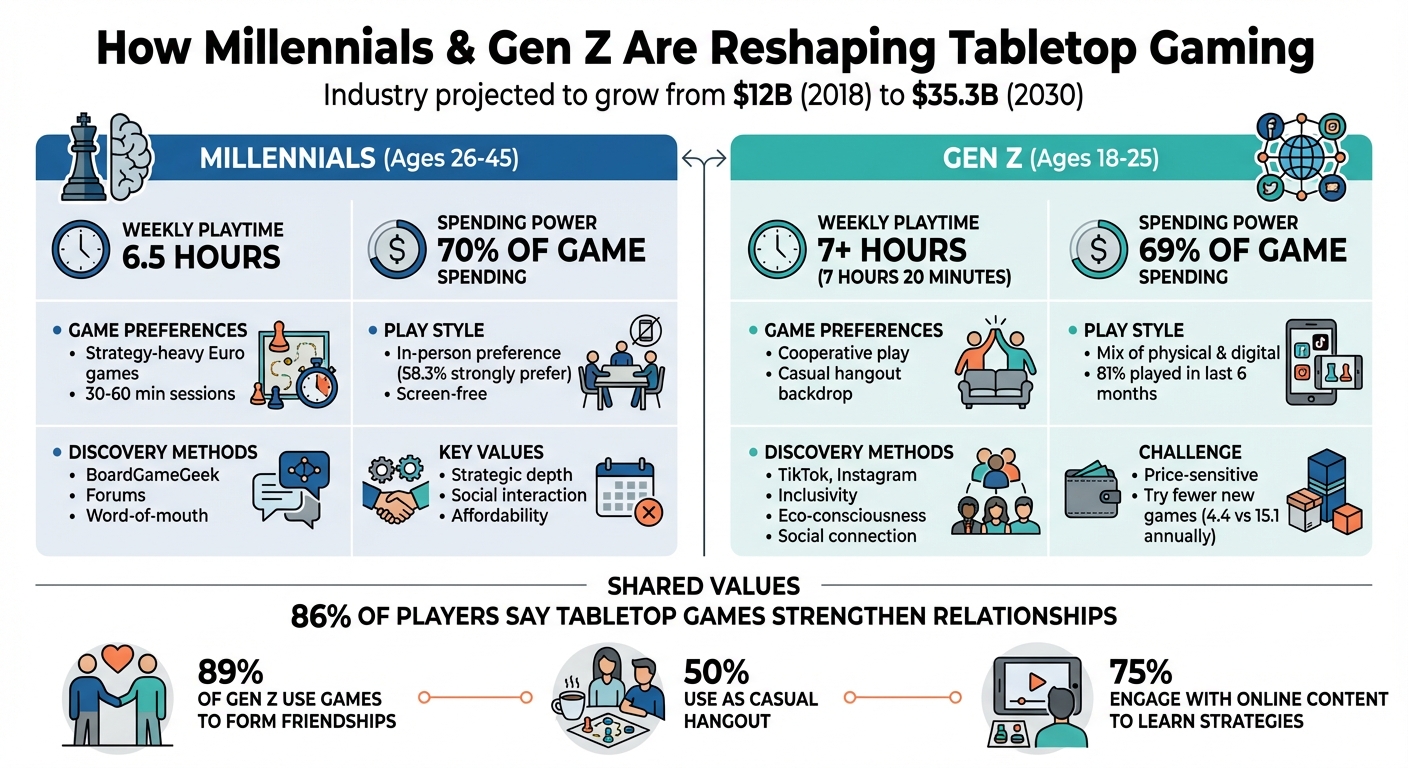
Millennials vs Gen Z Tabletop Gaming Preferences and Behaviors
1. What Millennials Want
Social Interaction
Millennials are drawn to tabletop games as a way to enjoy genuine, screen-free social experiences. In fact, 58.3% of board gamers strongly prefer playing in person rather than online, valuing the ability to pick up on body language and facial expressions - something digital platforms just can’t replicate. Catherine Cottney, Manager of Trends Europe at Mintel, explains:
"It's a way of socializing but it's a way of doing it in a financially responsible way."
Games like Settlers of Catan, which typically costs about $48.99, offer an affordable alternative to expensive nights out while still delivering meaningful social interaction. Additionally, around 30% of Millennials have shown interest in board-game-themed cafes and bars, where gameplay is paired with a lively, social setting. This focus on connection fuels the demand for games that enhance interaction and create shared experiences.
Game Innovation
The resurgence of board games, particularly Euro-style games, began over five years ago, according to Peter Wooding, owner of Orcs Nest. Millennials tend to gravitate toward games that emphasize strategy, negotiation, and teamwork. Guido Teuber, Managing Director of Catan, highlights this shift:
"Catan has benefited from a growing desire to interact and socialize away from screens. Specifically, Catan is a game in which players are always involved. There is no downtime. It requires social skills to play cleverly."
Games like Catan keep everyone engaged throughout the session, avoiding downtime or player elimination - features Millennials generally dislike. Instead, they prefer mechanics like worker placement, deck building, and cooperative play. These games often cater to their busy schedules, with sessions lasting 30 to 60 minutes and accommodating 3 to 4 players.
Companies like MINIFINITI have tapped into this trend by creating games such as Red Tape, which combines humor with strategic gameplay. These innovative designs align with Millennials’ desire for fresh, engaging experiences.
Industry Adaptation
The gaming industry has evolved to meet Millennials' changing preferences. Crowdfunding platforms like Kickstarter have become a major force, with gaming emerging as the top-funded category. Over 41,000 projects have raised $2.39 billion in pledges, allowing creators to connect directly with enthusiastic audiences. This success, coupled with a focus on sustainability, helped global sales of games and puzzles reach $9.6 billion by 2016.
Manufacturers are also prioritizing sustainability, incorporating recycled materials and biodegradable components to align with Millennial values. Beyond the physical gameplay, 75% of Millennials engage with online content to improve their strategies or learn new techniques. Companies like MINIFINITI are leaning into this community-driven approach by hosting weekly game nights, fostering spaces where social interaction is just as important as the games themselves.
sbb-itb-7b84150
2. How Gen Z Is Changing the Game
Social Interaction
For Gen Z, tabletop games are more than just a pastime - they’ve become a way to unplug from screens and build real friendships. A striking 89% of Gen Z players say they use games to form friendships, showing how central gaming is to their social lives. Interestingly, 50% of them use games as a casual way to hang out, focusing less on strict gameplay and more on the social vibe. This contrasts with Millennials, 37% of whom are more gameplay-focused. Gen Z also gravitates toward games that align with their values, such as those featuring diverse representation and ethical design. This shift highlights how they blend traditional gameplay with modern social priorities.
Technology Integration
Even though Gen Z cherishes in-person connections, they’re transforming how technology complements tabletop gaming. Instead of relying solely on traditional rulebooks, many turn to livestreaming platforms like Twitch and YouTube to learn complex games. In fact, 75% of Gen Z gamers watch game-related videos and streams to understand mechanics. The industry has responded by creating hybrid experiences, combining physical game elements with digital tools - like AI-generated scripts for Dungeon Masters - to enhance gameplay.
Industry Adaptation
Game developers are meeting Gen Z where they spend much of their time: online. About 40% of Gen Z gamers engage with tabletop gaming communities on platforms like Discord and Reddit, where they discuss strategies and share experiences. These platforms are evolving into virtual hangout spots, turning games into digital spaces for connection. With 81% of Gen Z gamers having played in the last six months and averaging 7 hours and 20 minutes of weekly playtime, it’s clear this generation is deeply invested. Companies are responding by prioritizing community-driven designs, such as reactive storytelling and social-first gameplay, which emphasize collaboration over competition. For instance, MINIFINITI has embraced this trend by hosting weekly game nights that focus on fostering connections and creating immersive experiences.
What is driving the board game renaissance among younger Americans?
Pros and Cons
Millennials and Gen Z are reshaping the tabletop gaming world in unique ways, each bringing its own set of opportunities and game night essentials to consider. Understanding these differences helps shape design and marketing strategies across the industry.
Millennials are a reliable, revenue-generating group. Known for their high level of education, they gravitate toward games with strategic complexity, like Euro games and worker-placement mechanics. With 70% of Millennials spending money on games, they represent a dependable customer base. However, 74% of them report struggling with scheduling conflicts, which can limit their ability to play as frequently as they might like.
Gen Z, on the other hand, is driving growth by embracing board games as a break from digital overload and a way to connect socially. An impressive 81% of them have played a tabletop game in the last six months, and their preference for inclusive themes and eco-conscious designs is shaping new game trends. That said, players aged 18–23 are more price-sensitive and tend to try fewer new games annually - 4.4 on average compared to 15.1 for older players.
| Feature | Millennials (Ages 26–45) | Gen Z (Ages 18–25) |
|---|---|---|
| Strength | Strategic depth and 70% spending power | Social media influence and demand for inclusivity |
| Challenge | Time and scheduling conflicts | High price sensitivity and less game exploration |
| Game Preferences | Euro games with heavy strategy in 30–60 min sessions | Cooperative play, shorter sessions, and a focus on socializing |
| Discovery | BoardGameGeek, forums, and word-of-mouth | TikTok, Instagram, and influencer-driven communities |
Despite their differences, both groups share a desire for games that foster social interaction and engagement. In fact, 86% of all players report that tabletop gaming has strengthened their social relationships. This shared value continues to drive innovation and creativity in the industry.
Conclusion
Millennials and Gen Z are not just enjoying tabletop games - they're actively transforming the industry. Millennials bring significant spending power and a preference for games with strategic depth, while Gen Z introduces fresh energy through social media influence and a focus on inclusive, eco-conscious gaming. Together, they dominate game spending, accounting for 70% and 69%, respectively, far surpassing older generations.
This shift reflects a fusion of physical and digital worlds. A great example is the Total War: Warhammer collaboration, which attracted over 10 million new players and doubled its revenue by 2020. This trend highlights how younger audiences often discover games online but still crave the hands-on, face-to-face interactions that only tabletop gaming can offer.
Game designers are responding by creating cooperative mechanics that align with Gen Z's preferences while preserving the strategic complexity Millennials value. Platforms like TikTok have become key tools for making board games visually engaging and shareable, further expanding their appeal.
Social connection remains a cornerstone of this trend. A striking 86% of players say tabletop gaming has strengthened their relationships. For Millennials and Gen Z, these games are more than just entertainment - they’re a way to build real connections in an increasingly digital age. Weekly game nights are a prime example of how these generations blend social interaction with strategic play.
As these younger players continue to shape the industry with their spending habits, values, and creativity, companies must stay agile. Success will come to those who adapt and evolve to meet the ever-changing expectations of this dynamic audience.
FAQs
What game features appeal most to Millennials vs. Gen Z?
Millennials tend to gravitate toward board games and RPGs that encourage face-to-face interaction and tap into a sense of nostalgia. These games align with their appreciation for social connection and opportunities to express creativity.
On the other hand, Gen Z leans more toward mobile and online multiplayer games with quick, accessible, and digital-friendly features. Their preferences reflect a love for fast-paced, immersive, and competitive experiences that complement their mobile-first, on-the-go lifestyles.
How are tabletop games blending physical play with digital tools?
Tabletop games are stepping into a new era by blending physical play with digital tools, creating hybrid experiences that elevate how people play and connect. Features such as companion apps, digital rulebooks, and online platforms streamline game setup, make rules easier to understand, and even allow for remote multiplayer sessions. Interactive game boards and digital versions are also making it simpler to learn new games, speeding up gameplay, and merging the hands-on feel of traditional games with the digital interactivity that younger generations enjoy. This combination caters to the growing demand for immersive and social gaming experiences.
How can game makers design for inclusivity and sustainability without raising costs?
Game designers can prioritize inclusivity by incorporating features like larger game pieces, high-contrast visuals for better visibility, and symbols that work across multiple languages. Testing games with a diverse group of players ensures the design is accessible to a wide audience. On the sustainability front, using eco-conscious materials, reducing waste during production, and creating modular components that can be replaced or upgraded can make a big difference. These practical steps can improve both accessibility and environmental responsibility without drastically raising costs.